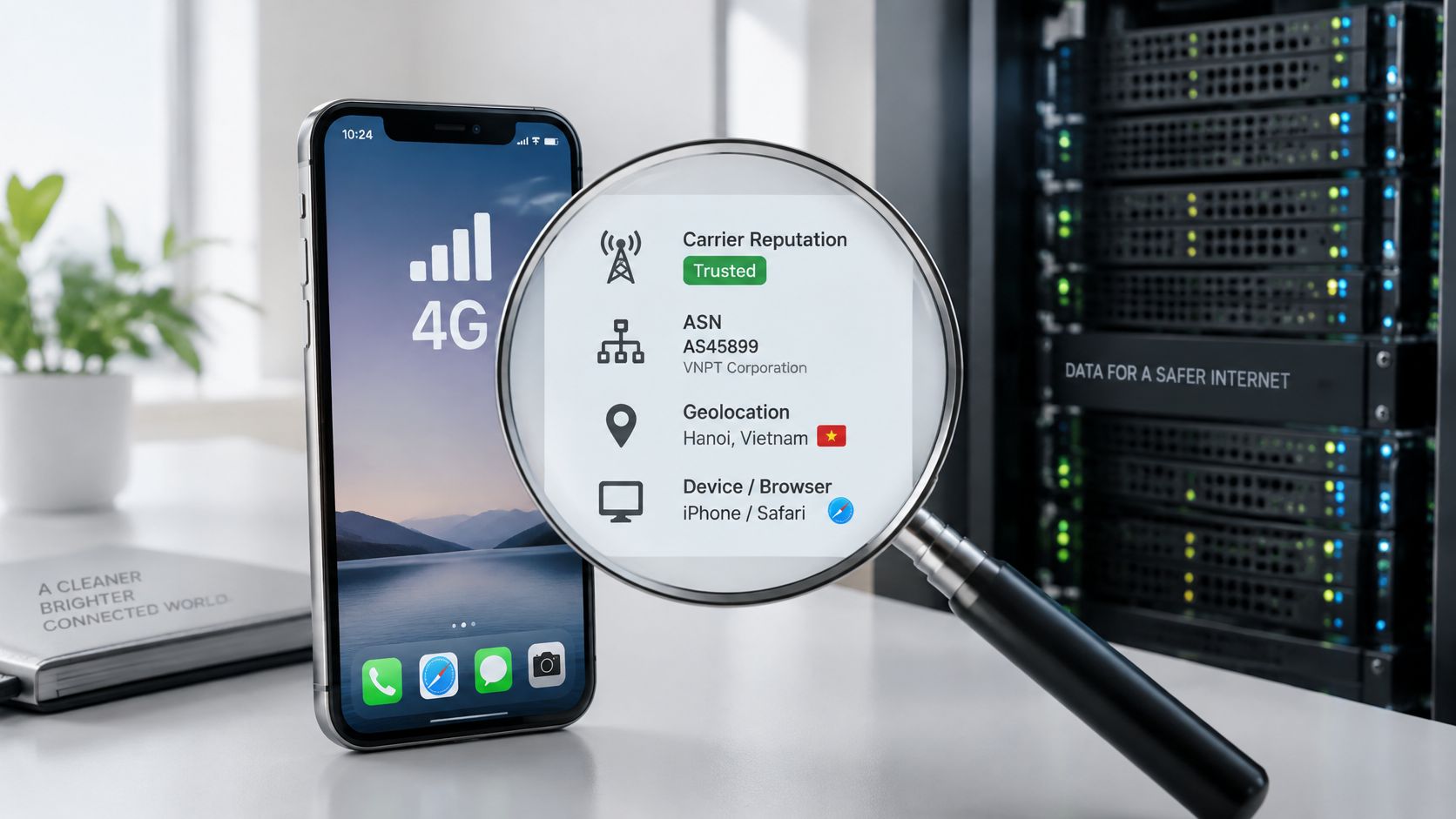
A mobile IP isn't automatically clean, trustworthy, or suitable for every task. The popular advice to switch from a datacenter address to a 4G proxy and expect fewer problems ignores what destination sites can observe: carrier identity, location, browser and device signals, cookies, account history, request pace, and session behavior.
The practical question isn't whether an address is labelled “mobile.” It's whether the connection stays correctly localized and performs consistently for your legitimate workflow. That calls for repeatable tests, not a vendor's trust score or a headline speed claim.
Why Mobile Proxy Quality Is Hard to Judge
A 4G connection can look more like ordinary carrier traffic than an address from a hosting provider, but that doesn't make it a universally accepted identity. Carrier-grade NAT, or CGNAT, lets operators route many subscribers through shared public addresses. That shared footprint differs from a hosting-provider IP, but it doesn't guarantee that a destination will treat the traffic as trustworthy. The technical discussion of mobile proxies and detection also identifies behavior such as repeated registrations, concentrated activity, and consistent browser fingerprints as relevant signals.
The network itself matters, too. Ericsson reported that 4G accounted for 85% of global mobile subscriptions at the end of 2024, with 835 commercially deployed 4G networks worldwide. Outside mainland China, 4G population coverage reached 90% globally at that point, with a projection to exceed 95% by 2030. Those figures show why 4G remains a useful reference for mobile access, but they don't establish that a particular provider's French exit will work reliably for your destination. (Ericsson's June 2025 Mobility Report)
Coverage also varies with geography and infrastructure. The International Telecommunication Union reported 4G coverage for 93% of the world's population, but the figure was 99% for urban populations and 84% for rural populations. In low-income countries, coverage was 56%. A national availability claim therefore can't stand in for a test of the city, carrier, and route you need. (ITU's mobile network coverage statistics)
For a buyer, a useful comparison starts with evidence that can be checked: the exit's carrier ASN, its observed location, session persistence, leakage behavior, and performance against the intended destination. A 4G address may suit geographic QA or campaign checks and still be a poor choice for a workflow that needs stable logins or predictable latency.
Buyer's test: The best 4G proxy is the one that stays correctly localized and behaves consistently for the specific task, not the one with the boldest trust claim.
Understand 4G Proxy Essentials
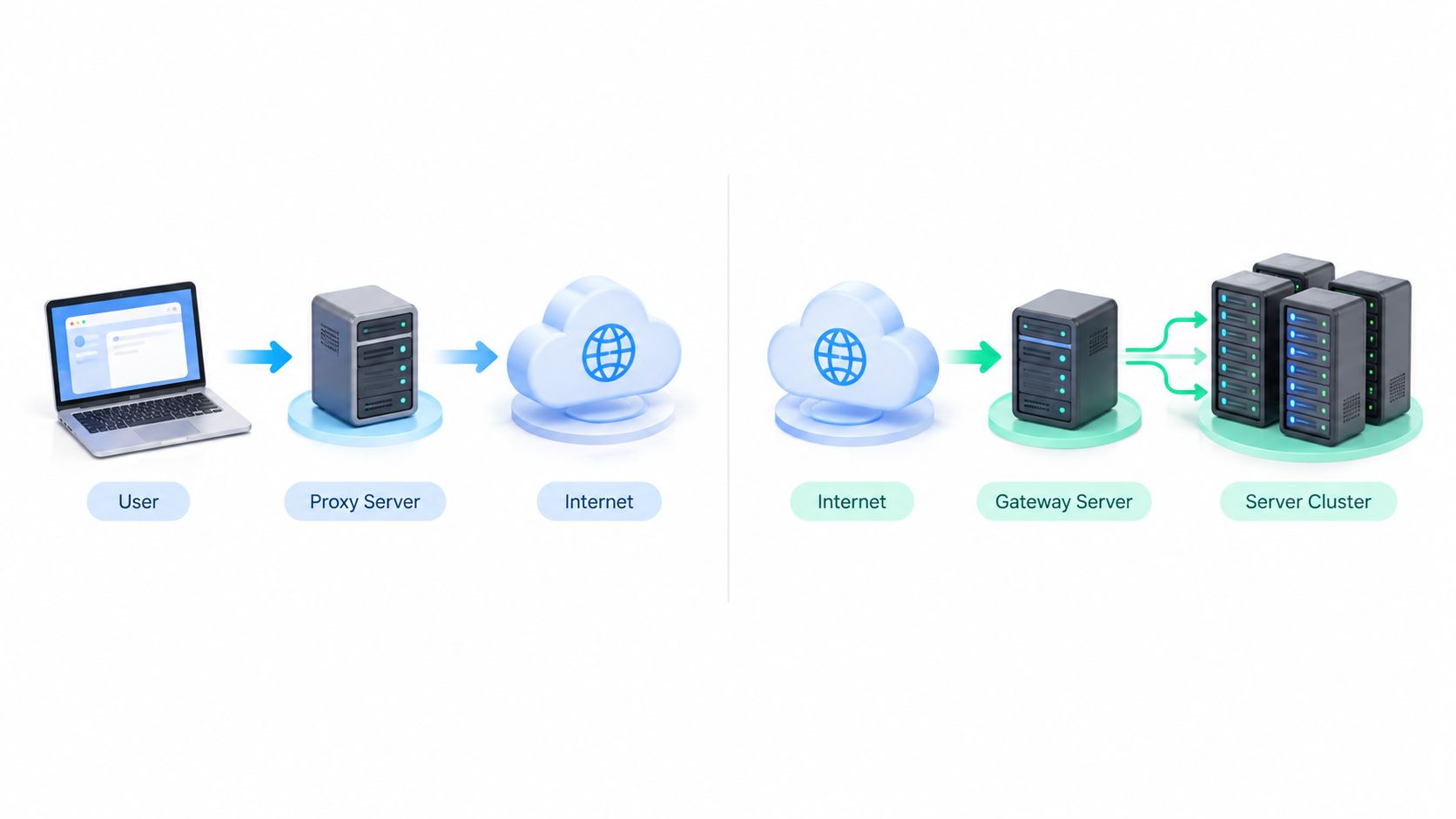
A proxy routes a client's connection through an intermediary server or device. The proxy type describes the network behind the visible exit address, not a guarantee of how a destination will respond.
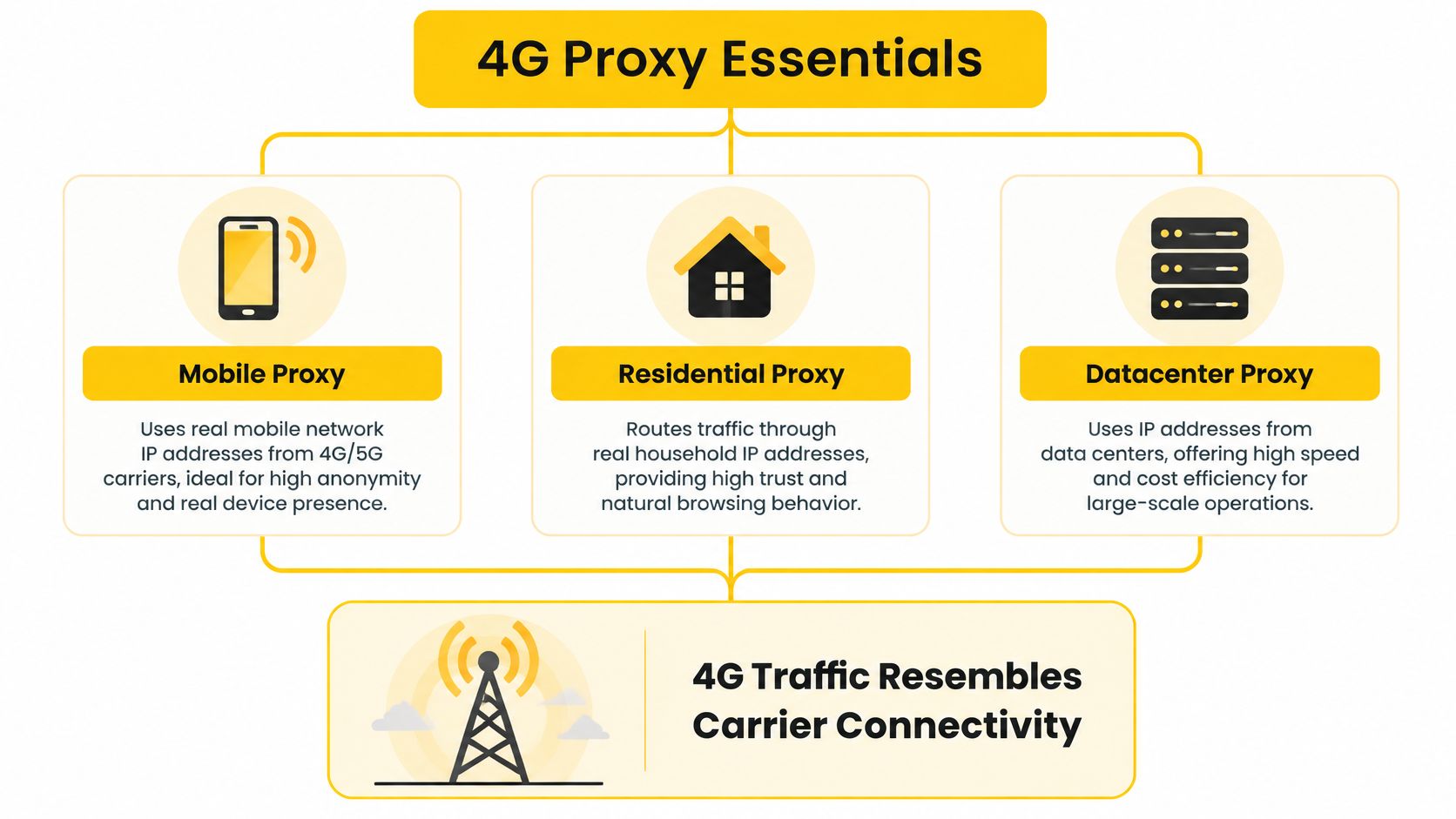
- Mobile proxies route traffic through cellular networks, such as 4G or LTE. Carrier identity can make the address resemble ordinary mobile traffic.
- Residential proxies use addresses associated with residential internet connections. They represent a different access network and shouldn't be treated as interchangeable with cellular service.
- Datacenter proxies use infrastructure hosted in data centers. They can be useful for many routine tasks, but their hosting-network origin differs from a mobile carrier's.
The difference matters for location-sensitive QA, ad verification, and market research. A mobile IP can match a carrier network more closely than a cloud-hosting address, but the destination can still assess other signals. The mobile proxy overview offers a starting point for understanding the connection model.
Sessions, rotation, and carrier identity
IP rotation changes the visible exit address. Sticky sessions keep a connection on the same exit for a period or workflow. For a QA flow that logs in, browses, and submits a form, a consistent session is usually easier to evaluate than an address change midway through. For independent research requests, controlled rotation between tasks may be appropriate.
An ASN, or autonomous system number, identifies the network that announces an IP range. Checking the ASN helps confirm whether an exit belongs to the intended carrier rather than a hosting network. It doesn't prove that the address is exclusive or suitable for every site.
Carrier-grade NAT is the network translation used when an operator shares public IPv4 addresses across subscribers. The standards document RFC 6598 defines shared address space for service-provider networks and CGN devices. Shared address space is a technical feature, not a promise of anonymity, clean reputation, or acceptance.
Protocol and location checks
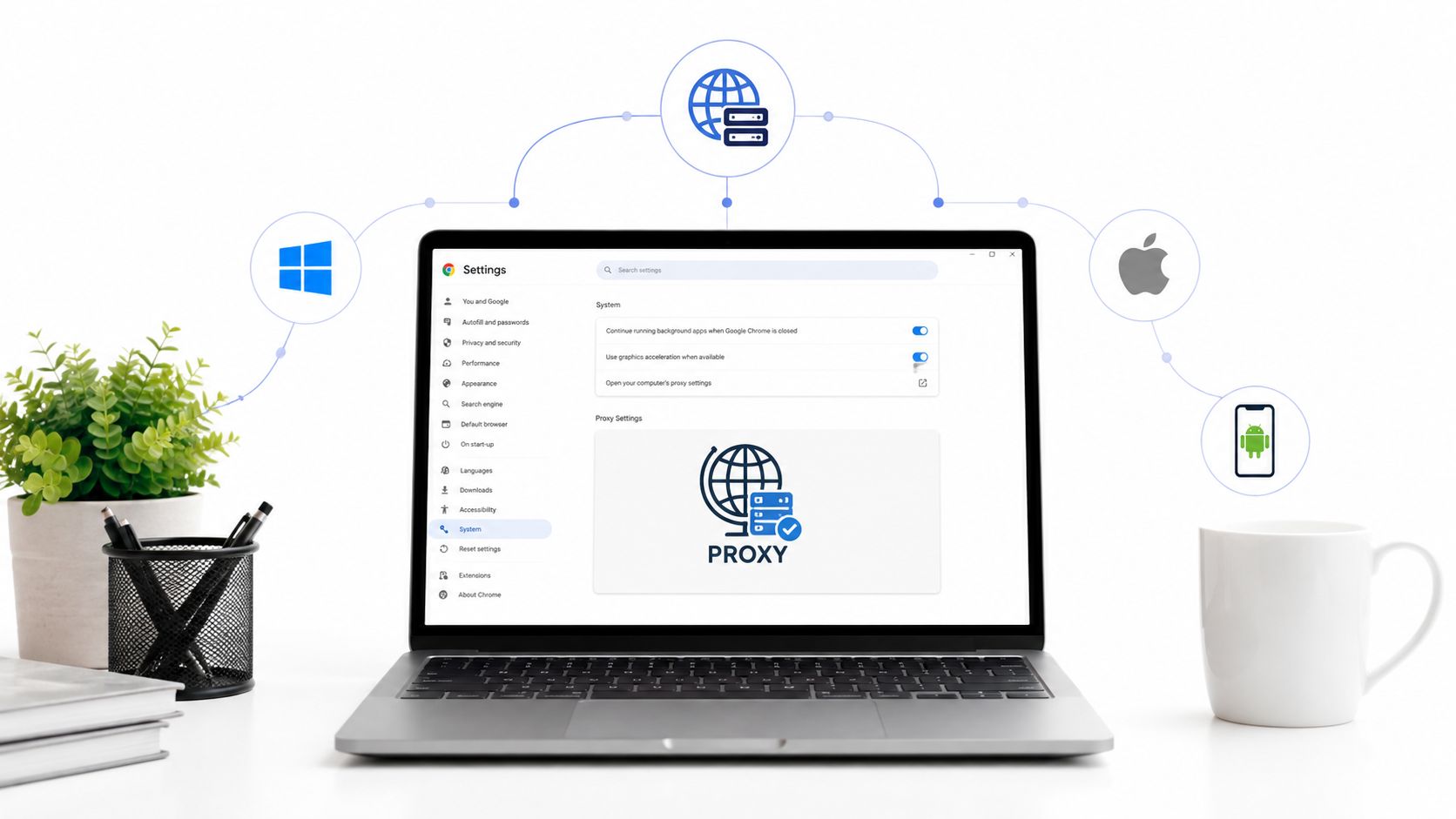
An HTTP or HTTPS proxy is commonly used for web traffic. SOCKS5 is another proxy protocol, supported by clients that can route connections through a SOCKS endpoint. A working protocol setting says nothing on its own about the IP's carrier or quality. Mozilla's documentation explains the browser's SOCKS proxy settings.
Geo-targeting means selecting an exit for a requested location. Don't rely only on a country label: check the observed country and, when the task depends on it, the city. For each concept, ask a practical question: does the ASN match, does the session behave as configured, does the client support the protocol, and does the observed location match the test requirement?
Compare Providers by Operational Criteria
A useful comparison starts with the job, not a ranking. A social team managing legitimate accounts may need session continuity. A QA team may need repeatable access from a specific French location. A research team may care more about sustained throughput and a predictable exit than a short-lived peak speed.
The table compares proxy types, not named providers. Each connection model has trade-offs that should be checked against the actual workflow.
| Provider or proxy type | Connection model | Best fit | Main trade-off | Must-test evidence |
|---|---|---|---|---|
| Mobile 4G/LTE | Cellular carrier exit, with rotation or sticky sessions depending on the service | Location-specific QA, campaign checks, and workflows that need mobile-network access | Shared carrier reputation and variable radio conditions can affect results | Carrier ASN, observed city, session control, leakage, sustained throughput, and destination success |
| Residential | Exit associated with a residential connection | Research tasks that require a residential-network context | It isn't a substitute for a carrier identity when mobile access is the requirement | Location consistency, session behavior, protocol support, and results on permitted targets |
| Datacenter | Exit from hosting infrastructure | Routine workloads that don't require a mobile or residential network identity | Hosting-network origin may not fit mobile-specific validation | Destination compatibility, latency, connection stability, and successful completion of the intended task |
Compare service behavior, not maximum claims
A stated peak rate doesn't tell you the usable throughput at your client, session, and destination. Cellular conditions, congestion, throttling, connection overhead, and the destination's own limits can all affect application performance. Measure repeated samples and include both typical latency and the slow tail, rather than judging a service by one fast request. The proxy speed testing guide can help structure a test.
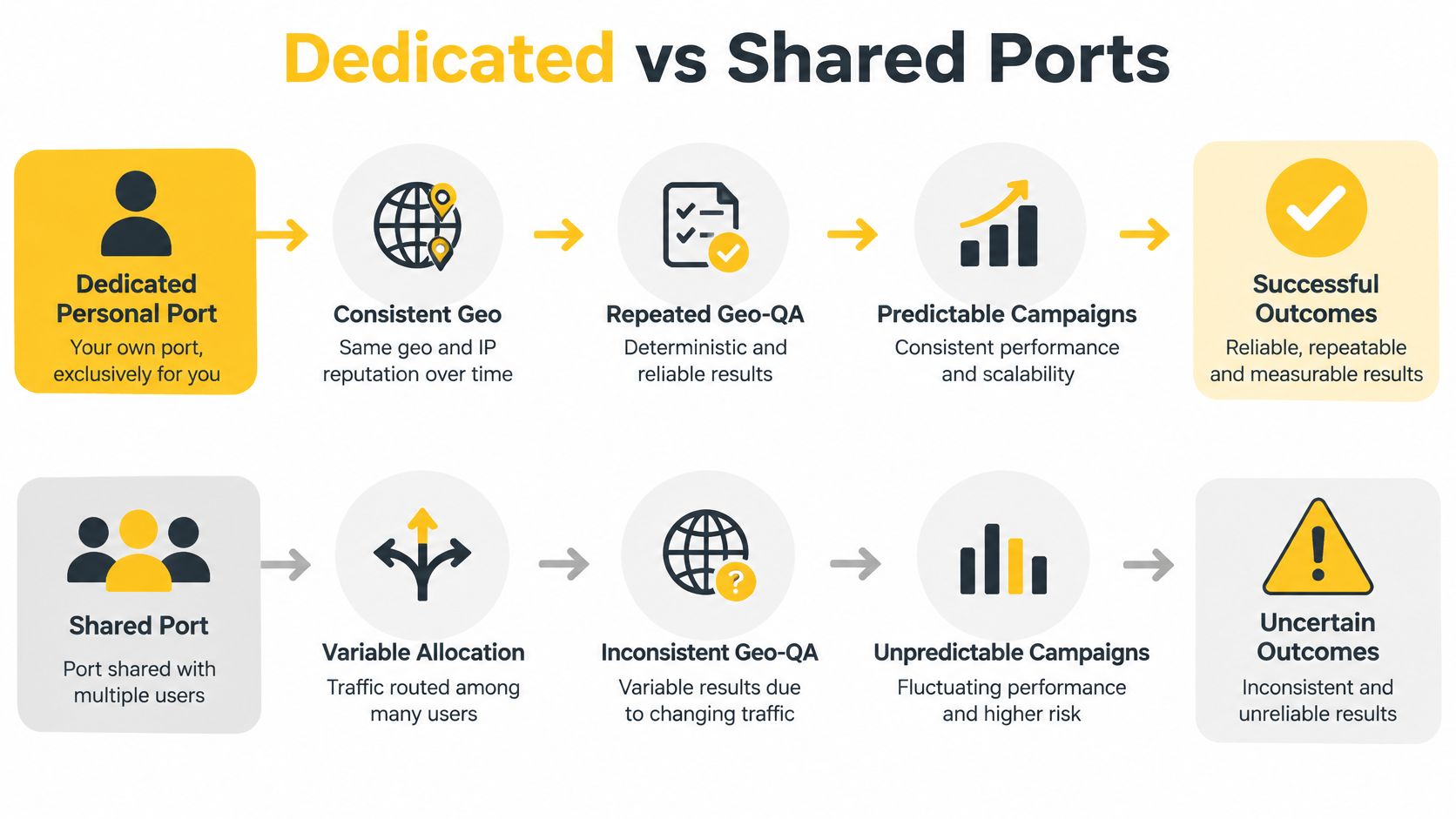
Check port isolation as well. Dedicated hardware can make contention more predictable, while shared access may introduce more variation. Neither is automatically the right choice: a short research check may not need dedicated capacity, while repeated QA flows may benefit from a more controlled connection.
Verify geography and provenance
For French access, confirm that the exit resolves to the intended carrier and location, then test it at the destination you plan to use. Ask how the provider sources traffic and whether it can document carrier authorization and relevant operating practices. Also check whether the service supports the required protocol, authentication method, and session behavior.
Support quality is operational evidence too. Before committing, ask how the provider handles connection failures, location discrepancies, and rotation problems. A clear answer to those questions is more useful than an unqualified claim of universal compatibility.
Evaluate Evoproxy for French Mobile Access
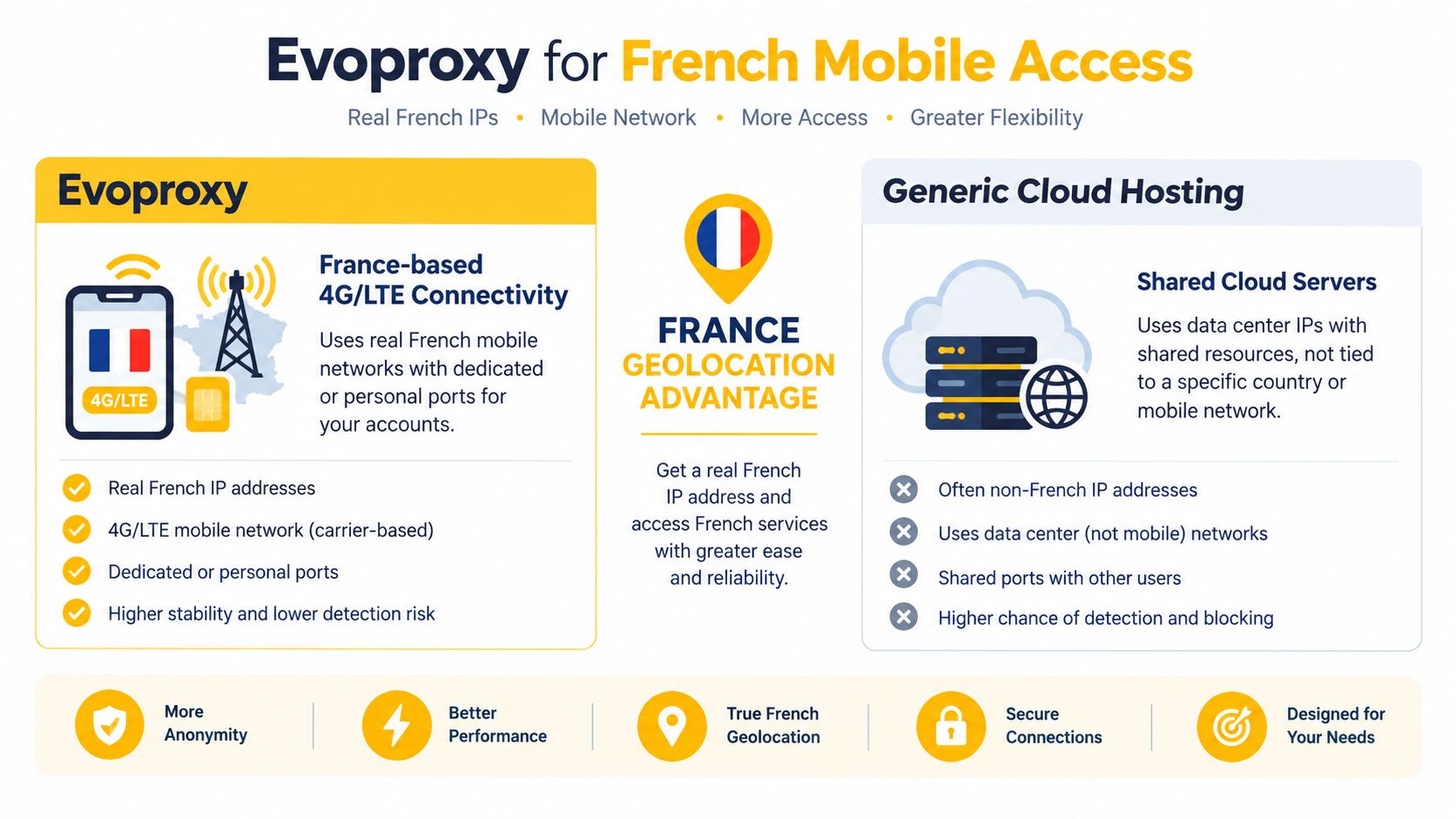
Evoproxy provides 4G/LTE/3G connectivity from France through personal ports with unique IPs and 250 GB of monthly traffic, or shared ports with scheduled rotation and 50 GB of traffic. Those are the product details available for comparison; they don't establish a guaranteed throughput, universal destination access, or account safety.
For a buyer who specifically needs French mobile access, the key evaluation is whether the exit's carrier identity and observed location match the intended test. A country-level label may be enough for broad checks, but QA and campaign validation can require city-level confirmation. Test the actual destination and retain the results instead of assuming that a French endpoint label proves location fidelity. The France proxy information page can provide product context.
Personal and shared ports serve different tests
A personal port with a unique IP and its stated traffic allowance may be the more controlled option for recurring French geo-QA or multi-step campaign checks. The buyer should still verify session persistence, rotation behavior, location, and the application's performance. A unique IP is a product attribute, not proof that every other signal remains consistent.
A shared port may suit short-term checks or exploratory research where variable contention is acceptable. Its scheduled rotation and lower stated traffic allowance make it important to test whether the rotation cadence fits the workflow, particularly if a task involves login or multiple page transitions.
Evoproxy's product details don't provide an independently measured throughput result or a guarantee of broad website compatibility. Evaluate the service with your own target destinations, client configuration, and acceptance criteria. If a test fails, record whether the cause appears to be location, protocol, session change, network performance, or the destination's response. That makes the result useful for a buying decision instead of reducing it to a generic “trust” label.
Match Dedicated and Shared Ports to Your Workload
The choice between dedicated and shared access is a choice about control versus variability. For repeated campaign validation, a personal port can make it easier to keep the same connection context while checking a sequence of pages. A shared port may be adequate for a brief market check where each request stands alone and occasional variation won't invalidate the result.
Keep multi-step flows intact
For a compliant social-media workflow or an application test, use a sticky session across login, navigation, and submission. If the exit changes halfway through, it becomes harder to distinguish an application issue from a network or session issue. After the workflow finishes, rotate before starting a separate test when that separation is useful and permitted.
For independent checks, use scheduled or on-demand rotation between tasks rather than changing the exit during a single flow. Record the observed address and location before and after rotation. That confirms whether the control did what you intended without assuming that a rotation command guarantees a new geography.
Operational insight: A stable session is often more valuable than frequent IP changes. Rotation can separate independent tasks, but unnecessary changes can disrupt continuity and make results harder to interpret.
Match the port to the risk of inconsistency
- Social operations: Keep a stable session for permitted account workflows and follow the platform's rules. Treat a proxy as a network route, not as a substitute for consistent device and account practices.
- Geo-QA: Prefer the more controlled connection when repeated runs must start from a comparable French mobile exit. Track location and application results together.
- Market research: Shared access may be sufficient for short, independent checks. Use respectful pacing and collect only data you're authorized to process.
- Advertising verification: Use consistent carrier and location signals across comparable checks. Rotate between distinct test runs, not in the middle of one.
The right configuration is the one that preserves the conditions your test needs. If shared access produces materially different results between runs, move to a more controlled setup or narrow the test. If the workflow remains consistent, paying for greater isolation may add little practical value.
Test Reliability Before Production Use
Treat provider claims as hypotheses and run an acceptance test before connecting a production workflow. Use permitted destinations and the same client settings you expect to deploy. A successful request only proves that one request worked under those conditions.
Run a repeatable acceptance test
- Confirm the exit identity. Check the public IP's ASN and confirm that it resolves to the intended mobile carrier. Record the observed country and city, especially when local testing is part of the job.
- Validate the client protocol. Configure the HTTP, HTTPS, or SOCKS5 option your application supports. Test authentication and confirm the request exits through the proxy rather than falling back to a direct connection.
- Check for leaks. Test DNS and WebRTC behavior where relevant to the client. A correctly routed web request doesn't automatically establish that other traffic follows the same route.
- Exercise real requests. Send representative HTTPS requests to the permitted destinations used by the workflow. Record whether the response contains the expected page or result, not just whether the connection returned a status code.
- Measure across repeated runs. Track median and p95 latency, repeated download-throughput samples, connection-establishment time, timeout rate, HTTP success rate, and challenge frequency across relevant French endpoints and times of day.
- Test session control. Keep the exit through a multi-step flow, then test rotation between separate tasks. Verify that the IP changes as advertised and that the observed location remains appropriate.
Read failures in context
These checks are independent. SOCKS5 compatibility doesn't prove mobile identity, and a matching carrier ASN doesn't prove good throughput. Likewise, an IP that reaches one destination successfully doesn't establish account safety or guarantee future access.
For bandwidth-sensitive work, test sustained application throughput rather than relying on a headline maximum. Cellular radio conditions, tower congestion, carrier throttling, transport overhead, and destination-side limits can all constrain the result. Compare complete workflows, including the time and failures associated with connection or rotation, instead of timing only the page request after a connection is already ready.
Keep a simple test record: configuration, location, ASN, session mode, destination, result, latency, and any leakage or challenge observed. That gives you a defensible basis for choosing a setup and makes later regressions easier to diagnose.
Choose Responsibly for Your Target Workflow
Compliance obligations attach to the workflow, not to the proxy: the same connection that is legitimate for geo-QA can become unlawful the moment personal data is collected without a legal basis. Treat that boundary as part of the purchase decision, not as an afterthought once trial results are in.
Each workload carries its own exposure. Social-media managers running compliant multi-account operations should weigh stable sessions and consistent client behavior against platform terms. QA teams should verify French city-level access where location matters and confirm the application flow end to end. Researchers should pair stable geography with respectful request pacing and a documented collection basis. Advertising specialists should validate repeatable carrier signals against each relevant destination instead of assuming one test generalizes.
Privacy deserves the same scrutiny as throughput. Ask what the operator logs: destination domains, timestamps, authentication details, and IP assignments. Check retention periods, international transfers, deletion options, and whether the provider can supply processing documentation. The European Commission notes that pseudonymized data remains personal data when it can be re-identified, and GDPR applies regardless of the technology used; its GDPR guidance for businesses is relevant when workflows involve personal data.
A proxy does not make every use lawful or compliant. Keep legitimate QA, market research, and campaign verification separate from scraping personal data, bypassing access controls, or creating deceptive accounts. Then run a controlled trial using your own destinations and acceptance criteria, and compare stable sessions, location accuracy, leakage, and completed results before committing.
Evoproxy offers French mobile 4G/LTE/3G access through personal ports with unique IPs and 250 GB of monthly traffic, or shared ports with scheduled rotation and 50 GB. Try it in a controlled test against your specific workflow, and visit Evoproxy to review the available options.