
The popular advice that a mobile IP makes ad checks "undetectable" gets the job backward. An ad verification proxy works like a survey instrument: it reproduces how an ad, landing page, or targeting rule behaves over a mobile connection in a specific market, then records what a device in that context received. Rendered creative, geography, carrier, redirect path: all observable. Whether the auction was fair or a real person saw the impression: outside its reach.
Standards bodies are precise about what counts as measured. Under the Media Rating Council's viewability standard adopted by the Interactive Advertising Bureau, a display ad is viewable when at least 50% of its pixels sit in the browser's viewable area for one continuous second, while video requires two (IAB ad verification guidelines). A proxy can document what rendered on screen. Treating that record as proof of auction integrity or human attention is how verification reports lose credibility.
What an Ad Verification Proxy Actually Does
An ad verification proxy is a proxy used to observe how ad creative, landing pages, and targeting behave from the perspective of a user in a specific market, so verification teams can compare what an ad platform claims with what a device receives. A proxy routes a request through an intermediary network connection. In verification work, that intermediary supplies the network and location context for a controlled observation.
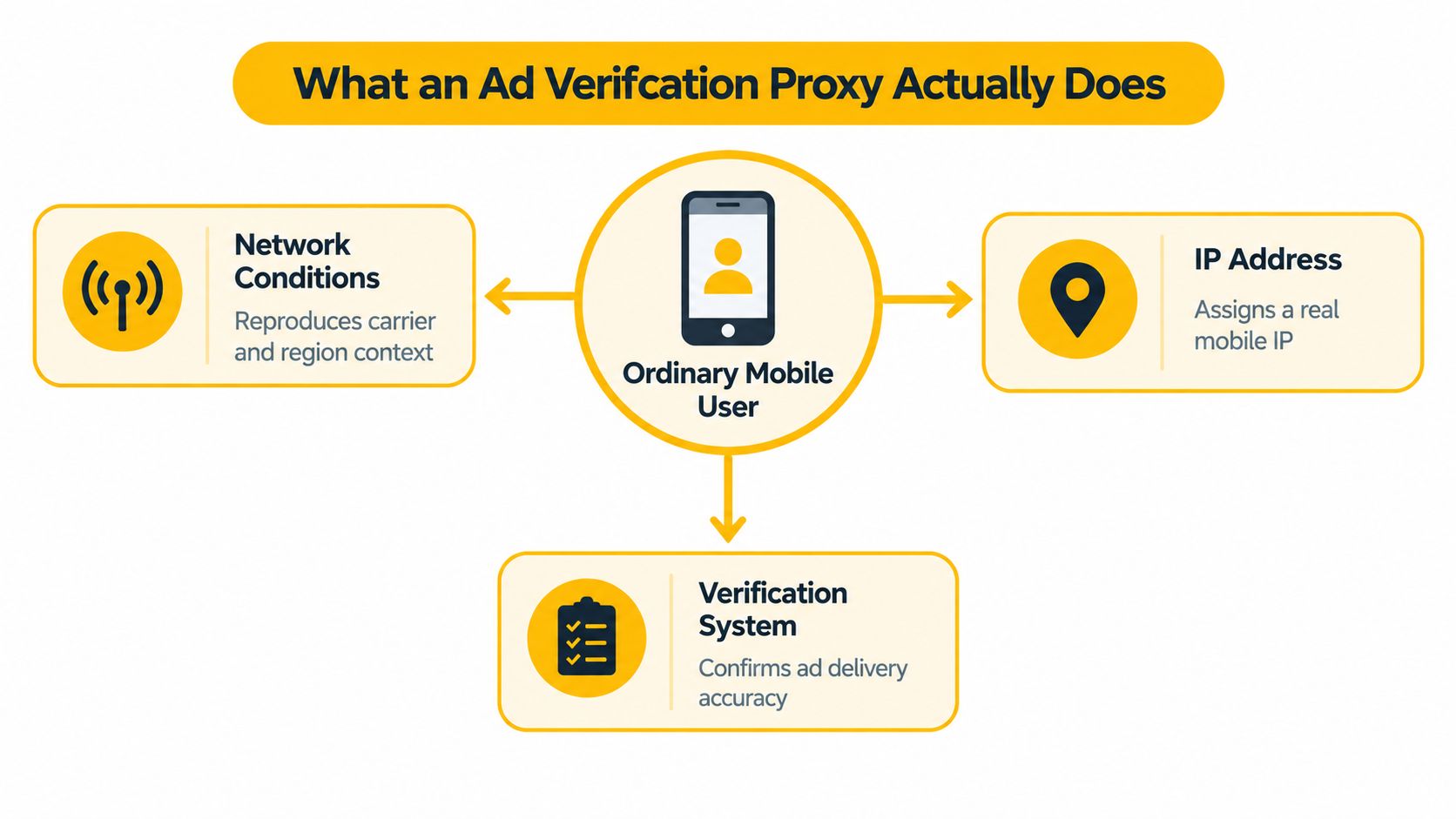
Why is a second observation needed at all? Because an ad server's report and a user's experience are two different records. A server log can confirm that an impression was served. It cannot confirm that the creative rendered correctly, displayed in the intended market, or entered a browser's visible area. A verification session run through a proxy produces that second record, captured from the vantage point a real user in that market would occupy.
The IAB defines ad verification as the technology and processes for confirming that ads appear on intended sites and reach their intended audience. The scope covers viewability, invalid traffic, geography, placement, brand safety, and related delivery conditions. The IAB guidelines introduced earlier also draw a line inside invalid traffic: every fraudulent impression is invalid, yet an invalid impression can have an innocent cause, such as a misfired tag or a search engine crawler loading a page.
Practical rule: Treat the proxy as a measuring instrument for delivery conditions. It records what a session received, and the audit record decides what that evidence means.
That limit shapes how a team reads its own data. The evidence a proxy captures lives at the delivery layer: which creative version a device received, which market and network carried the request, where a redirect chain ended. The auction happened earlier, inside the ad platform's systems. Human attention happened afterward, on the other side of the screen. Both sit outside what a controlled session can record, so the ordering stays fixed: measurement first, access second. A team that starts by asking how to hide its IP risks treating a successful connection as trustworthy evidence.
The Three Verification Jobs a Proxy Supports
Three questions, three separate records in the audit log. A single proxy session can feed all three checks, yet each one answers a different question, and mixing them produces evidence that proves less than it appears to.
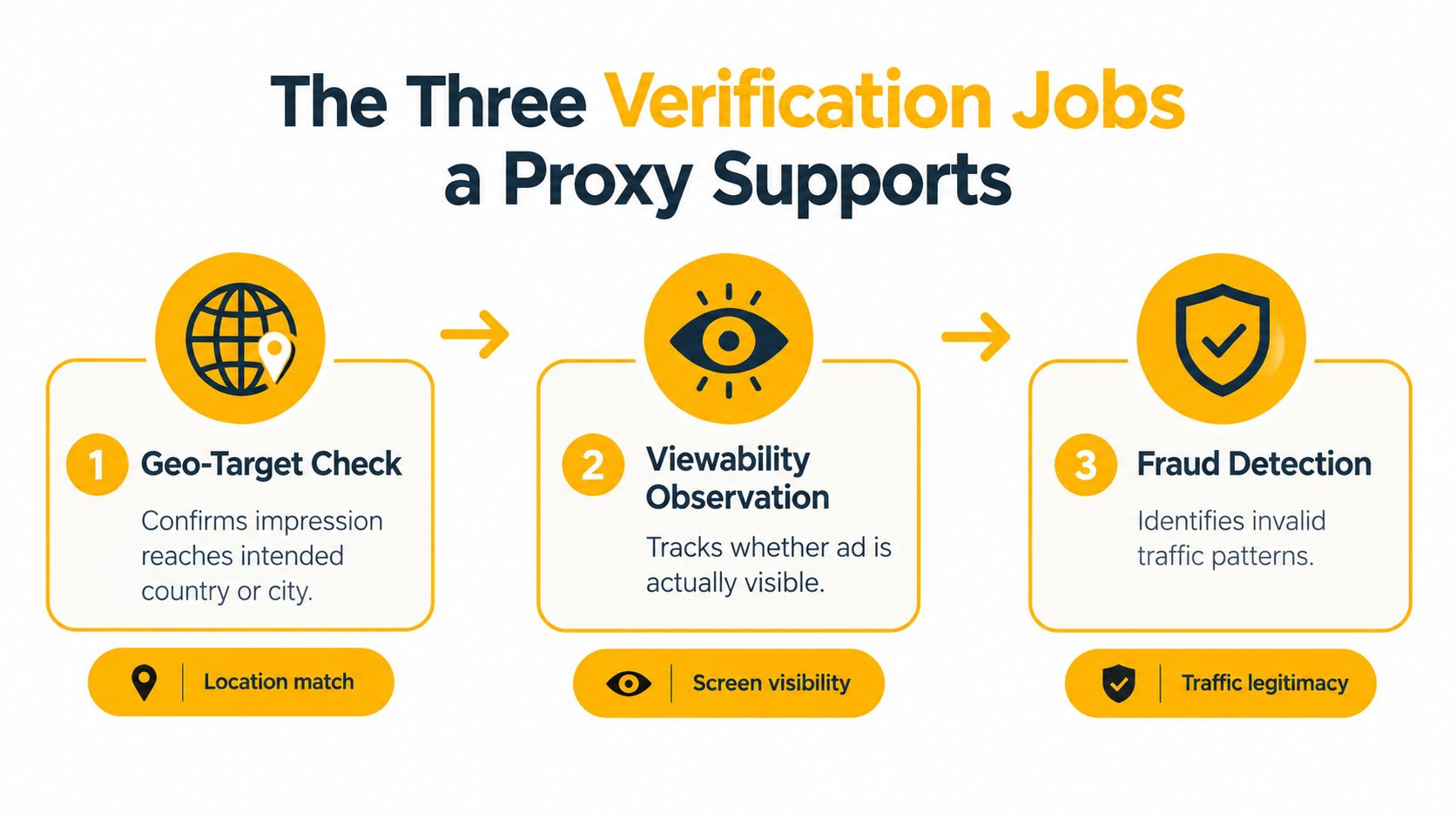
Geo-target checking asks whether the campaign behaves as intended in a market. A media buyer testing a country-specific offer routes a connection through the target region, records the proxy's IP type, ASN (Autonomous System Number, an identifier for a network), and location signals, then compares the rendered creative against the campaign setup. The result confirms what that test session received. Extending the conclusion to every user in the market requires more than one observation point.
Viewability observation asks whether the ad rendered and entered the visible viewport. Viewability carries a defined threshold: under the MRC/IAB viewability standard already cited, a specified portion of the ad must remain in view for a set duration. A proxy session can capture browser-side render and visibility events. Whether a real person's eyes met the screen sits outside that record, and treating a logged event as attention is one of the most common misreadings in verification work.
Fraud-signal detection compares what the controlled endpoint observed with campaign records. A server-side impression with no corresponding render event, or a click without a plausible preceding exposure, deserves investigation. Capture the redirect path, render timestamp, and click events alongside the IP and ASN classification. Those discrepancies point analysts somewhere useful, while an IP reputation label on its own rarely does.
A proxy validates delivery conditions and surfaces anomalies. Bid integrity, impression legitimacy, and human gaze all demand evidence the session itself cannot produce.
Mobile, Residential, and Datacenter Proxies Compared
Two analysts checking the same campaign from different networks can record different creatives, different landing pages, and different redirect chains. The proxy type decides whose traffic your test session resembles, and that resemblance sets the ceiling on what the observation can claim. A mobile proxy routes through a carrier network, such as a 4G or 5G connection. A residential proxy exits through an IP tied to a household broadband line. A datacenter proxy runs on server-hosted infrastructure, with no consumer carrier or household behind the address.
Each type works like a different measuring instrument. A mobile egress reads the campaign the way a carrier subscriber's device might, while a datacenter egress reads it the way a server would. Neither instrument is broken; they answer different questions.
| Attribute | Mobile 4G/5G | Residential | Datacenter |
|---|---|---|---|
| Typical network identity | Mobile carrier ASN | Residential ISP ASN | Hosting or data-center ASN |
| Carrier-grade NAT behavior | Commonly shares public addresses across subscribers | Depends on the residential network | Usually not a mobile carrier's shared-address setup |
| IP trust for mobile ad checks | Often a closer match to carrier-based user traffic | Useful for household broadband context | May be easier for some ad systems to distinguish from consumer traffic |
| Detection risk | Harder to block by IP type alone, but not undetectable | Can resemble household traffic, though behavior still matters | More likely to stand out when the test requires a consumer network context |
| Best fit | Carrier- or mobile-specific delivery checks | Residential-market observations | Infrastructure checks where consumer-network realism isn't required |
Mobile IPs earn their reputation through the nature of their networks: they come from carrier networks, often shared among ordinary subscribers, so blunt IP-based blocking catches real users alongside test traffic. Detection systems look past the address, though. The IAB counts proxy traffic among possible invalid-traffic patterns, so classification should weigh observed behavior alongside the IP label (IAB definitions of invalid traffic).
Address sharing carries a second consequence junior buyers often miss. Carrier-grade NAT, or CGN, lets a provider stretch a small public IPv4 pool across many subscribers. The IETF reserves the block 100.64.0.0/10 for this shared address space and notes that geolocation may resolve to the CGN server rather than the end device (RFC 6598 on shared address space). An IP can therefore indicate a carrier's egress region without pinning down one subscriber. Reused addresses alone say nothing about fraud.
Match the network to the question you need answered. For mobile campaign delivery, 4G/5G egress usually reproduces the relevant context; for a household broadband check, residential fits better. The abuse side of the picture, covered in Securify on Shopify proxy abuse, shows why proxy signals demand careful interpretation rather than automatic suspicion. For a closer look at how the two consumer-grade options differ, the residential vs. mobile proxy comparison walks through what each connection can and cannot reproduce.
Technical Requirements for a Verification-Grade Setup
A proxy session measures only what its conditions allow. Keep those conditions stable enough for another operator to repeat, and keep them close to the network context the question is about.
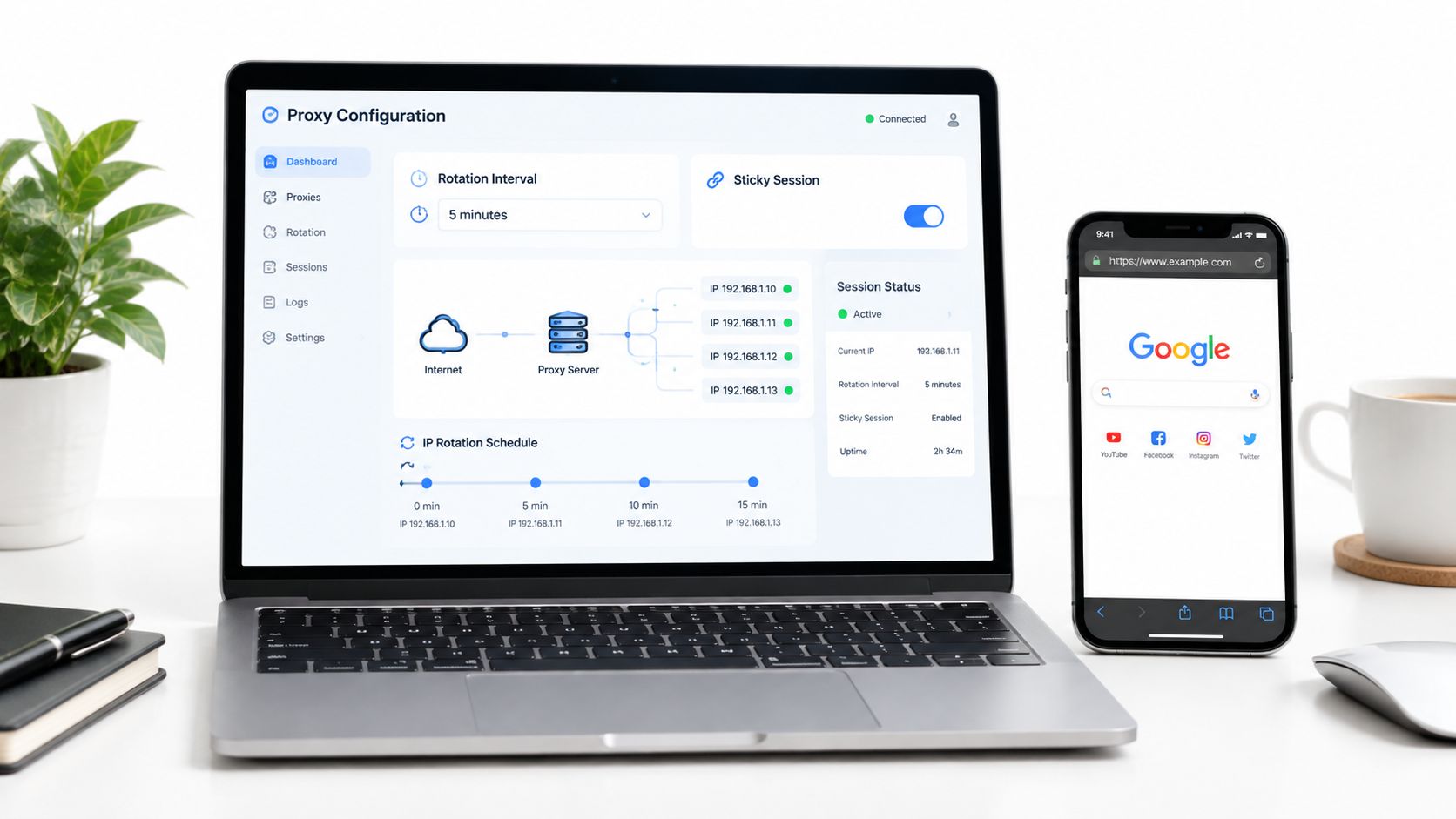
Set rotation around the test journey. IP rotation changes the address used between requests or sessions. Frequent rotation samples multiple endpoints, but it can also break a sequence that depends on cookies or redirects. A sticky session holds the same proxy identity for a defined period or journey, which is usually more useful when following an ad through a landing page and consent flow.
Keep geography and network identity consistent. If the question is whether a mobile campaign appears on a particular carrier, choose a mobile egress in the intended market and record its ASN and location context. A country-level match says nothing about city- or carrier-level delivery, so the test should state exactly what geographic precision it can support.
Choose a transport that fits the client. HTTP and HTTPS proxies handle web requests through the HTTP proxy protocol, with HTTPS traffic typically tunneled through the connection. SOCKS5 is a more general protocol that can relay different kinds of traffic. The right choice depends on the browser or test client. Neither protocol makes the underlying traffic more representative by itself.
Match device signals to the network. A mobile carrier IP paired with desktop-only headers creates a mismatch that can change the result. The proxy supplies the network identity. It does not rewrite the rest of the session. Record the user agent and device context rather than assuming the IP alone made the session look like a phone.
A clean test is one another operator can repeat and understand.
Before running a check, agree on the session length, rotation policy, target market, carrier or ASN requirement, and how credentials will be stored. Capture request and render timestamps, IP type, ASN, geolocation, connection characteristics, redirect path, and user-agent consistency. The MRC warns that proxy routing can reduce the granularity of signals used for invalid-traffic decisions, so proxy status alone shouldn't decide whether traffic is valid or invalid (MRC guidance on proxy routing and IVT).
Building a Workflow That Produces Defensible Evidence
Start by writing down the question the test is meant to answer. "Does the intended creative render on a mobile connection in the target market?" is verifiable. "Is this campaign fraud-free?" asks more than a proxy session can establish. A proxy session is a measurement instrument, so treat its output the way a lab treats a sample: documented, reproducible, and labeled with its limits.
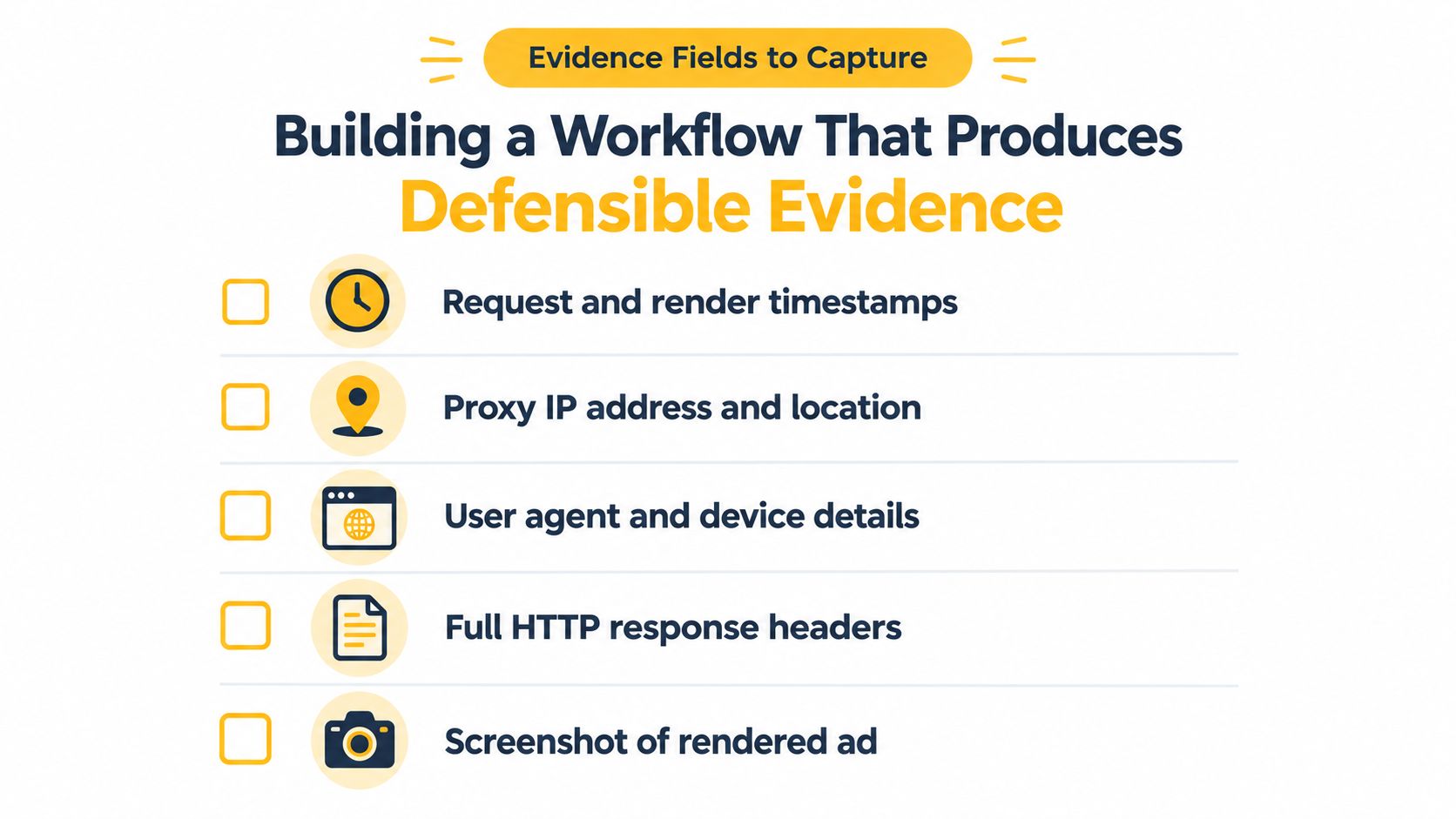
Build each test record from linked evidence, not a single IP score:
- Session context: Record the proxy IP type, ASN, geolocation, device signals, user agent, and the test's purpose.
- Delivery record: Save request and render timestamps, ad-slot and creative identifiers, page or app context, and viewport details.
- Journey evidence: Preserve redirect steps, response details, render events, and any click events that occur naturally during the test.
- Disposition: Mark the outcome as valid, invalid, or unknown, and retain the reason for that classification.
- Comparison: Match the client-side record against ad-server logs and measurement beacons using campaign identifiers and timestamps.
Consistent with the IAB invalid-traffic definitions cited earlier, impressions should be recorded late in the delivery chain with invalid traffic filtered out, and general invalid traffic is distinguished from the more complex forms that need deeper analysis. A useful record therefore captures what happened in the browser alongside what the server logged. A proxy's IP reputation can inform that record, but it cannot serve as the verdict on its own.
Don't generate artificial clicks or repeat impressions beyond what a controlled user journey requires. Those actions can contaminate campaign metrics and make the test harder to interpret. For a related approach to campaign performance tracking, keep the measurement record distinct from live campaign activity.
If the evidence doesn't support a decision, label the result unknown rather than forcing it into a valid or invalid bucket. That's especially important when proxy routing obscures originating signals or produces conflicting results.
Two Scenarios With Mobile 4G Proxies
A French-market QA check starts with a specific question: does the intended creative and landing experience resolve correctly over a French mobile connection? The tester selects a mobile 4G egress in the target market, opens the campaign page in a consistent mobile browser context, and records the user agent, location and ASN signals, request time, rendered creative, viewport, and any consent banner shown.
Next, the tester follows the landing-page path without manufacturing clicks. They capture the redirect chain and the final page, then compare those observations with the campaign's expected creative and destination. The team records any mismatch, shares the evidence with the campaign owner, and keeps the browser session separate from live performance reporting. A practical checklist for localization QA testing can help teams document these market-specific checks.
A media buyer can use the same method to compare a campaign in two European markets. The buyer runs the same controlled journey through a mobile connection in each target location, keeping browser settings and test steps consistent. They record each rendered creative, redirect path, timestamps, and the market and carrier context, then compare the observations with the ad-server logs.
If one location produces a different creative or no render event, the buyer doesn't immediately call it fraud. They report the discrepancy, attach the records, and ask the relevant operations team to investigate the delivery path. In both scenarios, the team documents what appeared, what the server reported, and what wasn't tested. They don't click ads to generate conversion signals or inflate impression counts. That restraint keeps the audit trail useful and the campaign data cleaner.
Common Misconceptions Worth Retiring
A mobile IP isn't "undetectable." Carrier context can make a session look more representative of mobile traffic, yet it leaves other signals untouched: device fingerprint, TLS handshake, request timing, behavioral patterns. The IAB invalid-traffic definitions cited earlier include proxy traffic among possible IVT patterns, which is exactly why a verifier needs context and corroborating evidence rather than confidence in the IP type alone.
Verification and fraud detection are different jobs. Treat your proxy as a measuring instrument, and the boundary becomes clear. A camera records what was in front of the lens; it can't tell you who was standing behind it or whether the scene was staged. In the same way, a proxy session can reproduce a location and carrier context, capture the rendered creative, and preserve the redirect path. It cannot prove auction integrity, confirm a human eye saw the ad, or establish that an install was genuine. Those questions need log data, conversion evidence, and human review sitting alongside the session capture. For a broader view of where proxy observations fit, these click fraud statistics and benchmarks keep the line between fraud indicators and controlled measurement clear.
More testing doesn't automatically mean cleaner data. Repeated requests from the same proxy can alter the conditions you're measuring, and intermediary routing can strip the detail needed for invalid-traffic decisions. The MRC guidance cited earlier advises against treating proxy routing alone as sufficient grounds to filter traffic. Preserve the evidence, and classify inconclusive cases as unknown.
The standard worth holding is modest but strong. Report what the session showed, state what it couldn't establish, and point to the records that support your conclusion.
Evoproxy offers mobile 4G/LTE connectivity with configurable rotation and personal or shared ports, which can support controlled checks of market-specific ad delivery and landing-page behavior. If your workflow needs a French mobile network context, try mobile 4G proxies for your use case and visit Evoproxy to review the available options.