Your French campaign is ready, but the landing page keeps showing the international offer. A colleague in France sees something different, while your account-management session triggers an unfamiliar-location check. You need a France IP address, but selecting France in a proxy dashboard hasn't resolved the problem.
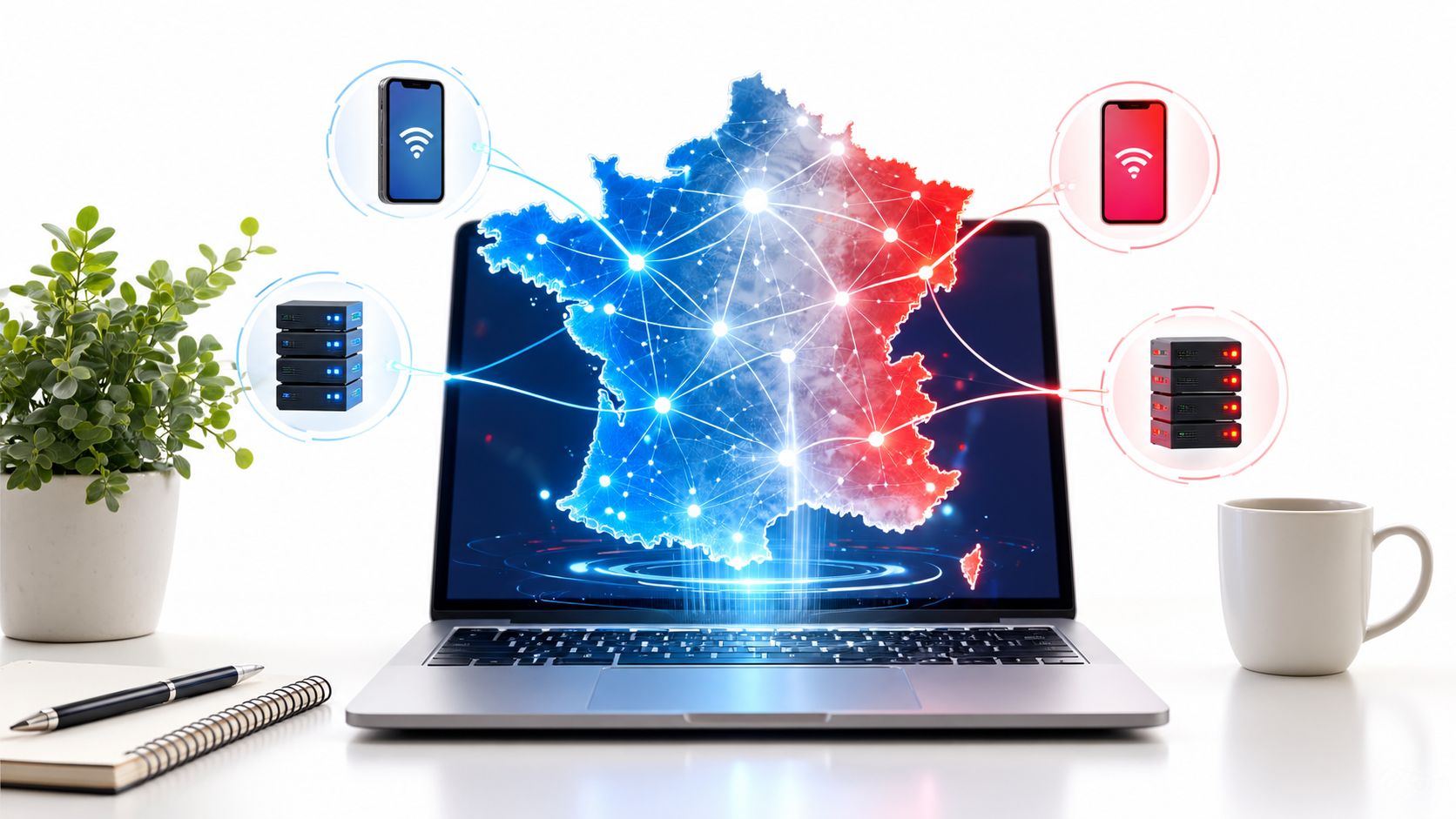
The missing detail is often the network behind that address. A French mobile exit, a home broadband connection, and a hosted server can all resolve to France while presenting different network characteristics. Choosing the right connection means validating more than a country label.
Why a French IP Matters in Real Workflows
Consider an ad-verification task: you're responsible for confirming that French visitors receive the right promotion, language, currency, and checkout experience. Your browser shows the global storefront, so you change the exit location to France. The homepage now looks correct, but the checkout still offers the wrong delivery options.
That doesn't automatically mean the proxy failed. The application might also use your existing cookies, account settings, browser language, or delivery selection. A French network connection is a useful test input, not a replacement for controlling the rest of the session.
The same distinction matters for authorized social media management. A team working across borders needs a documented access pattern, consistent authentication, and an appropriate connection for the accounts it manages. Changing countries or addresses indiscriminately isn't a sound operational strategy.
Define the result before choosing the connection
Start with the business question you're trying to answer:
- Country targeting: Does a French visitor receive the French offer rather than the international one?
- Network realism: Does the experience work through a consumer mobile connection, not just a hosted server?
- Session continuity: Can an authorized user complete login, navigation, and checkout without an unexpected connection change?
- Reproducibility: Can another tester recreate the conditions behind a failed result?
These requirements lead to different infrastructure choices. A country-specific public page may only need a correctly geolocated exit. An authenticated workflow deserves closer attention to address persistence and the surrounding account state.
Practical rule: Treat the French IP as a controlled test condition, not as proof that you're reproducing the entire French customer experience.
For market research, the connection helps establish a comparable regional observation point. For brand protection, it helps inspect what a French audience can access. For privacy, it changes the public network address presented through the configured application, but it doesn't remove identifiers already attached to a signed-in session.
The useful question isn't whether you need a French address. It's whether your job requires French geography, a particular network type, or a stable authenticated workflow. Specify that first, and you can judge a connection against an actual acceptance criterion rather than a reassuring dashboard label.
What a France IP Address Actually Is
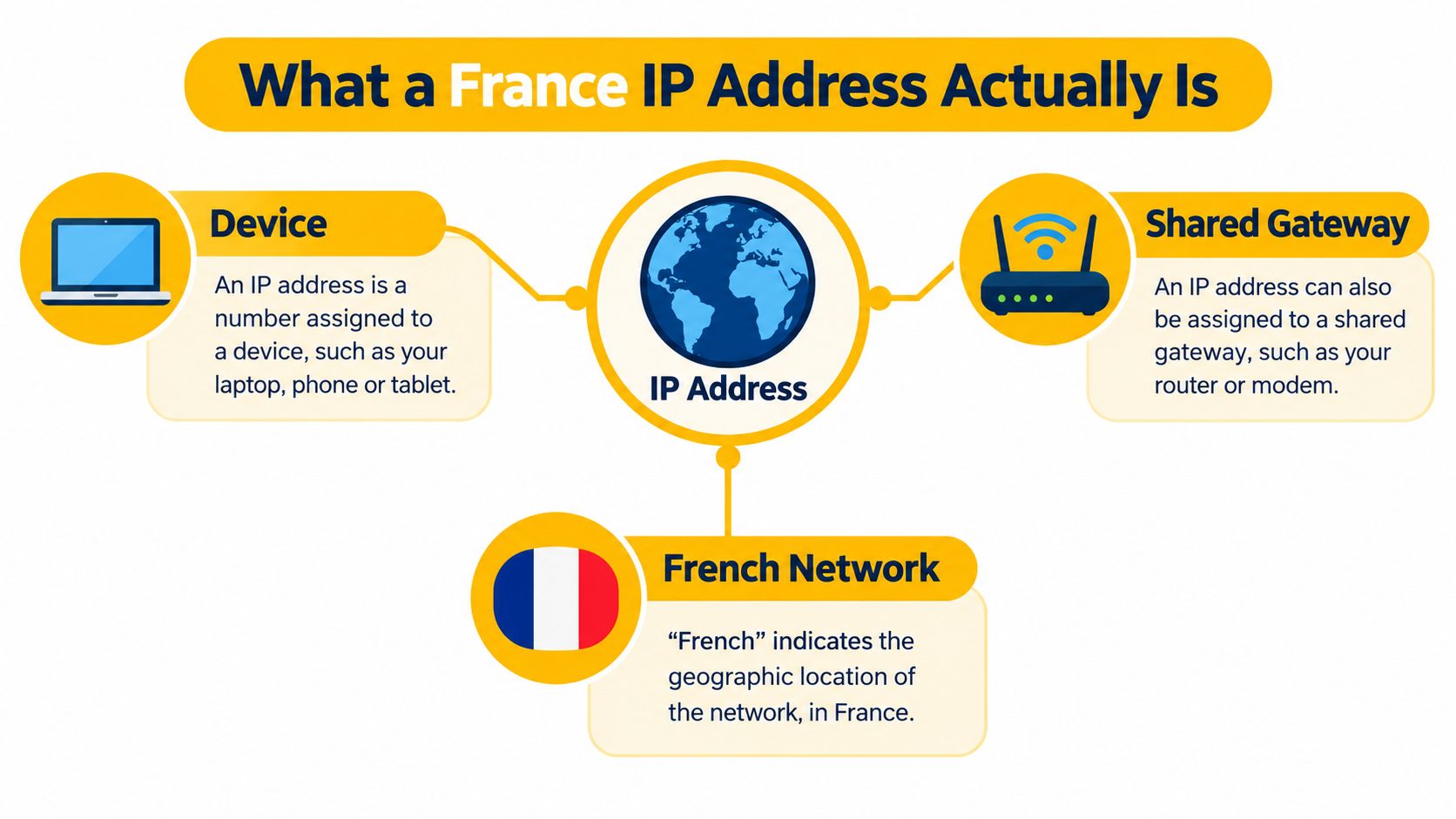
An IP address identifies a network endpoint, which may be a device or a gateway serving multiple devices. When a website receives your request through a proxy, it observes the proxy's public exit address rather than the originating address for that routed connection.
“French” usually describes how that public address is classified geographically. It doesn't establish your physical location, and an operator's registration country alone shouldn't be treated as decisive evidence of the exit's location.
Understand ownership and address scarcity
An autonomous system number, or ASN, identifies a network's routing administration. For practical validation, it helps distinguish a carrier network from a home-access ISP or hosting network. Country and ASN answer different questions: where an address is mapped, and which network operates its routes.
France's mobile environment includes Free, Orange, SFR, and Bouygues; the France network inventory associates substantial mobile address ranges with these operators. Carrier ownership is useful evidence, but it isn't a substitute for checking the exact exit used by your application.
France's address environment also reflects IPv4 scarcity. On 25 November 2019, the regional registry distributed its final available IPv4 allocation, a /22 containing 1,024 addresses; French operators had already assigned approximately 94% to 99% of their holdings by the end of June, according to Arcep's 2019 transition barometer.
That history matters when interpreting proxy terminology:
- Public address: The address the destination observes.
- Translated address: An address used behind a gateway, which may differ from the public exit.
- IPv4 or IPv6: The address family used for a particular connection.
- Dual-stack: Support for both families, without implying that every destination supports both.
Separate proxying from spoofing
A proxy establishes a routed application connection through an exit. That's different from merely altering a claimed source address or adding an IP-like value to a request header.
For background on that terminology, the GoReplay IP spoofing guide is a useful companion resource. For localization work, however, the operational requirement is straightforward: validate the address observed at the destination, not a location field or header you control locally.
Datacenter, Residential, and Mobile IPs Compared
Datacenter proxies exit through hosted infrastructure. Residential proxies use home-access networks. Mobile proxies route through cellular access, such as 4G or 5G, with a carrier-operated public exit.
Those distinctions describe network origin, not guaranteed acceptance. There's no universal platform trust score that lets you rank every address reliably. The following comparison is a practical selection framework, not a benchmark of block rates.
French IP types at a glance
| IP type | Trust to platforms | Detection risk | Best fit |
|---|---|---|---|
| Datacenter | Identifiable as hosted infrastructure, suitability depends on the destination | Hosting classification can make network origin straightforward to recognize | Authorized bulk retrieval, public-page checks, server-oriented QA |
| Residential | Resembles home broadband access, individual reputation still matters | Pool quality and connection history can vary | Localized price research, SEO observation, household-access QA |
| Mobile | Resembles carrier access, without guaranteeing account acceptance | Broad address blocking can affect unrelated subscribers | Mobile-experience QA, ad verification, authorized consumer-account workflows |
A datacenter connection is a reasonable starting point when geography is the main variable and the destination permits your activity. Don't discard it just because it isn't mobile. Conversely, don't expect a hosted exit to reproduce how a consumer carrier connection is classified.
Residential access provides a useful middle ground for retail monitoring and market research. Before committing to a pool, check its sourcing, geographic consistency, session controls, and suitability for the permitted workload. The residential versus mobile proxy comparison can help frame that choice around access type rather than marketing labels.
Why mobile exits can be harder to block broadly
Mobile networks commonly use carrier-grade NAT, or CGNAT, which allows many subscribers to share a public IPv4 address. The shared-address specification in RFC 6598 describes service-provider address space intended for this translation layer.
The practical implication is that blocking a carrier exit indiscriminately can affect unrelated subscribers. That gives mobile access a different blocking trade-off from a recognizable hosting address. It does not make mobile proxies undetectable, nor does it establish that a particular address has a clean history.
A mobile exit can reproduce carrier-network conditions. It can't make unauthorized automation acceptable or erase account history.
Rotation behavior also depends on the service configuration, not just the IP category. A mobile connection can retain an exit during a task, while a residential service may rotate between endpoints. Evaluate the behavior you receive rather than assuming a label guarantees persistence.
For data teams, the guide for developers automating web scraping provides additional implementation context. Keep collection authorized, respect applicable access rules, and select infrastructure around the required observation conditions rather than attempts to defeat enforcement.
Use Cases That Genuinely Need a French IP
A useful French-IP workflow produces a verifiable business result: a localized offer checked, a regional defect reproduced, or an authorized account accessed under controlled conditions. Access alone isn't the deliverable.
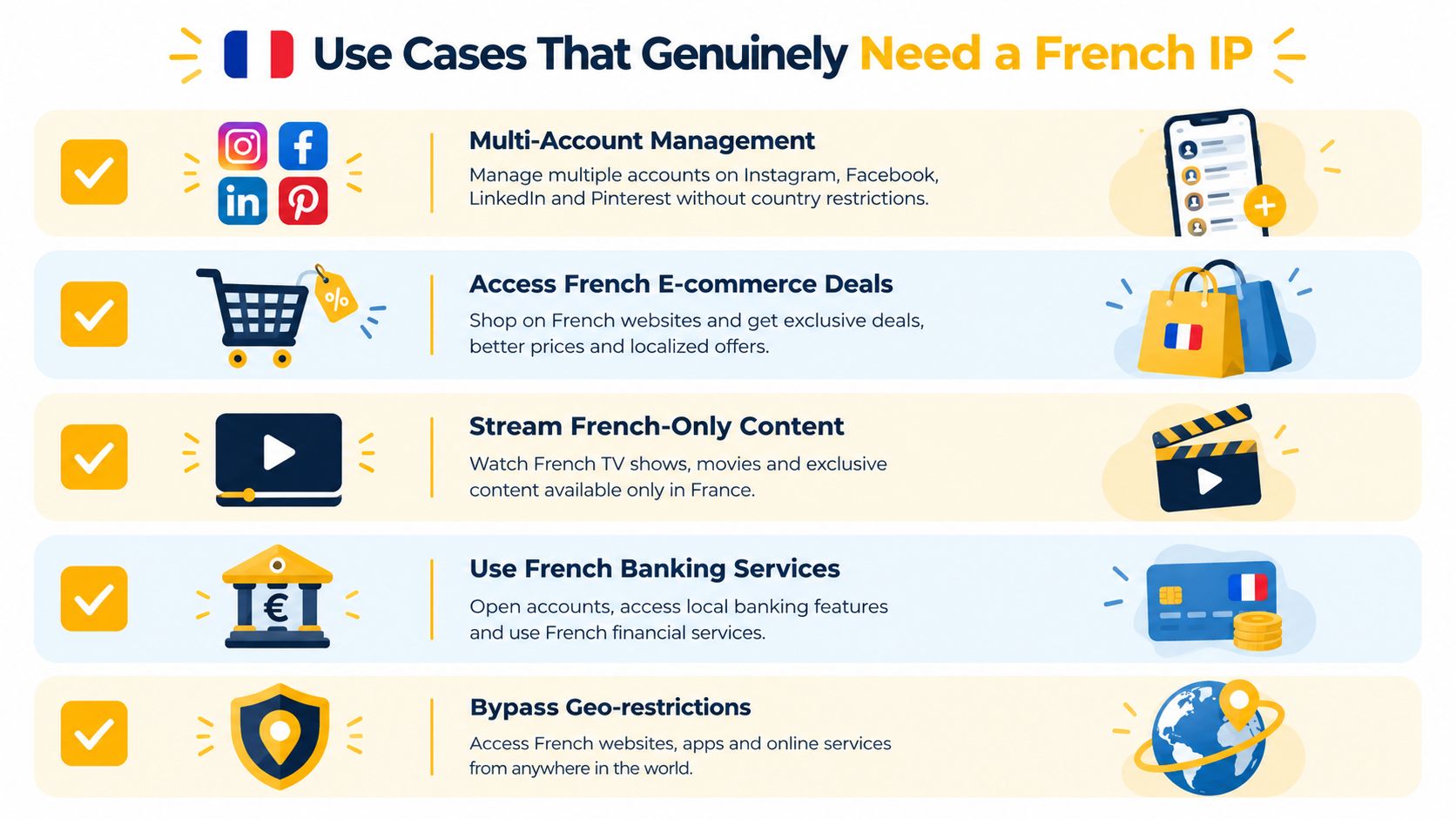
Geographic availability doesn't override eligibility, licensing, account authorization, or service terms. Treat those requirements separately from whether a page loads through a French connection.
Authorized account management and onboarding
For teams managing client-owned social accounts, use the platform's approved delegation and authentication mechanisms wherever available. A French mobile connection is appropriate when the operational requirement is specifically to test or maintain authorized access through French carrier infrastructure.
Without a controlled connection, troubleshooting becomes ambiguous: a location change, expired authentication, or account-permission issue can look like the same failure. Keep the authorized account context intact rather than rotating exits whenever a challenge appears.
For legitimate account registration and onboarding, validate the expected French experience using approved accounts. “Warming” should mean normal, permitted setup and use, not manufacturing a supposedly believable identity or disguising prohibited bulk registration.
Ad verification and regional QA
A media buyer should inspect the complete journey, not just the creative. Confirm the landing-page variant, displayed currency, promotion eligibility, consent interface, and destination after redirects.
Country targeting and city targeting need different evidence. Geolocation research found that up to 22% of observed addresses moved more than 40 km between database snapshots within a three-month period, illustrating why city mappings shouldn't be treated as fixed facts in the longitudinal geolocation analysis.
For a Paris- or Lyon-sensitive test, define the acceptable geographic tolerance and compare location classifications. Don't claim you've reproduced a city audience merely because an exit is French.
QA teams should capture:
- Expected variant: Language, offer, payment choices, and regulatory notices.
- Session state: Signed-in status, consent state, and selected delivery market.
- Observed outcome: Rendered page, redirect destination, and exact failure.
- Location evidence: Geolocation provider, lookup date, and required granularity.
The localization QA testing guide offers a useful framework for turning these checks into repeatable acceptance tests. Without controlled inputs, testers can misclassify a session-state issue as a geographic defect.
Research, retail monitoring, SEO, and brand protection
For retail and sneaker-market research, compare equivalent product variants, delivery destinations, and signed-in states. A French exit helps establish the network condition, but it doesn't make a global catalog and a French catalog directly comparable.
SEO teams should keep query language, account state, and observation conditions consistent when checking country-specific results. Otherwise, they risk reporting personalization differences as regional ranking changes.
Brand-protection teams can use authorized regional checks to inspect public offers, misleading listings, or localized misuse of brand assets. Collect only the evidence needed for the investigation, document the observation conditions, and avoid accessing protected material without permission.
How to Configure a French Mobile Proxy
Configuration starts with the workload. Write down the application that must use the proxy, the required country and carrier characteristics, whether the task is authenticated, and whether the exit must persist until completion.
Don't buy a connection solely because it advertises “French mobile.” Ask how the mobile exit is supplied, what happens during reconnection, which protocols are supported, and how the service handles session persistence.
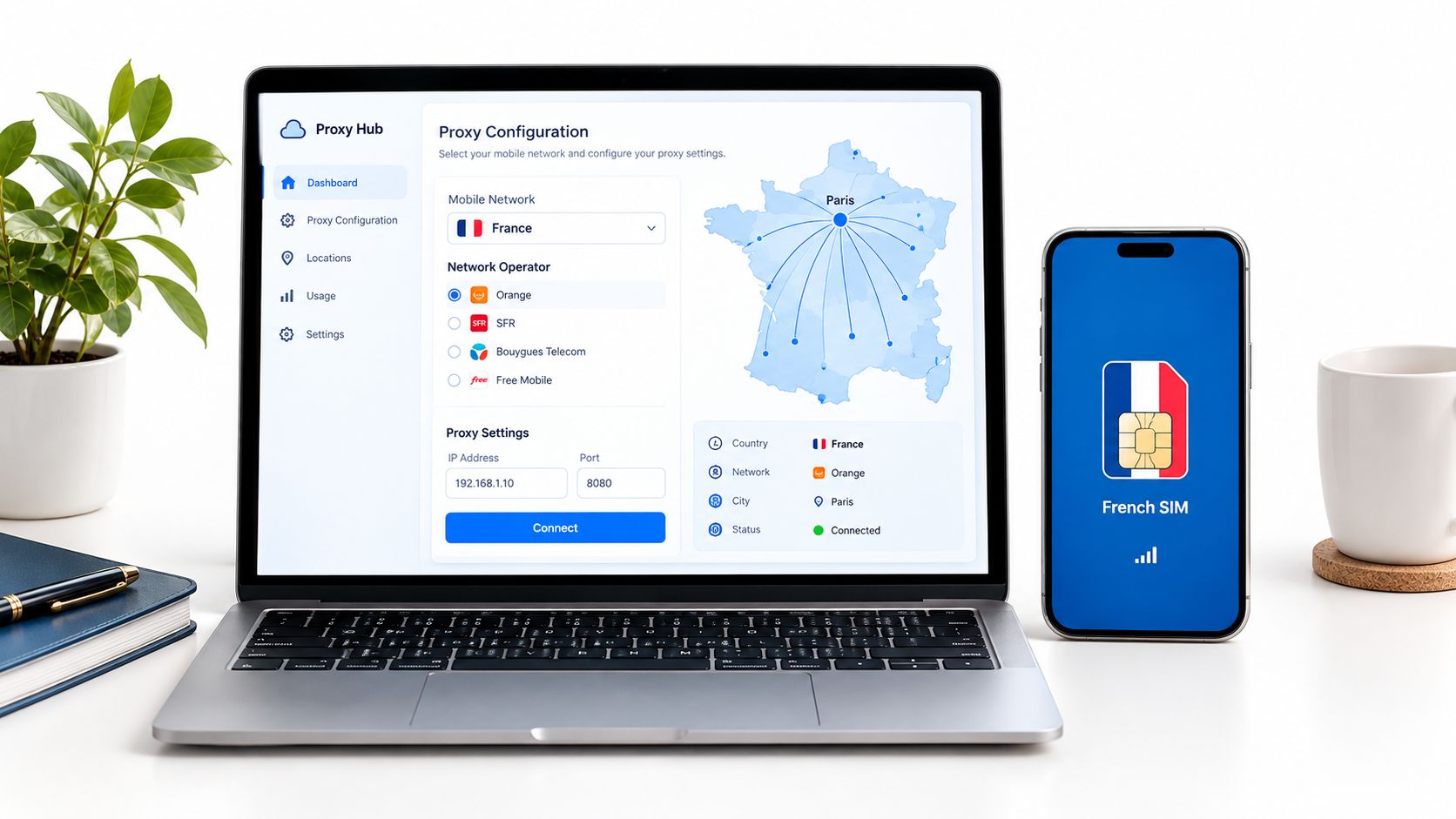
Choose the port model and session behavior
A personal port may provide dedicated mobile hardware and control over its connection. A shared port may suit short, independent tests where exclusive equipment isn't necessary. Compare actual service terms rather than assuming either label guarantees a unique public exit.
Dedicated hardware and exclusive public addressing are separate properties. Ask whether exclusivity applies to the equipment, the proxy endpoint, the visible carrier address, or some combination.
IP rotation changes the public exit used by subsequent traffic. Sticky sessions aim to retain the same exit for a defined workflow, subject to the underlying connection's behavior.
- Use rotation between independent observations: Separate public-page checks can tolerate a changed exit if each observation records its conditions.
- Keep multi-step tasks sticky: Login, checkout, and form submission should remain on a consistent connection where possible.
- Check scheduled changes: A rotation schedule shouldn't interrupt an active authenticated flow.
- Plan for reconnection: Define whether an interrupted task should stop, restart safely, or wait for operator review.
A practical test is to complete a permitted multi-step flow while monitoring the observed exit. Verify persistence empirically rather than treating “sticky” as an unconditional guarantee.
Match the protocol to the application
HTTP proxies are commonly used for web requests and can support protocol-aware handling. SOCKS5 provides a more general relay for applications that support it; the separate configuration models are documented in Mozilla's proxy settings reference.
Neither protocol changes the geographic ownership of the exit. Choose based on application compatibility and traffic-routing requirements, not a claim that one protocol is more French or more mobile.
Enter the supplied endpoint, port, and authentication details in the application that performs the work. For handset-specific setup, consult the mobile proxy configuration guide, then validate the actual application rather than a separate diagnostic browser.
Verify before running the workload
Check the observed public address through the same application path you'll use in production. Confirm its country classification and ASN, then load the actual page or permitted test flow.
Also inspect components that may use separate networking settings: API clients, background requests, name resolution, and telemetry. A proxied browser doesn't establish that every related process follows the same route.
Acceptance check: The configuration is ready when the intended application uses the intended exit and completes the permitted workflow, not merely when the proxy connection indicator turns green.
Keep credentials out of shared screenshots and logs. Record enough connection metadata to diagnose failures without retaining authentication secrets.
IPv4, IPv6, and Dual-Stack Realities in France
A French mobile network can support IPv6 while the destination remains IPv4-only. That's why “the proxy connects” and “the target is reachable” are different checks.
By 2024, IPv6 activation had reached 87% of fixed residential customers and 70% of consumer mobile customers, while only about 38% of websites and 25% of email servers were IPv6-enabled; operators projected completion of the consumer transition by 2027, according to Arcep's IPv6 transition update.
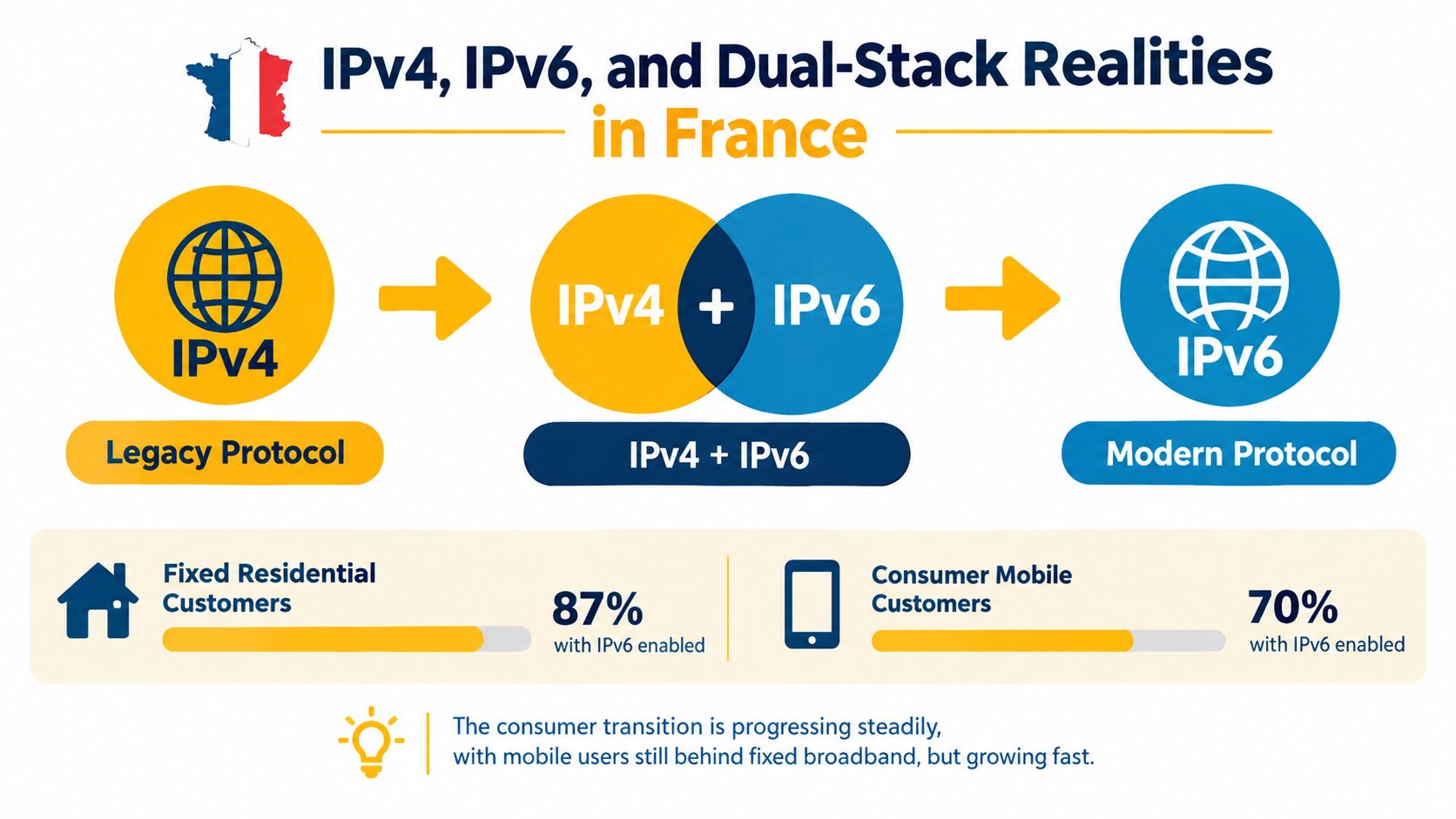
Test destination support separately
DNS A records identify IPv4 destinations, while AAAA records identify IPv6 destinations. Their presence is useful diagnostic information, but you still need to establish which address family the application uses and whether that path succeeds.
Use a controlled test routine:
- Inspect resolution: Check whether the destination offers IPv4, IPv6, or both, using your approved diagnostics.
- Confirm connection family: Record the family used by the actual application request.
- Exercise supported paths separately: Test each family where your application and proxy support it.
- Capture routing context: Retain the ASN and connection outcome alongside the family.
Don't assume that a service supporting SOCKS5 also supplies an IPv6 exit. Application protocol support, proxy capabilities, carrier capabilities, and destination reachability are separate layers.
Interpret inconsistent results correctly
Suppose a browser reaches the French landing page, but an API client fails against the same service. Before changing the proxy or attributing the failure to account risk, compare their routing and address-family behavior.
Similarly, a changed location classification may reflect a different IPv4 or IPv6 exit rather than a changed physical access point. Record which path produced each result instead of comparing location labels without connection context.
The decision framework is straightforward: choose the network type for the customer scenario, choose session behavior for the workflow, and test address-family compatibility for the destination. A French country label can't substitute for any of those checks.
For infrastructure acceptance, require successful target requests and reproducible metadata. Network-level IPv6 adoption is a reason to test both families where supported, not evidence that every French endpoint or destination already works over both.
Common Mistakes and How to Avoid Them
Treating country as identity is the most consequential mistake. A French exit doesn't establish who owns an account or whether the person using it is authorized.
Arcep's 2021 IPv6 transition barometer documents continued IPv4 scarcity among French operators. For stable identity, rely on authenticated sessions and appropriate supporting signals rather than public IP alone.
Fix the diagnosis before replacing the connection
- Address changed unexpectedly: Compare the observed IP, ASN, timestamp, and connection type. Determine whether the service rotated, the carrier connection changed, or only a location database classification changed.
- A target won't load: Inspect address-family compatibility and DNS behavior before declaring the proxy unavailable.
- The wrong city appears: Recheck the geographic tolerance and lookup provenance rather than treating a city label as physical-location proof.
- An account receives a challenge: Review authorization, session state, authentication history, and request patterns. Don't respond by cycling through exits to evade the challenge.
Keep access and permission separate
Skipping account authorization isn't a networking defect. Neither a mobile ASN nor a localized page grants permission to automate an account, collect restricted data, or ignore service terms.
For legitimate multi-account management, ad verification, QA, market research, and brand protection, retain an auditable record of the task and its authorized scope. Keep secure cookies and authentication credentials protected, and collect only the diagnostic metadata you need.
A well-configured French connection should help you reproduce customer conditions and explain results. It shouldn't be used to manufacture identities, commit fraud, or bypass platform enforcement.
For a mobile-network test, Evoproxy offers French 4G mobile proxy access with personal and shared ports and configurable rotation. Try it for an authorized ad-verification, localization QA, or account-management workflow, and validate the exit ASN, session persistence, and destination compatibility before expanding your use.