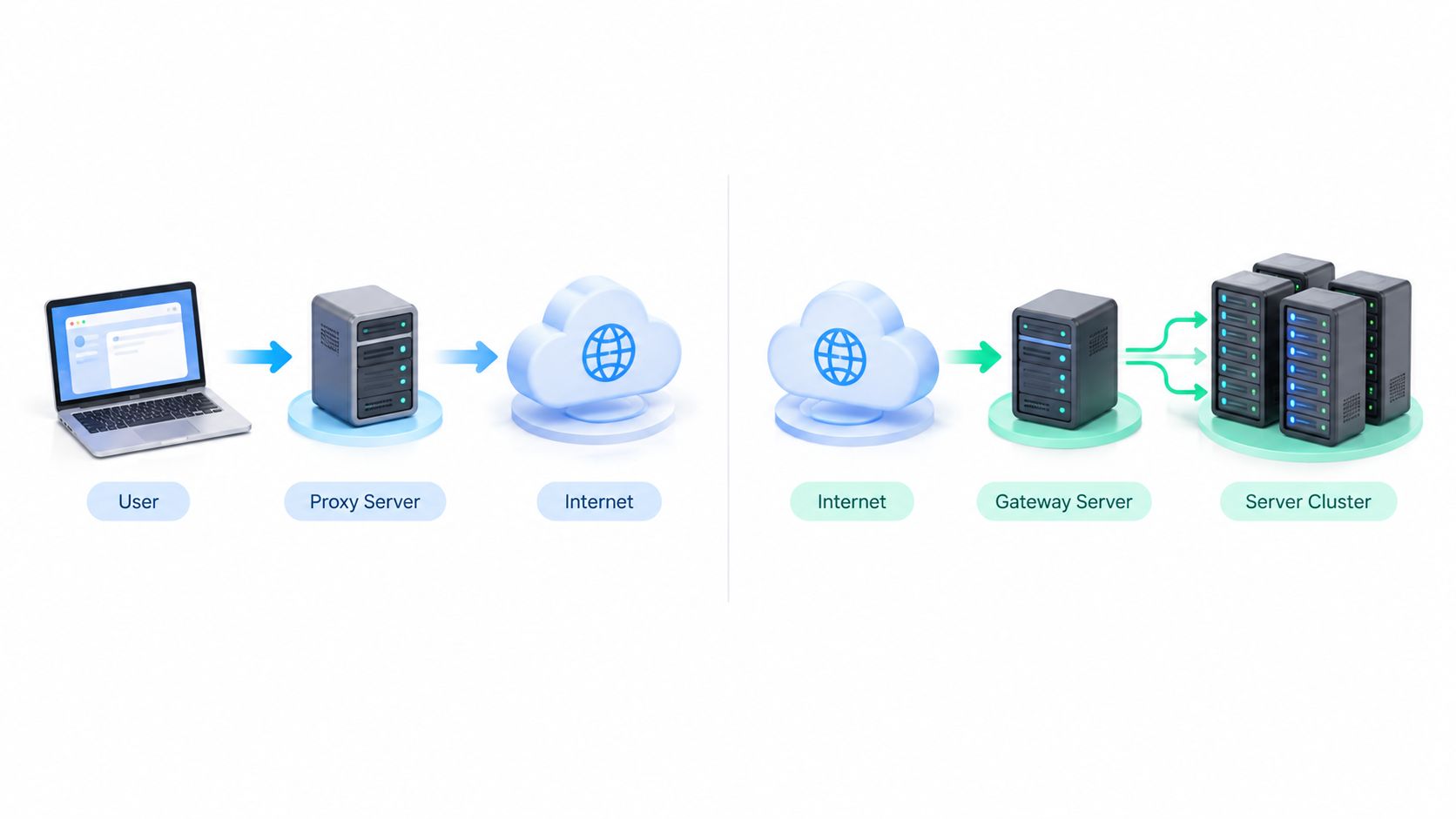
The most popular advice about residential vs mobile proxy selection is too simple: use residential for ordinary browsing and mobile whenever you need “more trust.” That shortcut ignores the network architecture behind the address, the way DNS and browser behavior expose inconsistencies, and the provenance of the IP pool itself.
Residential and mobile proxies both represent access networks rather than hosting infrastructure, but they model different users. A residential connection is closer to a fixed household or office broadband session. A mobile connection represents traffic from a cellular carrier, often with many subscribers sharing the same public address. Neither category guarantees acceptance, privacy, or ethical sourcing.
The practical choice depends on the user environment you need to test, the session behavior your workflow requires, and the evidence you collect when something fails. Fixed-location SEO monitoring, broad crawling, mobile ad verification, account workflows, and geo-dependent QA can all require different pools.
| Decision factor | Residential proxy | Mobile proxy |
|---|---|---|
| Network origin | Fixed broadband ISP | Cellular carrier network, commonly 4G or 5G |
| Address behavior | More closely tied to a household or office access line | Often shared through carrier-grade NAT |
| City-level targeting | Usually more precise | Can exit through a regional carrier gateway |
| Throughput and stability | Generally stronger for sustained workloads | More variable because of radio and carrier routing |
| Carrier identity | Absent | Present through the mobile ASN |
| Best fit | Local SEO, price monitoring, broad crawling, fixed-location QA | Mobile-first QA, social account management, mobile ad verification |
| Main operational risk | Unclear consent or residential IP provenance | Shared reputation, congestion, and less precise location |
Network Architecture and IP Allocation
The useful distinction is architectural, not reputational. Where the public IP comes from determines how traffic is routed, how an ASN identifies it, and how precisely an IP database can locate it.
Residential proxies use addresses assigned by fixed-line ISPs to household or office connections. Those addresses usually belong to a defined access network and often map more closely to a physical area. That makes residential routing suitable for city-specific search checks, store-locator validation, and local commerce research. For additional technical context, see this residential proxy network reference.
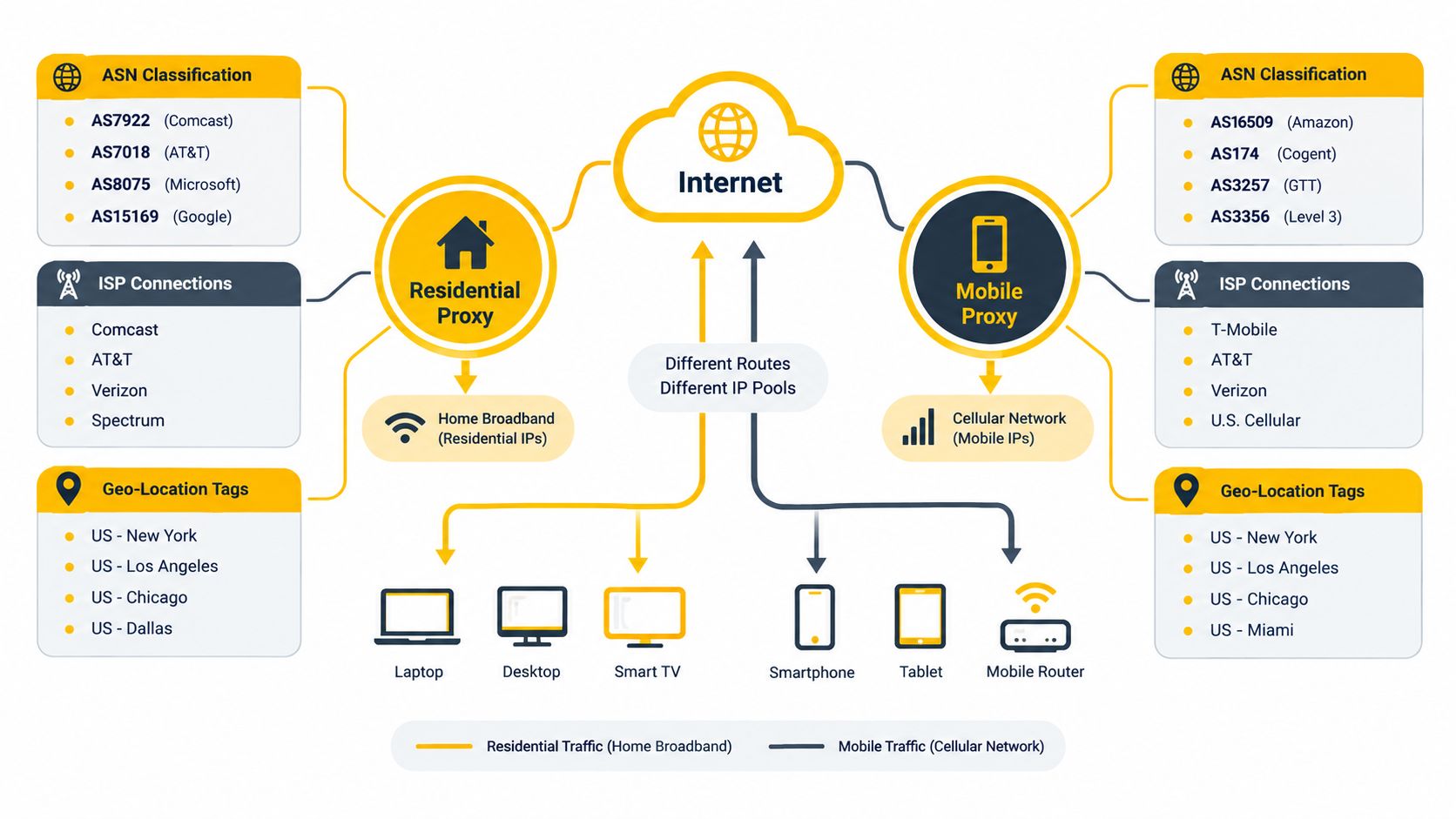
Mobile proxies use addresses advertised through cellular networks. Carriers commonly place subscribers behind carrier-grade NAT, or CGNAT, allowing multiple private subscribers to share public IPv4 space. IETF RFC 6888 describes CGN as an ISP-operated function subject to address-pooling requirements. Shared IPv4 addressing also means a public IP should not be treated as a one-to-one identifier for a person or device.
Why ASN matters
An autonomous system number, or ASN, identifies a network operating under a common routing policy. In proxy analysis, the ASN and its registered organization help distinguish fixed broadband, cellular, and hosting networks. IETF guidance on ASN-based network identity is useful because an IP lookup alone can hide the ownership and routing context behind an address.
A residential address generally presents an access-ISP signal associated with fixed connectivity. A mobile address presents a carrier signal that may align more closely with smartphone-origin traffic. Datacenter addresses typically show hosting or cloud ownership. A system that only checks whether an IP is absent from a known cloud range can therefore misclassify traffic.
ASN data also improves interpretation of geolocation. Residential IPs are usually better when a test must represent a specific city. Mobile traffic may exit through a carrier gateway elsewhere in the region, even when the device is nearby. The IP database can consequently report a broad location that does not match the handset's precise position.
Operational rule: Record the IP, ASN, organization, country, and timestamp as a network identity record. Do not treat that record as proof of a user's exact physical location.
Device-origin traffic provides useful context, with one limitation. Mobile devices generated about 3% of global website visits in 2010, reached approximately 50% in 2017, and accounted for roughly 58.5% in 2025, according to the Statista summary of StatCounter data. These figures describe traffic from mobile devices, not necessarily cellular networks, because a phone may connect through Wi-Fi. They show that mobile browsing is a familiar user pattern, so carrier-origin signals deserve separate analysis from fixed broadband signals.
Detection Risk and Sourcing Transparency
A residential IP isn't automatically safer, cleaner, or more ethical than a mobile IP. That assumption survives because both can resemble consumer traffic, but modern detection systems evaluate much more than the address. They can compare request rates, TLS and browser fingerprints, cookies, login history, navigation sequences, and behavioral consistency.
Residential pools also create a sourcing problem that trust-score comparisons often omit. DataDome's analysis of residential proxy sourcing reports that only 16% of websites can detect bots using residential proxies, leaving 84% exposed to traffic routed through residential connections. Separately, hCaptcha's analysis of millions of requests estimated that, on some days, 30% to 95% of requests through residential proxy services were blackhat or greyhat activity. That estimate describes observed proxy-service traffic, not every residential provider or customer, but it demonstrates why category labels aren't enough.
Verify the pool, not just the label
Before assigning a pool to account management, ad verification, or QA, ask how the addresses entered the network. A responsible procurement review should cover:
- Consent documentation: Confirm that device or household participation is explicit, understandable, and revocable.
- Abuse response: Check whether the operator investigates complaints, removes compromised endpoints, and publishes a contact path.
- IP history: Review whether addresses show abrupt reputation changes, repeated abuse, or suspicious short-lived activity.
- Use-case restrictions: Make sure the provider permits your authorized research, testing, and account workflows.
- Data handling: Understand what metadata is collected and how session records are retained.
Mobile networks have a different privacy characteristic. CGNAT can place many unrelated subscribers behind one public IPv4 address, making individual attribution difficult. That same sharing can create false positives, because a rate limit or block triggered by one subscriber may affect other users using the address at another time.
This isn't a reason to treat mobile IPs as automatically legitimate. A carrier ASN can still carry abusive traffic, and a mobile proxy can still conflict with a destination platform's rules. It is a reason to evaluate concentration and provenance alongside reputation. The more useful question is whether the network behaves like the authorized user environment and whether the provider can explain how it obtained access.
Governance check: If a provider can't explain consent, abuse handling, and IP history, a high-trust label doesn't make the pool suitable for sensitive work.
A recent analysis reported that 78% of malicious sessions using residential IPs evaded reputation feeds, while 89.7% of malicious residential IPs were active for less than one month before rotating out. Those findings, summarized in this analysis of residential and mobile proxy risk, reinforce a practical point: IP reputation alone is a weak selection metric. For a broader discussion of responsible proxy use, teams can review this proxy transparency and detection guide, while still applying their own authorization and compliance controls.
Performance Metrics and Protocol Behavior
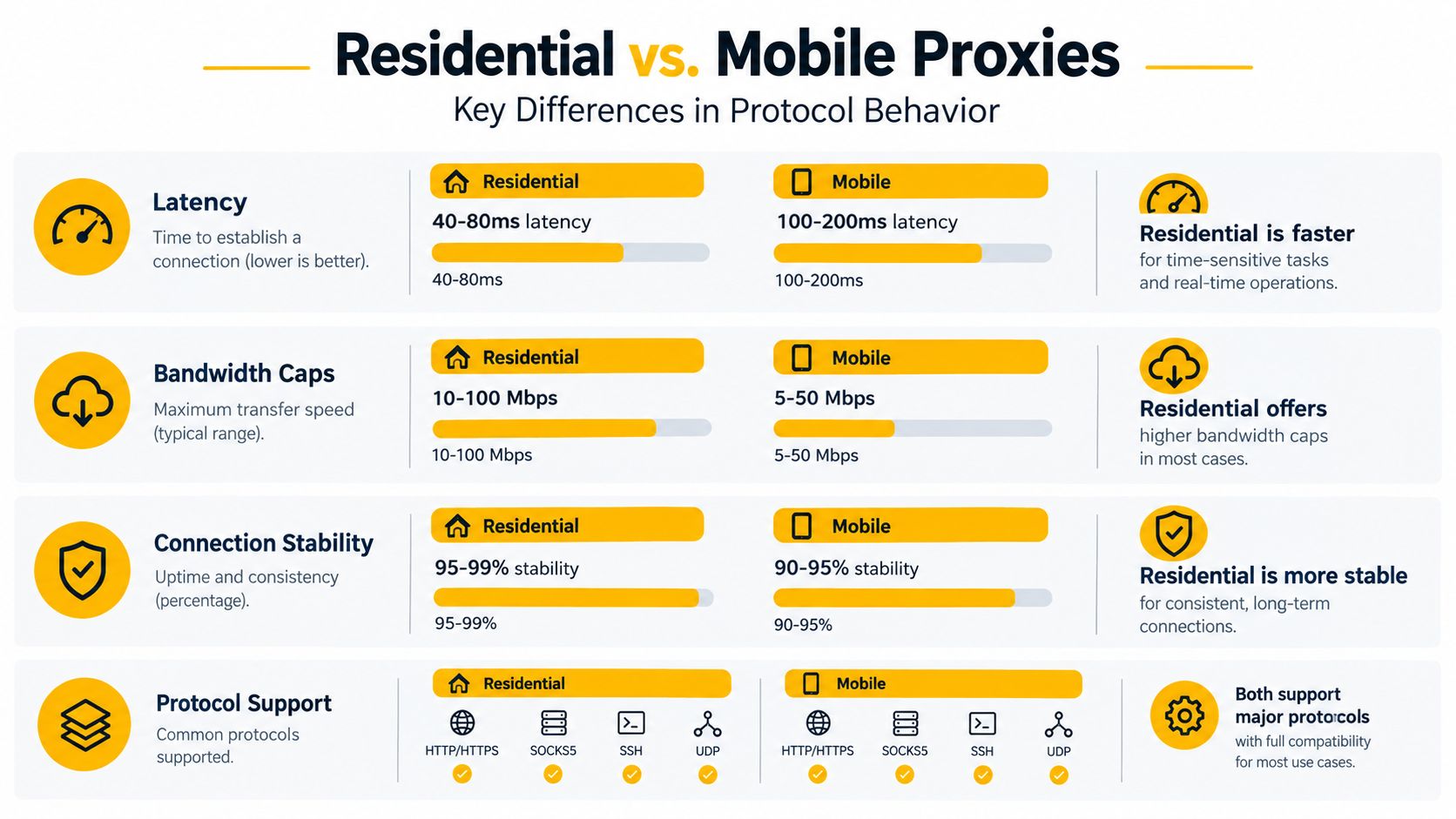
Residential connections generally win on predictable throughput and session stability. Fixed broadband avoids the radio segment used by cellular networks, while mobile traffic can experience additional delay from radio access, carrier routing, CGNAT, and gateway selection. Tower congestion and changing signal conditions can also make mobile latency fluctuate during a session.
One published comparison reports typical residential latency of roughly 30 to 120 milliseconds, compared with approximately 80 to 300 milliseconds for mobile proxies, as described in this proxy performance comparison. The same source reports workload-dependent residential rotating throughput around 3 to 8 Mbps, versus approximately 4 to 12 Mbps for 4G/LTE mobile proxies. These aren't universal limits. Provider design, target distance, concurrency, and payload size can change the result.
HTTP and SOCKS5 are configuration choices
HTTP proxies are designed for HTTP or HTTPS web traffic. SOCKS5 operates at a lower level and can relay a broader range of application traffic. The protocol doesn't determine whether a proxy is residential or mobile, and SOCKS5 isn't a proxy quality grade.
DNS behavior is where teams often create an avoidable mismatch. Mozilla's HTTP and proxy documentation distinguishes HTTP and SOCKS mechanisms and documents SOCKS5 DNS proxying behavior. If the connection travels through a French mobile endpoint while the client resolves domains through a local resolver, the destination can observe conflicting geography.
For reproducible regional QA, record:
- The proxy protocol and authentication method.
- Whether DNS requests resolve through the proxy.
- The endpoint's observed IP, ASN, and organization.
- The browser or application environment used for the test.
- The session and rotation policy.
Measure p50 and p95 latency, connection success rate, bytes transferred per session, and retry frequency from the target geography. A speed test that only records a best-case response can hide the tail latency that makes authenticated workflows unreliable. Use this proxy speed testing reference when designing a repeatable benchmark.
Use Cases and Situational Fit
The right proxy models the user environment behind the business question. A proxy pool that works well for local search monitoring can be the wrong choice for mobile application QA, even when both tasks require the same country.
Fixed-location research favors residential
Residential proxies are usually the better fit for local SEO monitoring, store-locator checks, and price research where city-level accuracy matters. A fixed broadband access network gives the test a clearer relationship to a local market than a mobile carrier gateway may provide. It also supports high-volume crawling more consistently when the job involves parallel page downloads, large response bodies, or repeated API requests.
For example, a retail team checking regional product availability might need to compare page language, currency, inventory messaging, and delivery options from several cities. Residential routing can represent those fixed locations more precisely, but the team should validate the rendered page rather than trust the IP database alone.
Carrier-origin workflows favor mobile
Mobile proxies fit tasks where the expected user environment is cellular. That includes mobile-first application QA, mobile ad delivery verification, and testing experiences that change by carrier or device context. A carrier ASN supplies a network identity that fixed broadband cannot reproduce.
Social media managers working on authorized brand accounts may also prefer mobile routing when the account workflow is designed around smartphone-origin access. The important control is session consistency. A stable mobile session with coherent browser, device, cookie, and login behavior is more useful than aggressive rotation that changes the network identity during an authenticated workflow.
Match the test to the delivery surface
Ad verification needs a precise distinction between desktop and mobile delivery. Residential routing can support desktop-oriented checks across local markets. Mobile routing is more appropriate when the campaign targets cellular users or when the QA team needs to validate a mobile creative and its landing flow.
Brand-protection and market-research teams should separate observation from interaction. Public price monitoring may need residential scale and stable geography. Authorized testing of a mobile checkout flow may need a carrier endpoint, a matching device profile, and a clearly documented test account.
Neither pool should be used to bypass access controls, exceed account limits, or violate platform policies. Authorization, rate limits, robots directives where applicable, and privacy requirements remain part of the technical design.
Decision Framework and Selection Criteria
Don't choose from a trust label. Choose from the workload variables that determine failure, cost, and evidence quality.
Proxy Selection Decision Matrix
| Workload Variable | Residential Proxy Fit | Mobile Proxy Fit |
|---|---|---|
| Requests per session | Strong for repeated page retrieval and broad crawling | Better when each request must resemble cellular-origin access |
| Concurrent accounts | Suitable when fixed ISP identity and controlled sessions are required | Suitable for authorized mobile workflows with carefully separated sessions |
| Session duration | Often more predictable for long downloads and persistent browsing | Useful when the target expects a carrier session, but monitor gateway changes |
| Rotation frequency | Flexible for distributed research and location checks | Useful for fresh carrier paths, but excessive rotation can disrupt authentication |
| ASN consistency | Favors fixed broadband geography | Favors carrier-network identity and mobile delivery validation |
| City precision | Usually the stronger option | Validate the actual destination experience because carrier exits can be regional |
| Bandwidth demand | Better for sustained transfers and parallel crawling | Reserve for tasks where carrier context matters more than throughput |
| Detection signals | Consumer broadband appearance, still subject to behavioral analysis | Cellular carrier appearance, still subject to shared reputation and fingerprint checks |
| Privacy and provenance | Require clear consent and abuse controls | Require carrier access transparency and controls for shared-address effects |
Start with the target environment. If the user you're modeling sits at home or in an office, residential routing is the closer baseline. If the user accesses the service through a smartphone or cellular application, mobile routing is more representative.
Then define session mechanics. Write down the expected number of requests, concurrent accounts, session duration, rotation interval, bandwidth per session, and required country or city coverage. These variables expose weak vendor claims quickly because they turn “high trust” into testable behavior.
Finally, benchmark both candidates against the authorized target. Track login success, challenge frequency, page completeness, ad rendering, API response geography, and recovery time after failure. A mobile pool is justified when its carrier signal solves a real problem. Residential is preferable when it delivers the required geography and consistency without adding unnecessary network variability.
Implementation and Validation Best Practices
Production reliability comes from matching session state, protocol behavior, and browser identity. Rotation by itself doesn't make a workflow safer. In an authenticated process, changing the IP while retaining the same cookies, device profile, and login history can create a stronger inconsistency than using a stable endpoint.
Configure sessions deliberately
Use sticky sessions for authenticated requests, account settings, checkout QA, and any flow that depends on continuity. A sticky session keeps related requests on the same proxy route for a defined period. Rotation is more useful for independent public-data requests, where each task can start cleanly without carrying authentication state.
Align the client with the network type. A mobile endpoint paired with a desktop-only browser signature, inconsistent timezone, conflicting locale, or mismatched device behavior creates a diagnostic problem. This doesn't mean fabricating a user identity. It means ensuring that an authorized test faithfully represents the device and connection being evaluated.
Set rotation based on the task rather than a generic timer:
- Authenticated workflows: Keep the route stable until the transaction or test case ends.
- Public-page monitoring: Rotate between independent checks when geographic sampling requires it.
- Ad verification: Preserve the route long enough to load the page, creative, redirect, and measurement response.
- Failure recovery: Change one variable at a time so the team can identify whether the issue is network, protocol, client, or target behavior.
Validate the observed route
Before scaling, make a baseline request and capture the observed IP, ASN, organization, country, and timestamp. Compare those fields with the expected target geography, then inspect the actual response for language, currency, consent behavior, product availability, advertising, and region-specific API output.
A successful IP lookup isn't enough. Carrier routing can produce a regional exit, and geo databases can disagree. For French testing, for example, verify that the page experience and advertising response match the intended French scenario instead of assuming that a French carrier ASN proves city-level accuracy.
Keep an evidence record for each test run. Include protocol, DNS mode, endpoint identifier, session identifier, browser context, response status, challenge outcome, and retry count. That record helps separate a blocked IP from a fingerprint mismatch or a target-side outage.
Validation habit: Test endpoint responses before increasing concurrency. Scaling an unverified route multiplies ambiguity, not reliability.
Apply authorization controls at the application layer. Respect account ownership, platform limits, robots directives where applicable, privacy obligations, and the destination's terms. Proxies can provide network diversity for legitimate testing and measurement, but they don't authorize access that the team otherwise lacks.
Strategic Recommendations for High-Trust Networks
The strongest strategy assigns each proxy type a defined job and controls the boundary between them.
Use residential pools for workloads requiring fixed-location accuracy, broad geographic sampling, sustained downloads, and stable broadband behavior. Local SEO, price monitoring, store-locator validation, and large public-data collections often benefit from that consistency. Keep the geography honest by validating the delivered page and recording the ASN instead of relying only on a location selector.
Use mobile pools when carrier identity is part of the test. Mobile ad verification, smartphone application QA, authorized social account workflows, and carrier-dependent user journeys are stronger candidates. As established in the network-architecture section, mobile browsing is a mainstream pattern, so cellular behavior belongs in first-class testing rather than as an edge case.
Mobile broadband traffic was projected to reach 1.5 zettabytes in 2025, after exceeding 1 zettabyte in 2023, while fixed broadband traffic was projected at 7.3 zettabytes in 2025, according to the International Telecommunication Union's traffic outlook. The same source reported average annual mobile broadband growth of 19% since 2021, compared with 16% for fixed broadband. Fixed networks still carry substantially more data, while mobile access is growing faster. Both proxy classes therefore remain operationally important, but for different reasons.
For European teams, a region-specific cellular pool can help when the workflow targets that market. French 4G/LTE routing, for example, can support validation of French mobile advertising, localized application flows, and authorized social workflows, provided the page, carrier, DNS, and browser signals agree.
Governance should be consistent across both categories: document consent, disclose sourcing, control sessions, record reproducible measurements, and respect destination policies. Start with a small workload. Compare failure modes rather than marketing scores, then reserve mobile capacity for tasks where carrier behavior changes the result.
Evoproxy provides residential and 4G/5G mobile proxy access through the same account, with France-based mobile connectivity, personal and shared ports, and configurable rotation for authorized social management, advertising checks, market research, and geo-dependent QA. Workflows that require a carrier network should be assessed against their session and geography requirements through Evoproxy.