Vendor rankings sell Instagram proxies on two numbers: pool size and rotation speed. Those numbers answer the wrong question.
Selecting an endpoint for Instagram is a traffic-engineering decision. The variable that determines whether a setup holds up is whether the network identity stays consistent with the task running on it, because enforcement analysis describes Instagram's detection drawing on signals beyond the network address (technical analysis of Instagram's enforcement signals). Instagram's Terms of Use also prohibit creating accounts or accessing or collecting information through unauthorized automated means, including activity performed while logged in (Instagram's Terms of Use). A proxy can improve network consistency, but permission is set by the platform, not the endpoint.
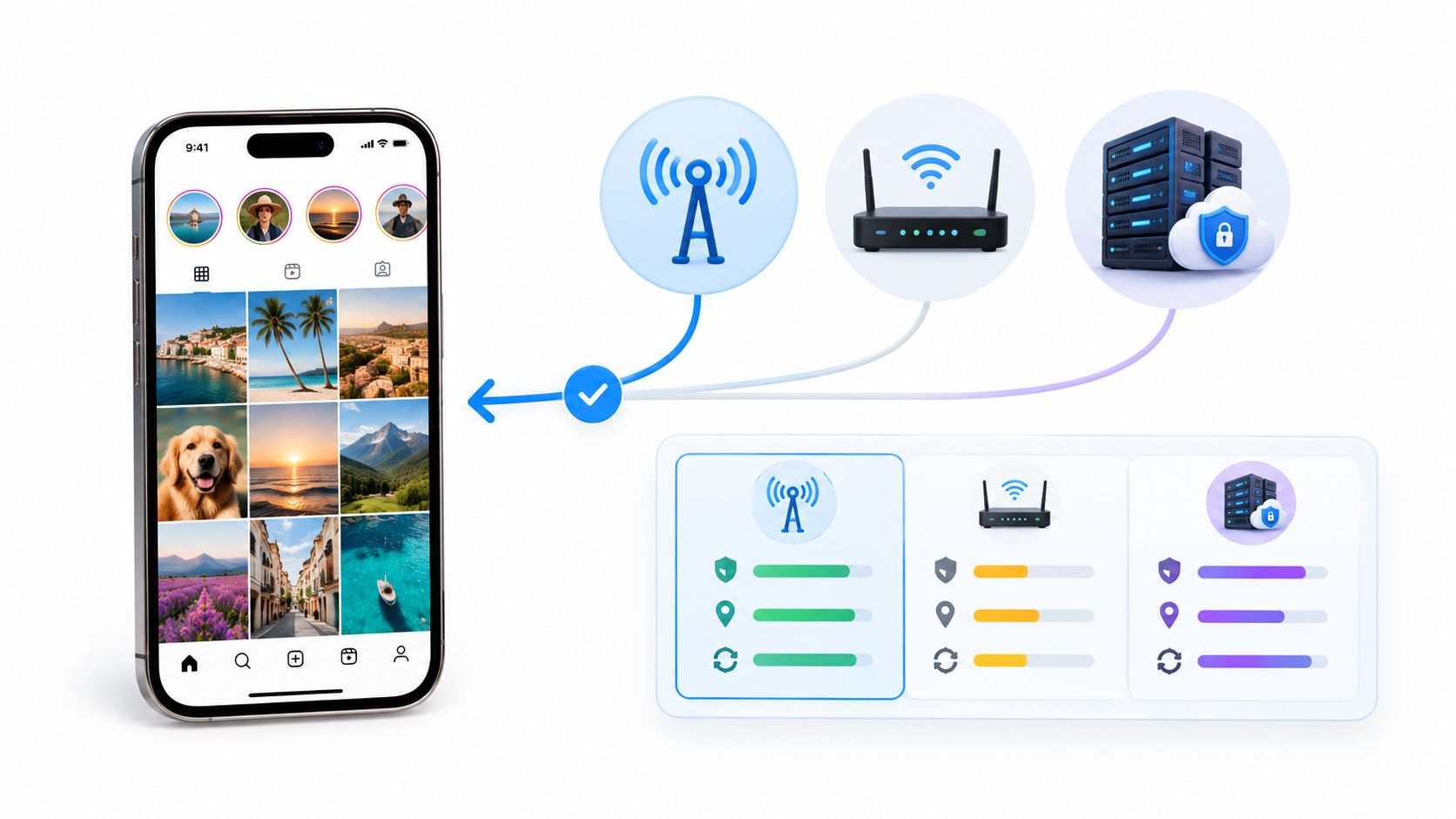
For business teams, a sound evaluation starts with the workload: does the setup support a permitted task with consistent geography, appropriate session persistence, and controlled access? Three proxy categories produce different answers.
| Proxy type | Typical network identity | Rotation approach | Suitable Instagram work |
|---|---|---|---|
| Mobile 4G/5G | Cellular carrier address, potentially shared through carrier-grade NAT | Stable session or controlled rotation | Authorized account workflows and regional checks that need a mobile connection |
| Residential | Home ISP address | Sticky or rotating, depending on the service | Market research and location-dependent browsing |
| Datacenter | Hosting or server network | Usually easy to rotate | Internal testing and non-sensitive, speed-oriented tasks |
A mobile connection that holds one carrier address through a logged-in session often outperforms a larger rotating pool, since every rotation resets the network identity an account workflow depends on. Rotation earns its place in discrete regional checks, where each request can carry a fresh identity. The use cases covered here are authorized social media management, market research, ad verification, price and SEO monitoring, brand protection, privacy, and QA testing.
Why Most Best Instagram Proxy Lists Get It Wrong
Ranked lists tend to compare what is easy to advertise: pool size, response time, rotation frequency. Those numbers describe inventory rather than fit. A large pool helps distributed location checks, yet it says nothing about whether a logged-in session will hold the same network identity for the duration of a task. High rotation frequency can even work against an account workflow, since every exit change alters the context a service observes mid-session.
The enforcement signals described earlier are why network consistency belongs in the evaluation criteria. A well-chosen proxy gives a task a stable, plausible exit address. It cannot make unauthorized collection or repetitive account activity acceptable, and no IP type changes that.
Practical rule: Choose an endpoint to fit the task, then keep the rest of the workflow consistent with that choice.
Treat compliance as a selection criterion
Before comparing proxy types, decide whether the task is permitted and whether an authorized interface can perform it. For account management and business workflows, prefer approved interfaces such as Business Login and OAuth-based tools where they support the task. If an action requires a person, a proxy does not turn it into an appropriate automated action.
Then make the provider answer a short diagnostic. For each candidate endpoint, record the expected country, ASN, session duration, and permitted task. Reject any plan that cannot state when the exit will change. A provider that can specify these values is selling a controlled connection. One that only cites pool size is selling inventory.
Rotation is a tool with a correct use, not an automatic advantage. A stable mobile exit held for the length of a session often serves logged-in account work better than frequent rotation, because the address stays consistent while still reading as ordinary carrier traffic. A series of discrete regional checks has the opposite requirement: controlled rotation between tests keeps each measurement independent. The right setting follows the task's session requirements, and that requirement should be written down before any provider is shortlisted.
Workload still sets the priorities. Agencies managing authorized client profiles typically weight predictable location and session behavior over throughput. Research teams care more about geographic coverage and controlled access. Ad verification and QA teams need to reproduce a regional experience without changing test conditions mid-run.
Mobile, Residential, and Datacenter Proxies Explained
A proxy sits between an application and the network destination, forwarding traffic through an exit address. The visible address, its network owner, and how long it stays consistent all affect the context a service can observe. Those are separate properties, so a proxy's type alone doesn't guarantee trust or successful access.
Start with the network behind the address
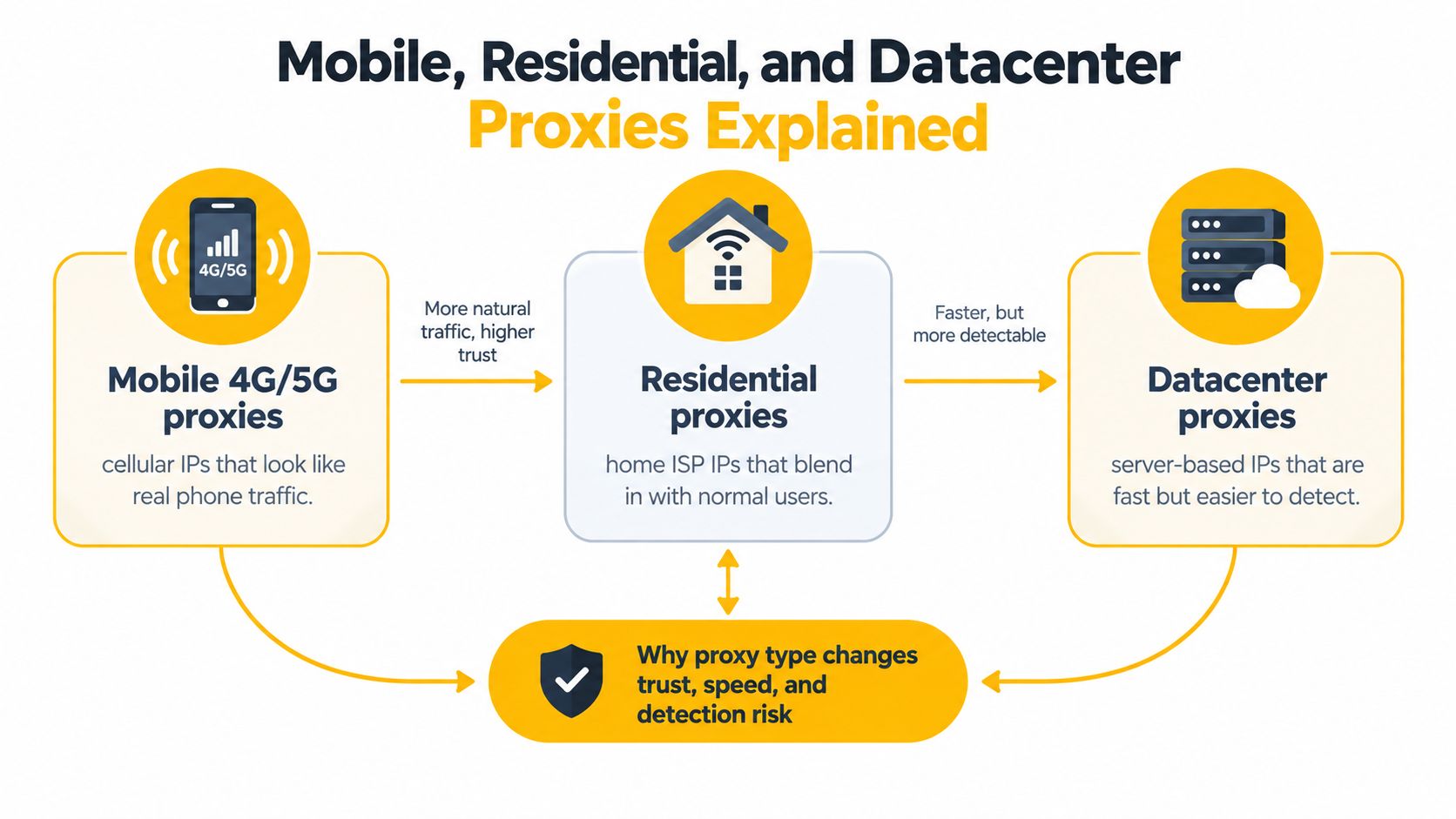
Mobile proxies route traffic through cellular networks, including 4G and 5G. Mobile networks often use carrier-grade NAT, or CGNAT, an ISP-level system that lets multiple subscribers share a public IPv4 address. The standards reserve a shared address range for service-provider networks and describe how carrier-grade NAT can mean subscribers don't receive unique public IPv4 addresses (RFC 6598 on shared address space). That shared-carrier context can make a mobile exit look like ordinary carrier traffic, but it also means an address's reputation may reflect activity from many users. Mobile IPs aren't automatically undetectable or immune to restrictions.
Residential proxies use addresses associated with home internet providers. They can suit research or region-specific browsing when a residential network context matters. Datacenter proxies use hosting infrastructure. They can be efficient for suitable internal or non-sensitive tasks, but a server-origin address has a different network identity from a household or cellular connection.
An ASN, or autonomous system number, identifies a network operator's routing domain. Checking the ASN can help confirm whether an exit is associated with a mobile carrier, consumer ISP, or hosting network. It's one useful signal, not a guarantee about how a platform will treat a session.
For a deeper explanation of the trade-offs, see residential versus mobile proxy characteristics.
Match rotation to the session
IP rotation changes the exit address according to a schedule or request. A sticky session keeps the same exit for a defined workflow. Account work and tests that depend on continuity usually call for a stable session; short-lived checks across locations may benefit from controlled rotation. Rotating on every request can break authentication, invalidate cookies, or make a test inconsistent.
HTTP proxies are commonly used to relay web requests. SOCKS5, defined as a proxy protocol in RFC 1928, can relay TCP and selected UDP traffic and supports domain-name and IPv6 addressing. Neither protocol is an anonymity or trust guarantee. The exit network, authentication, logging practices, and application setup still matter.
CGNAT can also involve port allocation and timing, not just a public IP address. Standards discuss deterministic mapping methods for carrier-grade NAT (RFC 7422 on address mapping). For a workflow that needs continuity, keeping a stable exit during the session is usually more useful than switching addresses without a task-based reason.
How to Evaluate an Instagram Proxy Provider
Start by writing down the task, the account or test environment involved, and the region that should appear to the service. Then compare providers against that requirement. A pool with broad coverage may help with location checks, while a stable endpoint may matter more for a logged-in workflow. Neither feature replaces permission to perform the underlying action.
Instagram's advertising tools indicated a potential global reach of approximately 1.74 billion users in January 2025, including approximately 414 million reachable users in India, 172 million in the United States, and 141 million in Brazil, according to DataReportal's Instagram audience analysis. These figures describe advertising reach, not a census of monthly active users. For regional validation, they illustrate why teams may need to test specific markets rather than rely on a generic location.
Score fit, not marketing language
Compare a provider on IP type and origin, rotation control, sticky-session support, country and ASN coverage, HTTP and SOCKS5 support, pricing structure, and fit with authorized interfaces. For account workflows, check whether the service can preserve a consistent region and session. For a location check, confirm it can provide the target market without rotating mid-test.
| Proxy type | Detection resistance | Rotation control | Best Instagram use case |
|---|---|---|---|
| Mobile | Carrier context may suit mobile-network testing, but doesn't guarantee acceptance | Stable connection or controlled rotation | Authorized workflows that need a mobile exit or regional validation |
| Residential | Home-ISP context suits residential browsing, with quality depending on the network and endpoint | Sticky sessions or rotation, depending on the plan | Market research and location-dependent browsing |
| Datacenter | Server-origin network may be unsuitable for sensitive account sessions | Often suited to predictable, technically controlled rotation | Internal testing and non-sensitive, speed-focused tasks |
Measure the connection under your own conditions
Ask for enough configuration detail to understand how rotation works and whether sessions can persist. Then measure median and p95 latency, successful login rate where login is authorized, session persistence, HTTP error rate, and IP-change frequency. Median latency describes typical response time; p95 helps reveal slower experiences that a typical value can hide.
Test the intended country and ASN rather than assuming a provider's location label tells the whole story. Keep the account's normal operating region, login history, and campaign target aligned. Avoid treating the biggest IP pool or the lowest advertised latency as a proxy for operational suitability. A small, well-controlled pool may serve a stable workflow better than a large pool that changes identity unpredictably.
Finally, examine how the proxy setup works with the approved application flow. A reliable network is only useful if the team can authenticate and act through a permitted interface, with account permissions and session behavior managed consistently.
A Focused Evoproxy Assessment for French Mobile Connectivity
Verified product details support a close look at one mobile option rather than a ranking across providers. For any other candidate, run the checklist at the end of this section against current documentation and your own pilot results before trusting published feature or pricing claims.
Evoproxy for French mobile connectivity
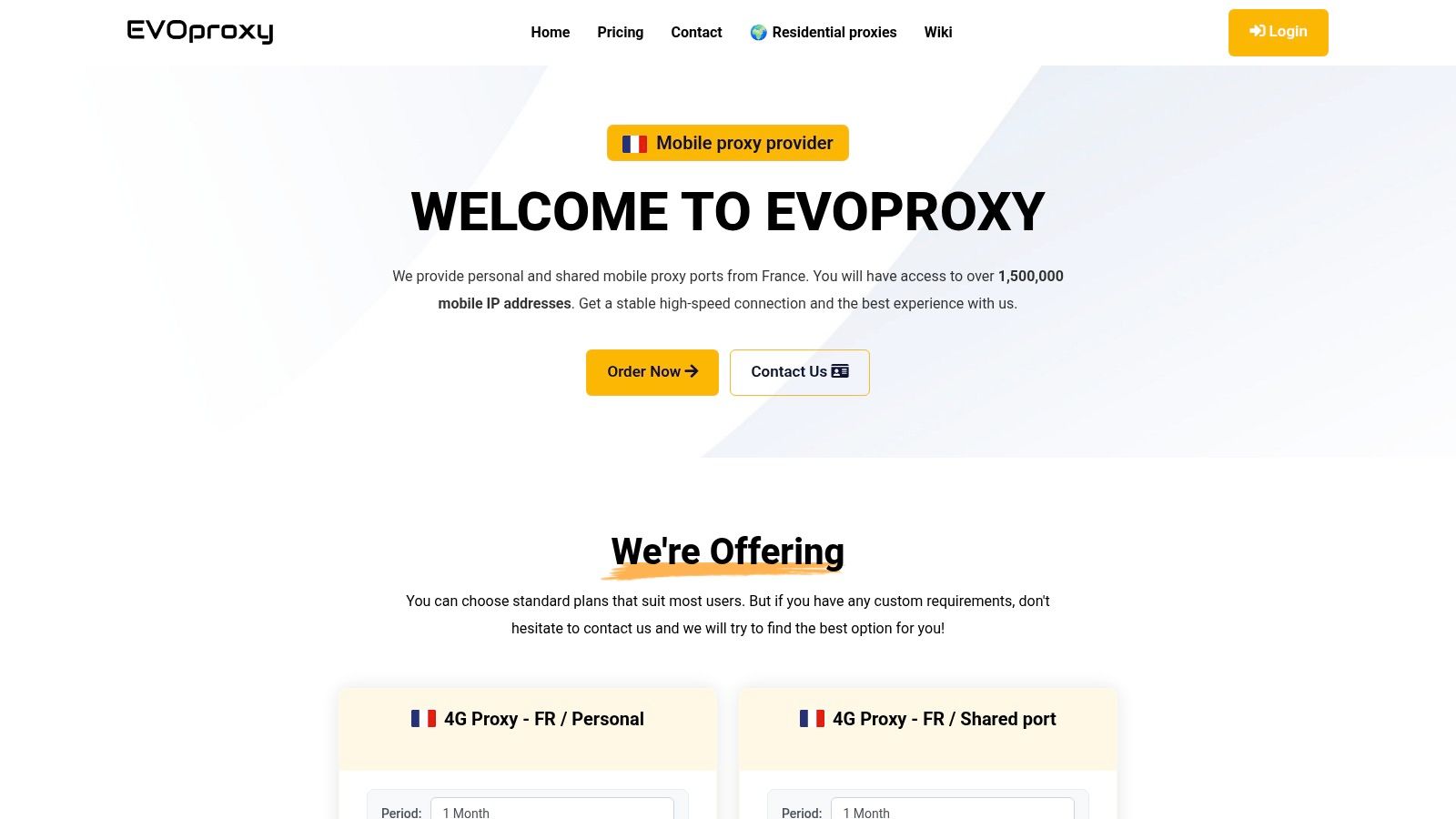
Evoproxy provides 4G/LTE/3G mobile connectivity from France, drawing on a pool of more than 1,500,000 mobile IP addresses. Two port types split the offer. Personal plans run on dedicated mobile hardware with unique IPs and 250 GB of monthly traffic. Shared ports carry 50 GB of traffic with scheduled rotation. Setup is described as taking about five minutes, with throughput up to 50 Mbps.
Rotation can be set at intervals between one and five minutes or triggered through on-demand links. Treat that range as a tuning option, not a default. On a shared port, frequent rotation suits short sampling tasks where each request can carry a different identity. A personal port, with dedicated hardware and a unique IP, is the configuration that supports a persistent session: the identity stays fixed while trust signals accumulate on a single endpoint.
The service advertises an IP trust score of 100% and states that it does not block websites. Read both as provider claims, since no trust metric issued by a seller predicts Instagram access, account safety, or policy compliance. The reliable test is a controlled pilot that holds market and session behavior constant while results are measured.
Verdict: A reasonable candidate when the workflow calls for a French mobile endpoint. Pick the port type around session requirements first, then verify performance in your own environment.
How to assess any other option
For residential, datacenter, or other mobile services, request the details that determine fit: where exits originate, how long a session can persist, whether rotation is configurable, what geographic targeting exists, and how usage is billed. Ask how the provider documents endpoint reuse and how it handles connection or authentication failures.
Useful infrastructure does not translate into suitability for every Instagram workflow. Enforcement weighs behavior, login method, device associations, IP reputation, and links among accounts, as noted earlier. That is why a stable ASN and geography, limited endpoint reuse, clean authentication history, and predictable sessions carry more weight in a buying decision than headline claims about speed or anonymity.
Matching Proxy Type to Your Instagram Use Case
The simplest way to choose a proxy is to identify whether the task needs identity continuity or location sampling. Managing an authorized account is a continuity problem. Checking how an experience appears in multiple regions is a sampling problem. Applying the same rotation setting to both creates unnecessary operational risk.
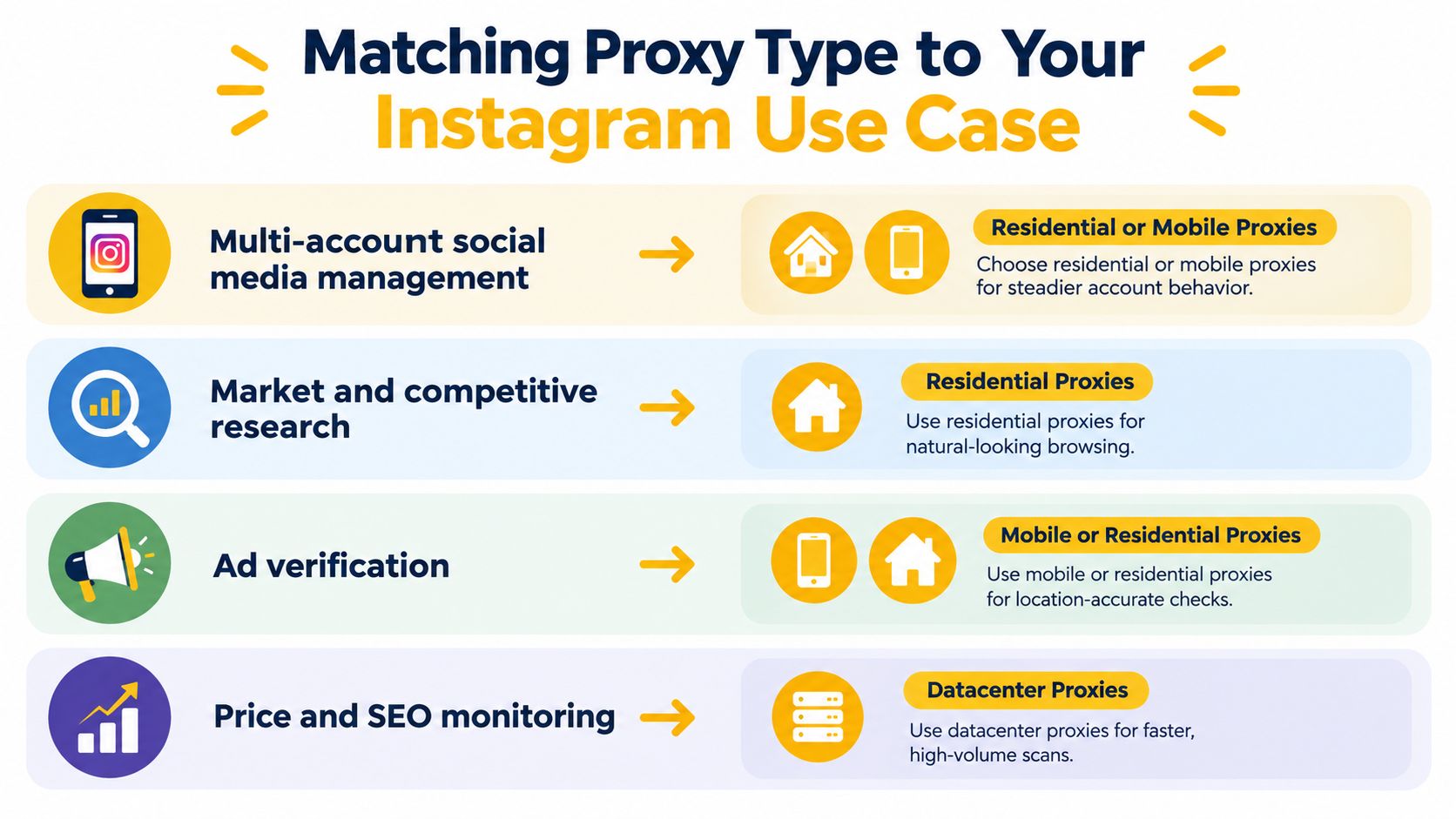
| Workload | Starting proxy choice | Rotation setting | Session behavior |
|---|---|---|---|
| Authorized multi-account management | Dedicated mobile or residential endpoint | Keep stable for the workflow | Assign a narrowly controlled endpoint or session pool to each account or client |
| Market and competitive research | Residential, if the task and collection method are permitted | Rotate only when a distinct research request needs a new location | Separate research sessions from account logins |
| Ad verification | Mobile or residential endpoint in the target market | Hold steady through each check | Record the market and network context with the test result |
| Price and SEO monitoring | Datacenter or residential, according to the access requirements | Use controlled rotation for distributed checks | Keep monitoring separate from account sessions |
| Brand protection | Residential or mobile, based on the target market and approved access method | Rotate between planned checks, not mid-session | Preserve enough context to reproduce findings |
| Geo-dependent QA | Mobile or residential endpoint in the test region | Stable during each test, change only between regions | Re-run the same test under documented conditions |
Multi-account management calls for consistent assignment and session behavior, not continual rotation. Market research and monitoring may need geographic variety, but the access method must still comply with platform rules. Teams should document the intended country and timezone so they can reproduce a test and investigate unexpected authentication prompts.
Rotation doesn't change API limits
Meta's documentation explains that rate limits apply at the app or user level and can lead to throttling or failed requests when exceeded (Meta's Graph API rate-limiting documentation). Changing an IP doesn't necessarily increase permitted request volume. An application or account may still encounter the applicable limit, so rotation isn't a substitute for workload design.
For teams managing authorized profiles, guidance on managing Instagram accounts can complement a setup built around appropriate permissions and stable sessions. Keep account management distinct from short-lived, multi-location checks. Controlled rotation can help with the latter, but it won't bypass platform-level quotas.
Running a Seven-Day Proxy Pilot Before You Commit
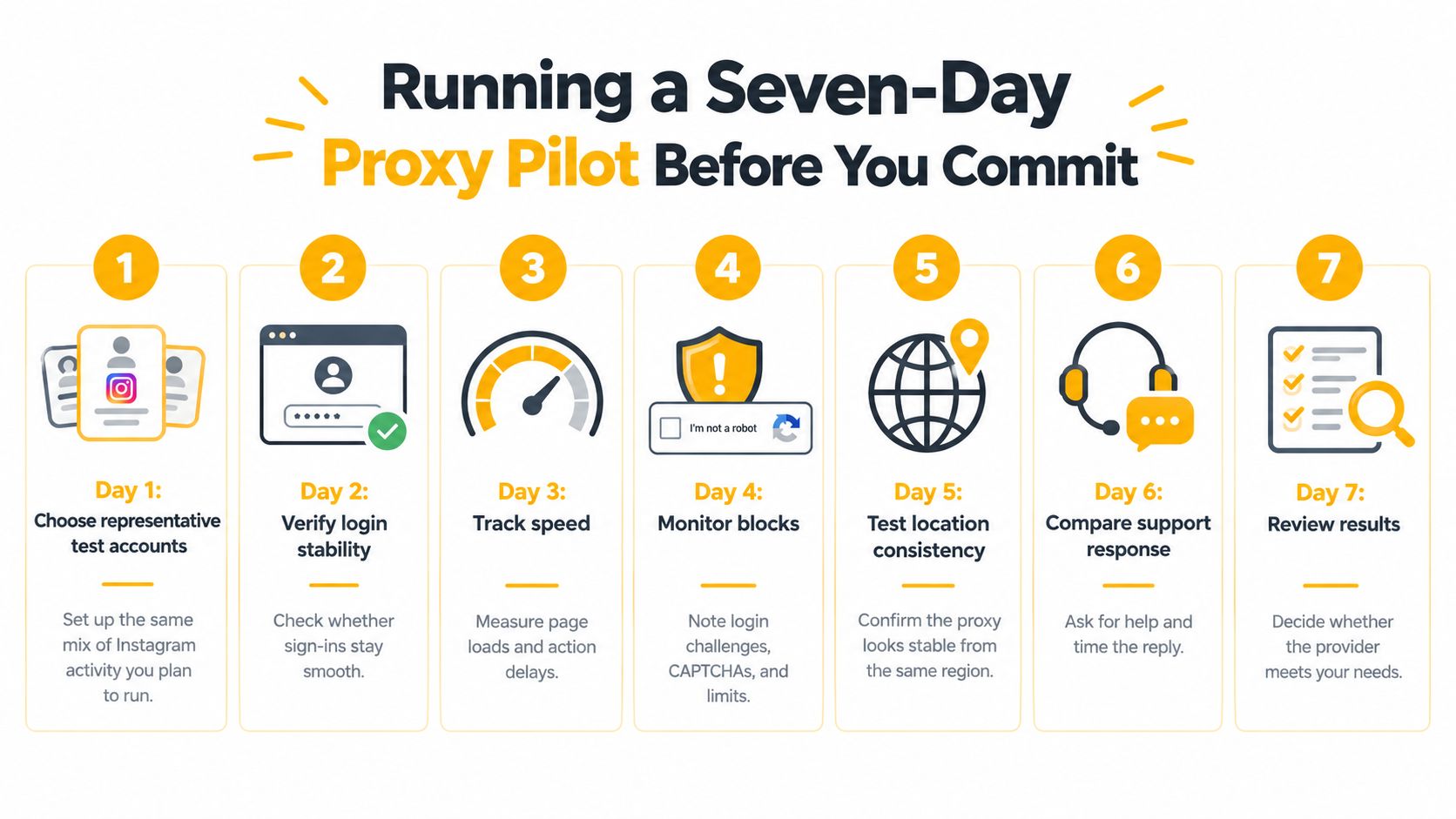
A pilot is more informative than a provider's speed claim because it tests the network against the team's real session pattern. Choose representative accounts and a permitted workflow, then compare each proxy pool separately. Keep the devices, action rates, and content patterns consistent so changes in behavior don't get mistaken for a proxy effect.
Keep the test controlled
Use the same intended country and timezone throughout a session, and assign one dedicated endpoint or a narrowly controlled pool to each account or client. Log the exact proxy pool used, and don't change the network setup and operating pattern at the same time. That makes it easier to identify which variable changed when a login challenge or failed request occurs.
Track these measures throughout the pilot:
- Successful requests: Record whether the intended action completed.
- Login challenges: Note authentication prompts and other interruptions.
- Forced re-authentication: Track when a session requires a fresh sign-in.
- Median and p95 response time: Compare typical and slower responses under the same conditions.
- Endpoint churn per account: Record how often the observed network identity changes.
- Session persistence and HTTP errors: Note whether sessions remain usable and whether requests fail.
Review results by workload
A practical schedule follows the test tasks rather than treating every day as a new configuration. Begin by selecting representative accounts and confirming the authorized workflow. Check login continuity, capture response times, note challenges or limits, verify that the connection appears in the intended region, and record how responsive provider support is when you ask about a test issue. Finish by reviewing the logs against the task's requirements.
If connection speed is part of the comparison, use a repeatable proxy speed test method and test under comparable conditions. Don't change devices, action pacing, or content patterns halfway through the pilot. Repetitive content and excessive action velocity can be treated as spam-related signals, so a high-quality connection doesn't remove the need for conservative pacing and human review where appropriate.
Choosing the Right Instagram Proxy for Your Workflow
For authorized account management, favor a stable mobile or residential connection when the workflow needs a consistent network identity. Research and regional checks may call for controlled location changes; price or SEO monitoring may suit a different network type, depending on access requirements. Ad verification and QA should preserve the target region throughout each test.
No proxy can bypass Instagram's own quotas. Build around authorized API support, conservative request pacing, account-level permissions, two-factor authentication, and manual review for sensitive actions. Run a pilot before committing, then select the setup that meets the task's session, geography, and reliability requirements.
Evoproxy offers French 4G/LTE/3G mobile proxies with personal and shared ports, plus configurable rotation for different session needs. After defining your workflow and testing it with a controlled pilot, visit Evoproxy to explore whether its mobile 4G connections fit your use case.