Proxy servers themselves are generally legal technologies in most jurisdictions, but legality depends on what you do through them, the laws that apply to your location, and the terms of service of the platforms you access. In the United States, the key federal boundary is the Computer Fraud and Abuse Act, originally enacted in 1986, which focuses on unauthorized access rather than banning proxies as a category.
That answer sounds simple until a marketing workflow crosses several legal boundaries at once. A proxy can support privacy protection, authorized quality assurance, ad verification, or market research. The same proxy can also be used to bypass authentication, evade account enforcement, collect unnecessary personal data, or conceal activity that a platform expressly prohibits.
The practical mistake is treating proxy legality as a single yes-or-no question. A defensible assessment separates authorization law, data protection law, and platform contract law. Your network route is only one part of the analysis.
Are Proxy Servers Legal For Business Use
Businesses can generally use proxy servers lawfully when they have a legitimate purpose and the workflow respects authorization, privacy, and contractual restrictions. The proxy changes the route and apparent source IP of a request. It doesn't grant access to systems, accounts, data, or features that the business wasn't already allowed to use.

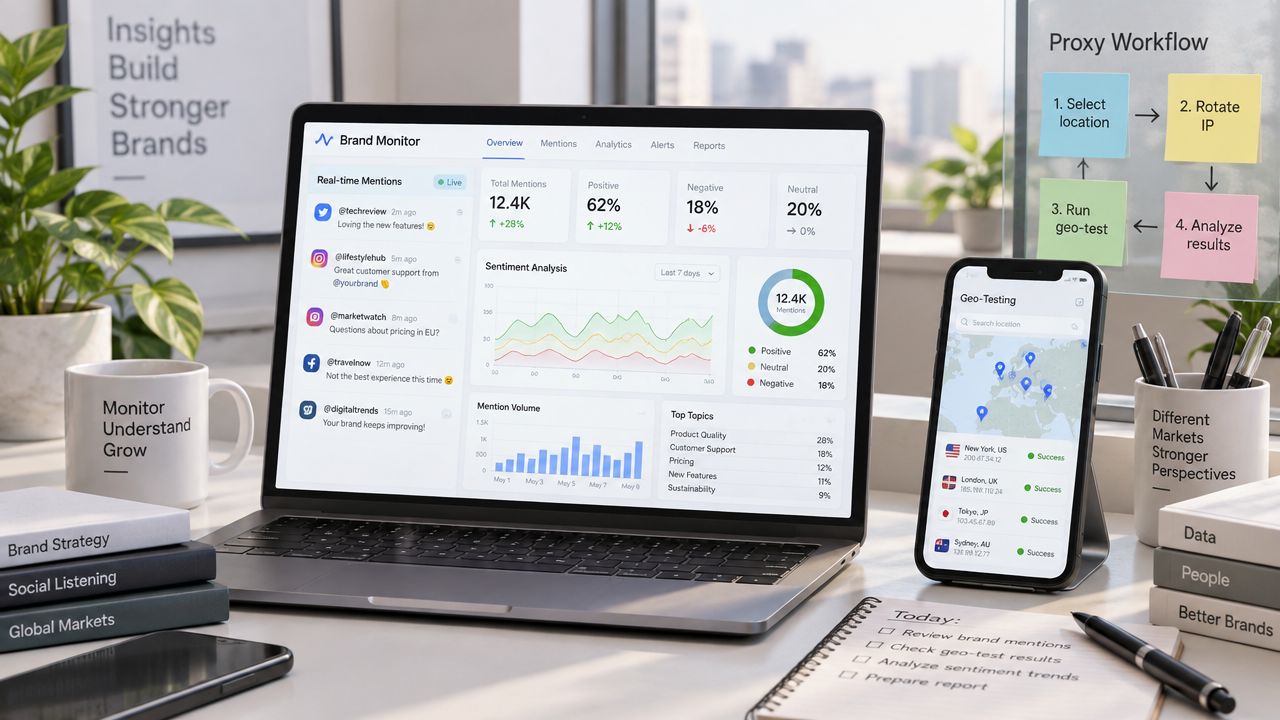
Consider a retail intelligence team checking how an authorized product page appears to users in different regions. The team can use geo-targeting to validate localized content, record publicly displayed prices, and monitor whether an approved advertising campaign is visible. If the team collects unnecessary personal profiles, ignores a platform restriction, or uses rotation to defeat a technical block, the same infrastructure creates a very different risk profile.
The three-layer test
Start with authorization law. Ask whether the business is accessing a system or data it has permission to access. In the United States, the Computer Fraud and Abuse Act, or CFAA, addresses intentional access to a protected computer without authorization or access that exceeds granted authorization. The U.S. Department of Justice computer fraud guidance also emphasizes that prosecutors should establish knowing access to a computer or computer area where the person wasn't permitted to go, with the purpose of obtaining or altering stored information.
That layer makes a proxy irrelevant to the core question. A proxy doesn't legalize credential theft, malware distribution, fraud, denial-of-service attacks, or unauthorized intrusion. It also doesn't turn a private account area into public data.
The second layer is data protection law. A workflow can involve lawful access and still create obligations if it collects names, account identifiers, IP addresses, cookies, device fingerprints, or behavioral profiles. The team must identify the purpose, collect only what it needs, protect the records, and establish suitable retention and access controls.
The third layer is platform contract law. A website or social platform may impose contractual restrictions on automated collection, account operations, or access methods. A technically accessible page isn't automatically a commercially safe source for unrestricted automation.
Practical rule: Treat a proxy as a routing control, not as a permission slip.
Apply the test before deployment
For each project, document the intended domains, accounts, data fields, geographic scope, request behavior, and person responsible for approval. Then ask:
- Authorization: Does the team have permission to access the relevant page, account, API, or system?
- Privacy: Could the workflow identify people through collected content, IP addresses, timestamps, or account data?
- Contract: Do the applicable terms restrict automated access, collection, account sharing, or geographic representation?
- Controls: Are rate limits, authentication barriers, robots directives, or other technical signals being respected?
This approach works for social-media management, price monitoring, ad verification, brand protection, and QA testing because it evaluates the actual workflow rather than the proxy label. It also exposes a common failure: a team may approve a legitimate business goal while overlooking the way its automation reaches the target.
Understanding US And EU Legal Frameworks
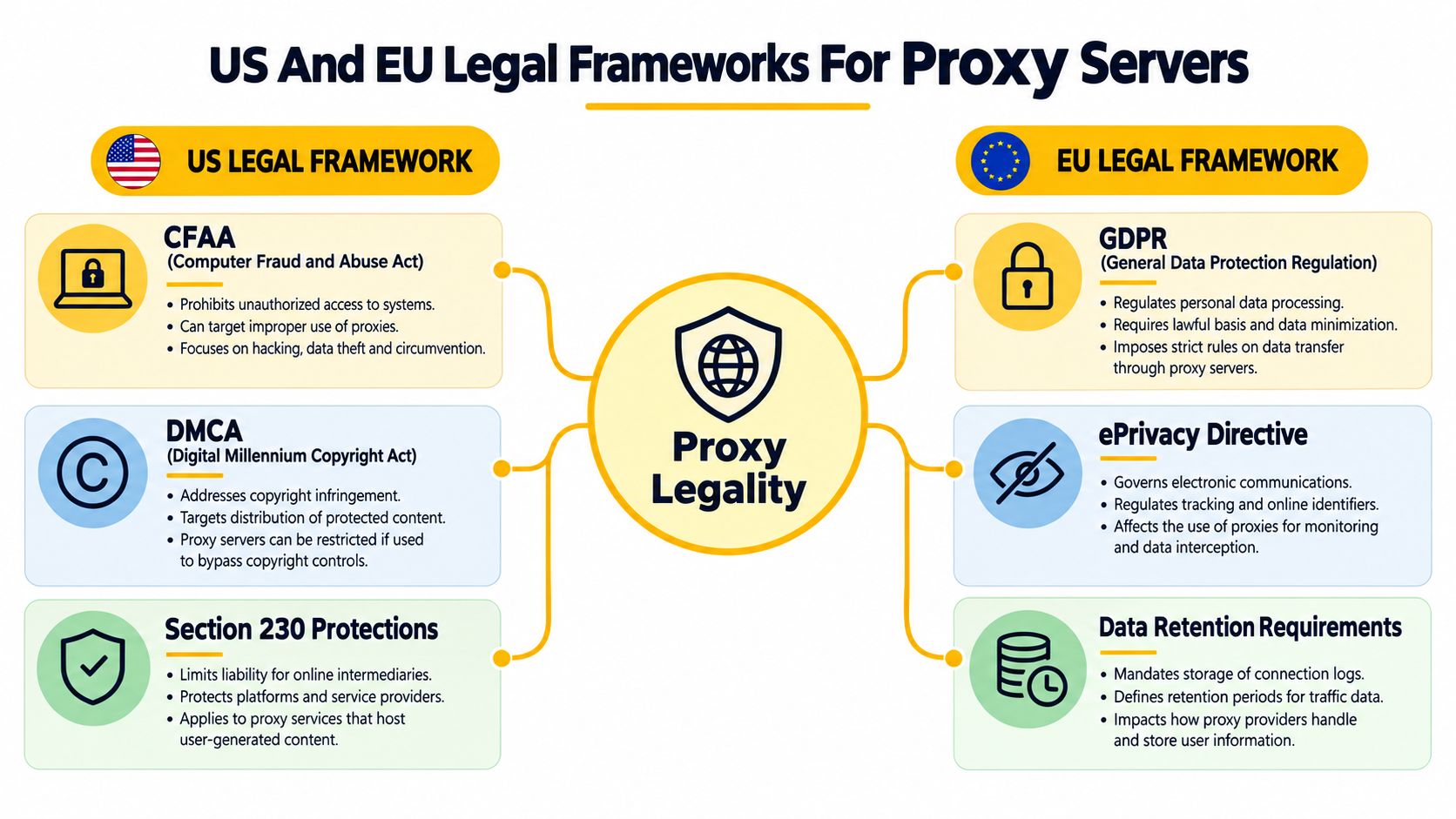
Proxy legality is determined by three separate legal layers, not by the proxy itself: authorization law, data protection law, and platform contract law. A proxy can change how a request is routed, but it cannot grant access rights, remove privacy obligations, or override a website's terms.
The United States starts with authorization
The CFAA, enacted in 1986, is the main federal reference point for unauthorized computer access in this context. It does not prohibit proxy servers as a category. The relevant question is whether a person intentionally accessed a protected computer without authorization or exceeded the access they had. The Department of Justice charging policy indicates that a basic contractual or terms-of-service violation should not automatically become criminal unauthorized access when the person was otherwise authorized to obtain the information.
Publicly accessible data creates a narrower authorization question. The Ninth Circuit's hiQ Labs v. LinkedIn ruling indicated that the CFAA generally does not cover scraping data available to the public, even where the website objects. It does not establish a general right to automate collection, and it leaves privacy, copyright, contract, database-rights, and excessive-request claims open. The boundary is also discussed in the analysis of public-data collection and proxy legality, but teams should assess their own workflow rather than rely on a broad public-data assumption.
A marketing team should document whether the target is public, whether authentication or another access barrier is involved, and whether the collection creates separate civil or contractual exposure. Request volume, session behavior, and account use also matter. Public visibility supports an authorization argument, but it does not settle the rest of the legal analysis.
The EU adds data protection duties
The EU uses a technology-neutral approach. GDPR may apply to organizations outside the EU when they offer services to, or monitor, people in the EU. The European Commission's GDPR guidance explains that the rules apply regardless of the technology used.
A proxy therefore does not place market research, advertising verification, or audience analysis outside GDPR scope. If a workflow collects names, account identifiers, IP addresses, or behavioral profiles, the business needs a defined purpose and lawful basis. It must also address fairness, necessity, minimization, security, and transparency where those duties apply.
An IP address can be personal data when it can be linked to an individual through information available to the relevant operator. Pseudonymization and encryption reduce risk but do not automatically remove GDPR obligations if re-identification remains possible. Teams should map data flows and retention before configuring collection, not after personal data has entered the database.
For practical preparation, teams can use this GDPR compliance testing resource and adapt its controls to their purpose, jurisdictions, providers, and data flows. Legal review is appropriate for identifiable individuals, sensitive categories, large-scale profiling, or uncertain authorization. Provider due diligence belongs in that review too, including the source of proxy addresses, consent or contractual controls, processing roles, security measures, and deletion procedures.
Comparing Mobile Residential And Datacenter Proxies
Proxy categories describe the network behind the exit address. They affect compatibility, reputation, blocking behavior, session stability, and procurement risk, but none of them changes the legal status of the underlying activity.
Datacenter proxies originate from hosting or cloud networks. Residential proxies use consumer-broadband address space. Mobile proxies use cellular networks such as 4G/LTE or 5G. These categories aren't interchangeable, and selecting a less obvious network doesn't remove platform restrictions or data protection duties.
Why mobile IPs behave differently
Mobile networks commonly use carrier-grade NAT, a carrier-operated address-translation system that allows numerous devices to share public IPv4 addresses. A destination may therefore see an address associated with ordinary handset traffic rather than a range clearly identified with a hosting provider. That shared carrier context can complicate simplistic IP-based blocking.
Mobile routing can be useful for authorized geo-targeted testing, mobile user-experience checks, localized ad verification, and account QA where the business has permission to operate the accounts. It can reduce reliance on datacenter address space, but it doesn't guarantee trust, prevent browser fingerprinting, or make a prohibited workflow acceptable.
Residential proxies can resemble home broadband traffic and may suit research that needs consumer-network context. Their compliance suitability depends heavily on how the provider obtained the addresses and whether the people or network operators involved gave appropriate consent. The business should never assume that the word “residential” proves ethical sourcing.
Datacenter proxies are often easier to provision and can be practical for controlled, high-volume work against authorized systems. Their hosting-network origin may make them easier for destinations to classify or block. That is a technical trade-off, not a legal conclusion.
Match the session model to the task
IP rotation changes the exit address over time. Controlled rotation can support aggregate price, search-result, or availability monitoring when the target permits the activity and the request rate remains reasonable. Rotation becomes problematic when its purpose is to defeat a block, evade account enforcement, or conceal unauthorized access.
A sticky session keeps one exit address associated with a session for a defined period. That is usually more suitable for authorized login-state testing, checkout QA, or multi-step user-flow validation because frequent changes can disrupt cookies, carts, and session state. Excessive stickiness can reduce geographic flexibility and may create a stronger association between a test identity and a particular route.
| Proxy category | Useful legitimate fit | Main operational trade-off |
|---|---|---|
| Mobile | Authorized mobile QA, ad verification, regional experience testing, account workflows | Cellular routing may reduce simplistic datacenter-IP blocks, but it doesn't override controls |
| Residential | Consumer-network research and localized validation | Provider sourcing, consent, logging, and personal-data handling need close review |
| Datacenter | Controlled workloads against authorized systems and services | Hosting-network ASNs can be easier for destinations to identify or restrict |
An ASN, or Autonomous System Number, identifies the network announcing an IP range. Destinations can use ASN and reputation data to distinguish hosting providers from telecom carriers. That is why a mobile or residential route may behave differently from a datacenter route, but technical appearance should never be confused with permission.
Building Compliant Proxy Workflows For Marketing Teams
A compliant proxy workflow starts before the first request. Marketing and data teams should write down the business purpose, approved targets, data fields, operating limits, and the person accountable for privacy and platform risk before anything goes live.
Establish a project record
Start with a short authorization record that answers five questions:
- Purpose: Is the project for authorized QA, ad verification, market research, brand protection, SEO monitoring, or another defined business need?
- Scope: Which domains, accounts, APIs, regions, and environments are approved?
- Data: Which fields are necessary, and which fields must be discarded immediately?
- Behavior: What request rate, session model, and retry behavior will the system use?
- Ownership: Who approved the workflow, and who can pause it when a target objects or controls change?
This record should separate public pages from authenticated areas. It should also state whether the business is testing its own properties, collecting permitted public information, or using a third-party platform under a specific agreement. Teams can use Evoproxy's compliance requirements checklist to structure the authorization record before deployment.
Use official APIs where they are available and suitable. Review platform terms before automating account activity or collection, and obtain written permission where the platform requires it. A proxy is a changed network path, not an exemption from authorization requirements.
Minimize the data pipeline
If the project needs product availability or page content, do not store names, profile details, account identifiers, or full request logs by default. Filter unnecessary personal data at the extraction layer, restrict internal access to what remains, and set a retention period that matches the purpose.
Keep geo-targeting tied to a legitimate testing or research objective. Testing how an authorized landing page appears in a region is different from misrepresenting eligibility, bypassing geographic restrictions, or creating accounts under false circumstances.
Choose the protocol for compatibility
HTTP proxies are designed for HTTP-aware requests. For encrypted HTTPS destinations, clients commonly use the HTTP CONNECT method to ask the proxy to establish a tunnel to a host and port. Once established, TLS protects the HTTPS request contents from ordinary network intermediaries.
SOCKS5 is a lower-level session proxy protocol defined by RFC 1928. It supports TCP connection requests, inbound binding, and UDP association, and it can represent IPv4 addresses, domain names, and IPv6 addresses. In practice, HTTP is often convenient for browsers, crawlers, and HTTP clients, while SOCKS5 can support a wider range of TCP applications and some UDP-aware workflows.
Neither protocol makes a user anonymous. Applications can leak headers or DNS requests, and the proxy operator may retain connection metadata. Encrypt credentials, confirm that DNS resolution follows the intended path, and ensure protocol logs follow the same privacy rules as the main dataset.
Control that works: Make “pause and review” a normal response to a block, terms change, authentication prompt, or unexpected personal-data field. Do not solve every operational interruption with more rotation.
Proxy Provider Due Diligence And Data Protection
A business can choose a legitimate use case and still inherit risk from its proxy provider. The provider's address supply chain, consent practices, logging, subprocessors, and abuse response all affect whether the workflow is defensible.
Treat IP-linked records as potentially identifying
The Court of Justice of the European Union addressed dynamic IP addresses in Breyer. A dynamic IP can qualify as personal data for a website operator when that operator has legal means to identify the individual using additional information held by the internet-access provider. The Breyer decision summary is especially relevant to teams that collect IP addresses as part of research, advertising validation, or QA.
A proxy may hide the operator's original address from a destination, but that doesn't automatically anonymize the data collected by the business or the provider. Timestamps, account identifiers, cookies, device fingerprints, destination logs, and request histories can connect activity over time.
For EU-facing work, treat collected IP addresses, timestamps, account identifiers, and request logs as potentially identifying until a documented legal assessment concludes otherwise. Define a lawful basis, minimize fields, restrict access, protect logs, and set retention limits. If a processor handles the data, document the relationship and assess international transfers and subprocessors.
Ask the provider questions procurement can verify
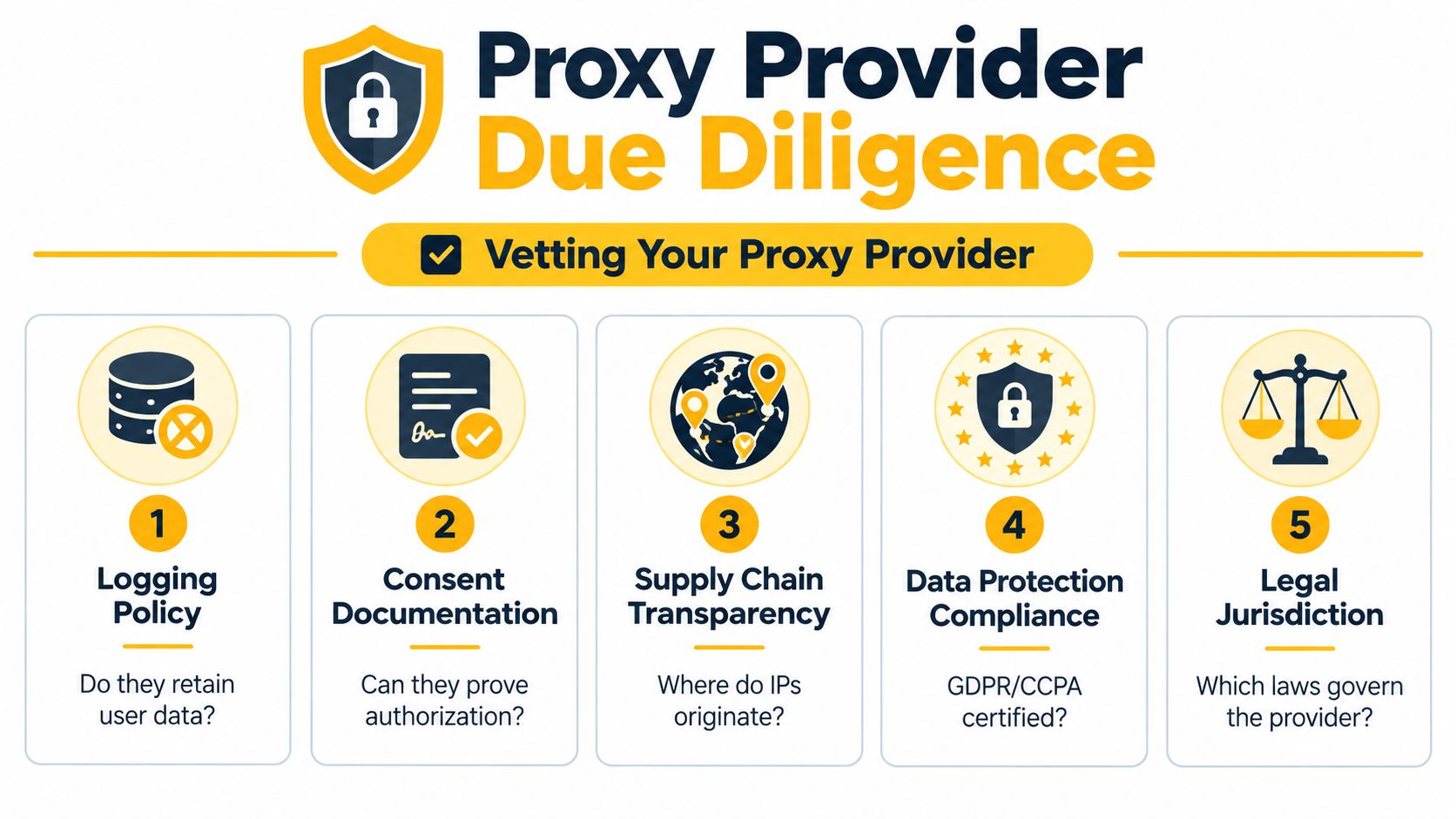
A vendor questionnaire should request evidence, not broad assurances:
- Network origin: Can the provider explain whether the mobile, residential, or datacenter addresses are owned, leased, or supplied through another network?
- Consent and authorization: Can it document the source's permission for traffic routed through the access network, especially for shared or residential addresses?
- Logging: Does it retain connection, destination, timestamp, account, or traffic metadata? For what purpose and for how long?
- Subprocessors: Which parties can access routing data, support records, or network telemetry?
- Security: How are credentials, dashboards, ports, and support channels protected?
- Abuse handling: Can the provider investigate complaints, suspend misuse, and provide a clear escalation path?
- Contract terms: Will it sign suitable data-processing terms when it processes personal data on the business's behalf?
A provider that can't explain where addresses came from or what logs it retains creates an unresolved compliance issue. The business shouldn't fill that gap with assumptions.
Procurement principle: A clean business purpose doesn't cure an opaque supply chain.
Mobile networks and shared routes can create additional complexity because several users may appear through the same public address. That doesn't by itself indicate wrongdoing, but it reinforces the need for accurate logs, controlled access, and a clear separation between the company's test identities and real individuals.
Best Practices For Responsible Proxy Use In 2026
Responsible proxy use is operational discipline. Before launch, confirm the target, purpose, authorization, data fields, provider controls, protocol, session behavior, and stop conditions. During the workflow, monitor errors and access signals without treating every block as a technical challenge to overcome.
Keep these principles visible to the people running campaigns and data jobs:
- Document permission: Record approved domains, accounts, APIs, regions, and business purposes.
- Collect less: Remove personal data that the analysis doesn't require and limit access to retained records.
- Respect platform rules: Use official interfaces where available and don't use IP rotation to bypass enforcement or technical controls.
- Control sessions: Use sticky sessions for authorized multi-step QA and controlled rotation only where the purpose supports it.
- Review providers: Verify network sourcing, consent documentation, logging, subprocessors, security, and abuse procedures.
- Monitor changes: Reassess the workflow when a platform changes its terms, adds authentication, modifies blocking behavior, or exposes new personal data.
The guide to web-scraping ethics can help teams turn these principles into internal operating rules. Mobile 4G routing may be appropriate for authorized social-media management, ad verification, market research, or geo-dependent QA, but the legal basis comes from the purpose and controls, not from the network category.

The answer to “are proxy servers legal” is therefore practical rather than absolute. Proxy servers are generally lawful tools. Your business remains responsible for authorization, personal-data processing, platform contracts, provider due diligence, and the conduct performed through the connection.
Evoproxy offers mobile 4G/LTE connectivity with personal and shared ports, session rotation options, and routes suited to authorized social-media management, market research, ad verification, and geo-dependent QA. Review the available options at Evoproxy and select a setup that matches your approved business purpose and compliance controls.