
TCP/IP fingerprinting classifies a remote network stack from packet behavior such as TTL, window size, and TCP option order, and the result is a probability, not proof of a device or user.
The popular advice to change your IP address and get a new fingerprint confuses network location with network behavior. For social, research, advertising, and QA teams, that distinction matters: a different exit address can change the test environment without changing the characteristics an observer can recognize.
What TCP/IP Fingerprinting Shows
TCP/IP fingerprinting infers an operating system or network-stack family from how that software builds and answers packets. The reading comes from the transport layer alone: no login, cookie, page body, or application banner required. A network stack is the operating-system software that handles network communication, and each implementation leaves small, consistent habits in the headers it produces.
TCP, the Transmission Control Protocol, manages reliable connections between endpoints. IP handles packet addressing and delivery. Implementations of both differ across operating systems, and those differences are what an observer measures.
An analyst's first look commonly includes:
- Initial TTL: IP time-to-live, a hop counter that routers decrement.
- TCP receive window: How much incoming data the sender advertises it can accept.
- Maximum segment size: MSS, the largest TCP payload the endpoint advertises it can receive in a segment.
- Window scale: An option that extends the receive-window range.
- TCP options: The supported options and their order in the header.
A stack match describes software on a path
Say a QA team tests a regional storefront from an office connection and then from a mobile connection. The public address changes, yet that change alone says little about what the remote server observes. Some endpoint defaults may remain recognizable, while an intermediary may introduce different characteristics.
Connection termination decides whose fingerprint appears. A forwarding proxy typically accepts the client's TCP connection and opens a second connection to the destination, so the destination observes the proxy's outbound stack rather than the client's original handshake. A tunnel or translated path produces yet another reading. On a mobile carrier path, carrier-grade NAT can place many subscribers behind a single public address, which makes that address a shared egress point instead of a label for one device.
Practical rule: Identify which system generated the packet before interpreting what the fingerprint says about it.
Moving among datacenter, residential, and mobile connections changes network context, and sometimes the system originating the destination-facing connection. The underlying transport signature can persist through all of that.
Firewalls, network address translation, virtualization, and operating-system updates can each alter the reading. Treat a match as a hypothesis about a stack on an observed path, then examine the fields supporting it.
Packet Fields That Form a Stack Signature
| Signal | Usual clue | Often rewritten by |
|---|---|---|
| Initial IP TTL | OS-family default after hop adjustment | Routers, tunnels, and some proxies |
| TCP receive window | Stack default or local tuning | Firewalls, OS tuning, and middleboxes |
| Maximum segment size | Stack default and path MTU | Cellular paths, VPNs, and path-MTU changes |
| Window scale | High-bandwidth stack choice | Middleboxes that strip or rewrite options |
| TCP option order | Implementation-specific signature | Normalizing proxies and stacks with custom options |
| IP ID pattern | Incremental versus more random IDs | NAT devices and some firewalls |
| TCP timestamps | Extra structure for passive clustering | Stacks or gateways that disable or rewrite them |
Initial TTL requires a path estimate. The receiver sees the remaining value after routers decrement it, not necessarily the sender's starting value. A longer route can therefore change the observed TTL without any operating-system change.
Receive window describes advertised receive capacity, not a user account. Window scale helps interpret that capacity on connections needing a larger effective window. Local kernel settings, virtualization, and middleboxes can make otherwise similar endpoints present different values.
MSS needs a path explanation. The maximum transmission unit, or MTU, limits packet size on a link or path. Tunnel overhead, VPN configuration, and cellular infrastructure can influence the advertised MSS, so a smaller value isn't conclusive evidence of a particular device or intermediary.
Read combinations, not isolated values
TCP option support and ordering are useful classic clues because implementations choose different combinations and sequences. RFC 9293 defines TCP options as variable-length fields at the end of the TCP header and requires support for configurable TTL values. Those implementation choices explain why a familiar option pattern can be informative without being immutable.
IP identification patterns add another dimension. An incremental-looking sequence and a more random-looking sequence can support different hypotheses, but translation devices and firewalls can obscure the original pattern. TCP timestamps can add structure for passive clustering when present, although a gateway may disable or rewrite them.
For proxy evaluation, examine the combination. A stable, unusual option list alongside consistent MSS, window scale, and later TLS behavior can remain useful for correlating sessions, even as addresses change. TLS, Transport Layer Security, protects application traffic but has its own observable handshake characteristics.
Rewriting headers isn't automatically neutral, either. An intermediary that normalizes traffic can produce a recognizable signature of its own, as the multilayer passive fingerprinting study helps illustrate through its use of transport and application features.
Record the capture location and whether the opening SYN packet, which initiates a TCP connection, came from the actual client or a gateway. Without that provenance, a precise-looking classification can describe the wrong component.
Active Probes Compared with Passive Capture
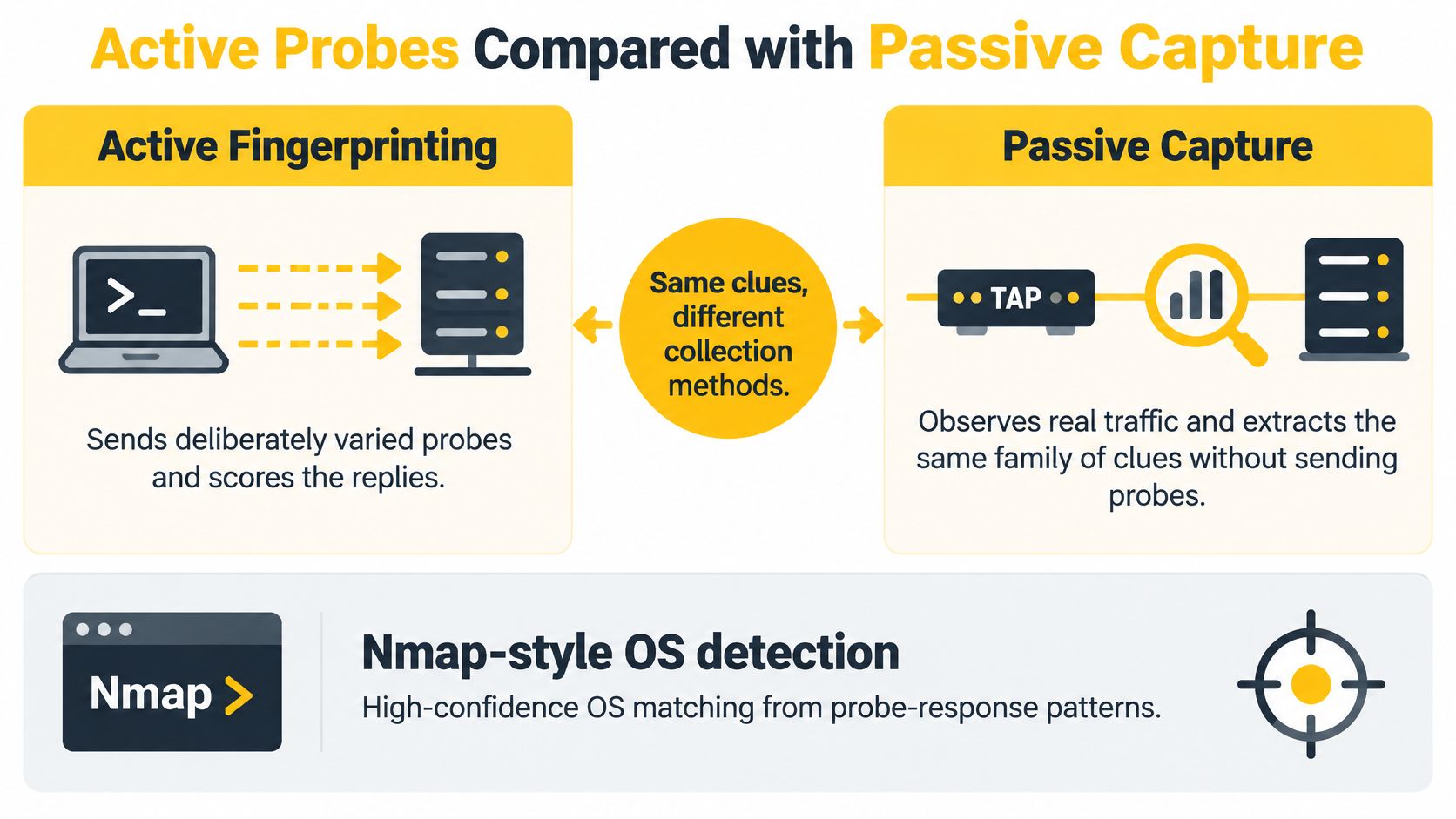
Active fingerprinting asks the endpoint questions. Passive fingerprinting observes traffic already being exchanged. Both examine related implementation clues, but their visibility and operational constraints differ.
Active collection tests response behavior
Nmap's OS-detection documentation describes sending up to 16 TCP, UDP, and ICMP probes and warns that detection becomes much less reliable without visibility of at least one open and one closed TCP port. UDP and ICMP provide additional protocol responses beyond TCP connections.
The TCP probes deliberately vary SYN option sets, option ordering, and advertised windows. The resulting signature can include initial window size, sequence-number behavior, IP-ID patterns, response flags, and estimated original TTL after accounting for hop distance.
This approach belongs on infrastructure your team is authorized to test. It's useful for checking an asset inventory or investigating whether a gateway has changed how a service presents its network stack. A filtered response is not equivalent to an endpoint choosing not to respond.
Passive collection reads existing exchanges
Passive analysis doesn't send those probes. It extracts available clues from traffic the team already receives, especially connection-opening packets. That makes it useful for an owned QA endpoint, authorized ad-verification infrastructure, or a service's network telemetry.
Ordinary application request logs usually aren't enough. They may contain an address and headers but omit SYN fields, so the team needs an appropriate capture point or network sensor.
Use a collection record with these observations:
- Collection method: Mark the observation as active or passive.
- Port visibility: For active testing, note whether open and closed ports were observable.
- Path context: Store the gateway, capture location, and relevant routing conditions.
- Confirmation status: Keep the inferred label separate from independently verified endpoint details.
Encrypted traffic and newer transports don't eliminate observation. The mobile-traffic fingerprinting report discusses how header features and traffic structure can support inference beyond application content.
QUIC doesn't use a TCP SYN, so classic TCP fields can't describe that connection. IPv6 also requires protocol-appropriate interpretation. Library behavior, timing, packet sizes, and destinations can still differ, which is why a TCP-only collection strategy won't cover every modern client.
Accuracy You Can Expect from a Match
A fingerprint match is a probability. How much weight that probability carries depends on the method, the classification target, and whatever sits in the path between the endpoint and the sensor.
| Method | Condition | Reported result | Source |
|---|---|---|---|
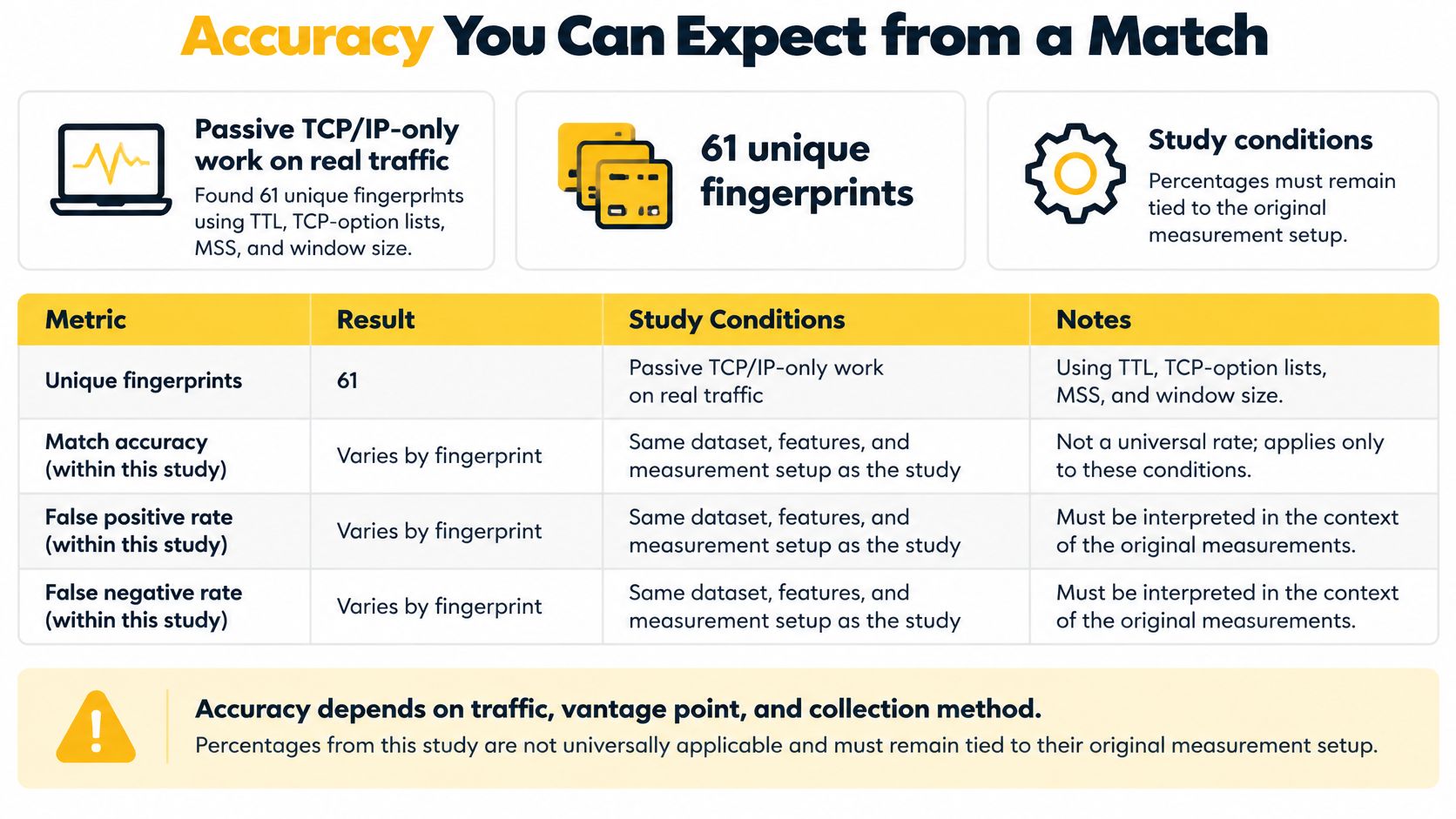
| Passive TCP/IP features only | Real traffic; TTL, options, MSS, window scale | 61 fingerprints; 55.54% total accuracy | Passive OS-fingerprinting paper |
| TCP/IP plus HTTP and TLS | One private-network evaluation | 99.4% major version; 97.5% minor version; uncertainty 2.41 to 0.13 bits | Same OS-fingerprinting paper |
| Active scan, no firewall | Windows 7 SP1 | 95% accuracy; 100% precision | Active-scan evaluation cited in the OS-fingerprinting paper |
| Active scan, firewall on | Windows 7 SP1 | 27.5% accuracy; 47.8% precision | Same cited evaluation |
| TCP/IP headers only for apps | Same Android device for training and testing | 88% app identification | KU Leuven mobile-traffic fingerprinting report |
| TCP/IP headers only for apps | Unseen but similar Android device | 67% app identification | KU Leuven mobile-traffic fingerprinting report |
The OS-fingerprinting paper linked in the table reports 55.54% total accuracy for TCP/IP-only classification across 61 fingerprints. Its combined model, which adds HTTP and TLS features, reached 99.4% major-version accuracy and 97.5% minor-version accuracy inside one private-network evaluation, with uncertainty falling from 2.41 to 0.13 bits.
The last two rows come from the KU Leuven mobile-traffic fingerprinting report and measure app identification, a different target from operating-system classification. A model trained and tested on one handset labeled 88% of traffic correctly. On a similar but previously unseen handset, the rate fell to 67%, which shows how tightly these scores bind to the device population used in training.
Interpret the target and the conditions
Accuracy counts how often classifications were correct across all evaluated observations. Precision counts how often predictions of a single class were right. Both can collapse together, as the two Windows 7 rows show: with the firewall enabled, accuracy fell from 95% to 27.5% and precision from 100% to 47.8%.
That firewall comparison matters most for practitioners. A scanner loses distinguishing responses when a defense blocks them; the operating system never changed, only the evidence did. With less evidence to work from, the classifier's output becomes less reliable or more selective. The same logic applies anywhere a middlebox, filter, or NAT device rewrites or suppresses the fields a model expects.
Adding HTTP and TLS features shrank uncertainty in that environment, so extra protocol layers helped distinguish hosts there. The combined score applies to that private-network evaluation. Any other system that mixes the same layers needs its own validation on comparable traffic before a team trusts its numbers.
A performance claim needs its method, network conditions, device population, and classification target attached.
Turn a match into a usable decision
For a QA report, keep the raw signature beside the inferred label and the known test-device details. When the label disagrees with the baseline, examine the connection path first. A firewall rule, VPN, or middlebox can strip TCP options and shift TTL values, which mimics a different stack entirely. Declaring the device misconfigured on the label alone sends the team debugging the wrong component.
For an anti-abuse review, treat a moderately confident OS guess as one weak signal among several. Request behavior and session context answer different questions from stack classification, and an automated account decision built on a probabilistic label will catch legitimate users whose paths happen to distort the signature.
Probe visibility, NAT, firewalls, virtualization, stale training examples, and operating-system or firmware updates all move the score. Every figure above describes how well a method named a stack under stated conditions; a stack and a path are what the signature belongs to. The operational question is whether the model has been validated on traffic resembling your deployment.
How NAT and Mobile Paths Change the Signal
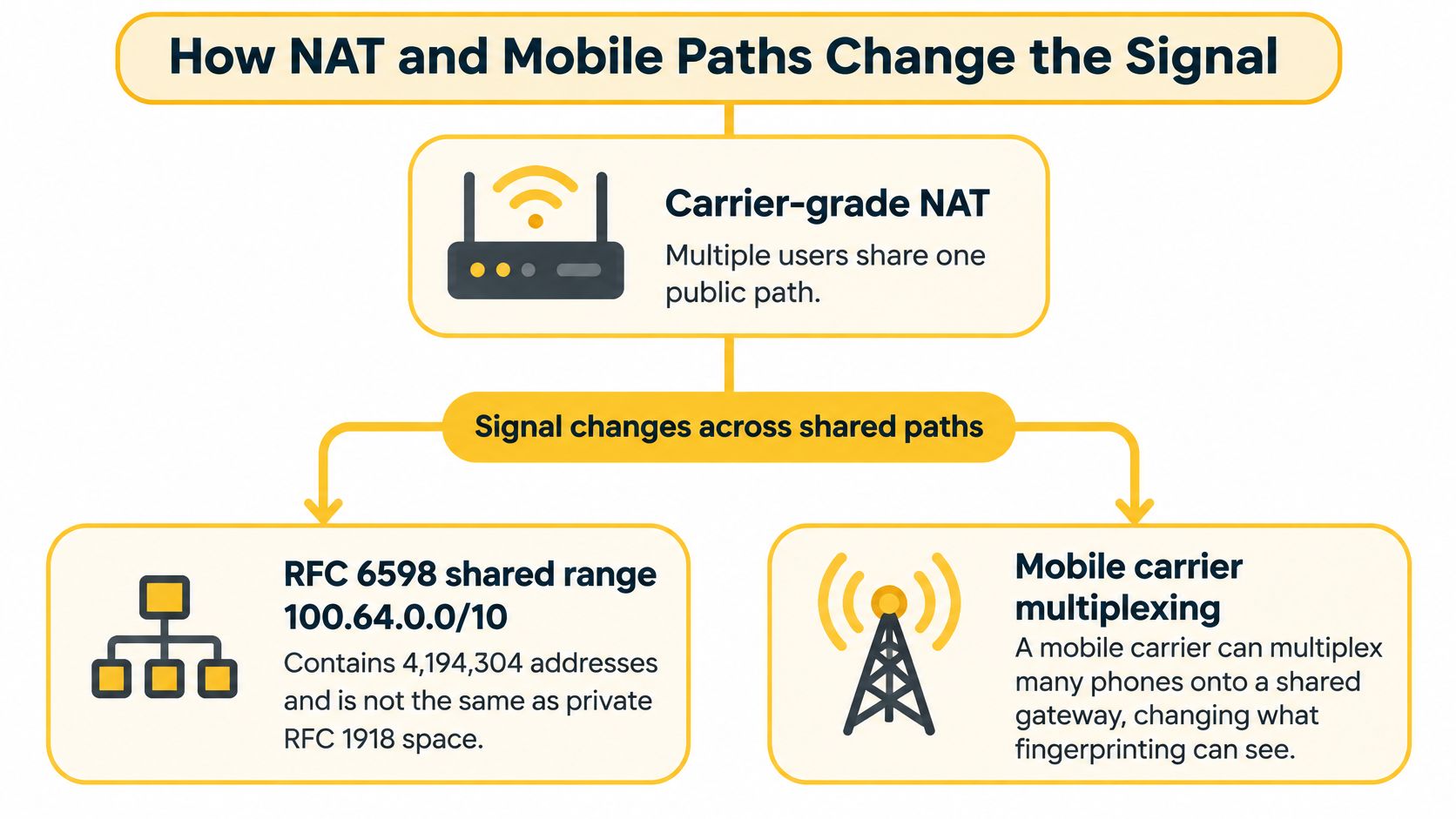
Carrier-grade NAT, or CGNAT, lets a provider translate traffic from many customers onto fewer public addresses. RFC 6598 reserves 100.64.0.0/10, containing 4,194,304 addresses, for provider shared address space, distinct from private RFC 1918 space.
A mobile carrier can multiplex traffic from many phones through shared translation infrastructure. The public address may therefore identify a carrier's egress point rather than an individual subscriber.
What the egress type tells you
| Egress category | Reasonable inference | What it doesn't prove |
|---|---|---|
| Datacenter | Address space associated with hosting infrastructure | That every request is unwanted automation |
| Residential | Address space associated with a consumer ISP | That the requester is a particular household member |
| Mobile 4G/5G | Carrier-associated connectivity, potentially behind CGNAT | That the endpoint is a phone or a unique subscriber |
An ASN, or autonomous system number, identifies a network operator's routing domain. Interpret the address alongside its ASN, carrier, session behavior, and request volume.
Mobile addresses can be harder to classify as proxy traffic from IP reputation alone because legitimate subscribers share carrier infrastructure. Blanket blocking also risks affecting unrelated users. That doesn't make mobile connectivity undetectable or establish a trustworthy identity.
For environment selection, the residential-versus-mobile proxy guide provides a useful distinction between consumer-ISP and carrier egress. If performance affects the test, SwiftNet Wifi's guidance on lower latency on 5G connections is a separate resource, not evidence about fingerprint anonymity.
Separate transport from session policy
HTTP proxies forward web requests or establish an HTTPS tunnel using CONNECT. SOCKS5 relays TCP connections more generally. Mozilla's proxy settings documentation specifies that proxied DNS defaults to true for SOCKS5 and false for SOCKS4 in that API.
DNS resolves domain names. Resolving locally while the web connection exits abroad can create a location mismatch during geo-targeted QA, so verify resolver routing rather than assuming it follows the proxy.
IP rotation changes egress identity; sticky sessions preserve it for a defined workflow. Use continuity for authorized account or checkout testing, and controlled rotation for regional availability or advertising comparisons. Per-request rotation can disrupt logins, carts, and meaningful rate-limit measurements, while leaving recognizable transport or TLS behavior intact.
Fair Uses and How to Judge a Result
A regional ad check returns an unfamiliar TTL and a different TCP window size. That result is a question about environment: which stack, which carrier path, which resolver. It becomes evidence only after the team separates endpoint changes from path changes.
Suitable workflows include:
- Social operations: Manage authorized accounts within platform rules and investigate inconsistent network conditions.
- Research and monitoring: Conduct permitted market research, price checks, and SEO monitoring.
- Advertising and brand protection: Verify regional ad delivery and review public listings through approved access methods.
- Retail and geo-QA: Test location-dependent availability and checkout behavior without bypassing purchase restrictions.
- Privacy review: Check whether routing and resolver behavior reveal unintended location information.
Validate portability before relying on a score
The Android header-based identification study covered 86,109 app launches across 1,595 apps and four devices, and found that performance deteriorated when evaluation moved beyond the training device. Strong same-device accuracy should be treated as local until the classifier meets an unfamiliar device family and network.
- Hold out unfamiliar environments. Reserve a device family and a network that the model hasn't trained on. Otherwise, you may be measuring recognition of familiar conditions rather than generalization.
- Investigate path changes separately. Check the ASN and intermediary chain before attributing a changed signature to the endpoint. NAT, cellular gateways, VPNs, and traffic interception can change the observation, and carrier-grade NAT can make one public address a shared egress for many subscribers.
- Price the error. Record confidence and false-positive impact beside accuracy. A challenge that interrupts a legitimate customer's session carries a different cost from an uncertain inventory label.
A fingerprint estimates the likely stack on one observed path. It says nothing about the person behind it.
For a social agency, an unfamiliar signature is a reason to review an authorized session and pause before concluding an account changed hands. For an ad-verification team, the next step is checking whether a discrepancy follows the network, browser, or campaign setup before assigning a cause.
Do not buy connectivity to evade detection, bypass access controls, commit fraud, or break platform terms. Consistency with a real client environment is a quality check for authorized testing.
Tools and Mitigation Strategies
An IP change that leaves the same SYN options in place is a tool-reading problem before it is an identity problem. Nmap performs active OS detection by sending probes and reading the replies. Wireshark and tshark let analysts inspect captured SYN fields directly, while Zeek records connection metadata for later review. Confirm which fields your configuration retains before building a classifier around its output: observed TTL and estimated initial TTL, window size and scaling, MSS, SACK, timestamp options, ECN and DF bits, and TCP option order.
When the choice is between packet inspection, active assessment, and telemetry, the penetration testing tool pricing comparison gives budget context for the active-assessment side. Field retention still decides whether a match can be audited later.
Tool-side checks before enforcement
- Lock a capture schema. Record observed TTL separately from estimated initial TTL, and store option order rather than only a normalized label.
- Keep raw packets beside logs. A Zeek entry should let reviewers reopen the SYN that produced the metadata during an appeal.
- Label active and passive evidence differently. An Nmap probe can induce responses that passive capture would never show.
- Repeat the portability checks. Use the same path, update, and retest discipline applied during validation so a tool change is not mistaken for a client change.
- Gate enforcement on repeatability. Prefer reviewable rate limits or challenges when a signature appears across tools and paths.
A fingerprint-protection overview can help frame which headers and options a privacy control touches. Verify the effect in captures from your own stack.
When hardening infrastructure you operate, follow protocol standards and vendor guidance for header handling. Unnecessary rewriting can impair interoperability or create a distinctive gateway pattern. No legitimate mitigation requires impersonating another client, and every classification remains a probability about stack and path.
Test Real Mobile Conditions Without Overclaiming
A new IP address changes less about a connection than testers expect. The destination still sees the same TCP options, window sizes, and TLS parameters your client stack produces, so matching the right egress context matters more than matching a country label. A mobile campaign, carrier-dependent storefront, or regional social workflow needs the transport conditions of a real carrier path.
For authorized QA, ad verification, social operations, and regional research, evaluate routing, session continuity, and endpoint behavior together. The mobile web testing guide is a useful starting point for defining those checks.
Build a bounded pilot
Select the target carrier and region, then decide whether the workflow needs a sticky session or timed rotation. Run an authorized test device as the baseline and compare the path's ASN and observed stack, not just the IP label. Remember that carrier-grade NAT means one public mobile address often represents a shared egress point for many subscribers, so a route that looks wrong at the IP layer may still be correct at the network layer.
We offer mobile 4G/LTE connectivity with country- and carrier-oriented routing options, session controls, and HTTP or SOCKS5 access, backed by over 1,500,000 mobile IP addresses. Match the plan's rotation mode and session length to the specific behavior under test, since a rotation interval that suits one workflow can break session continuity in another.
Keep current settings with your compliance records. Define what would count as a successful test, such as correct regional content and uninterrupted checkout, before introducing rotation or changing the route.
Treat the proxy as a controlled test variable and document what the destination observed at each layer. The useful outcome is a reproducible mobile-network test with evidence explaining how the path and the stack presented together.
Evoproxy offers mobile 4G/LTE connectivity for controlled tasks such as ad verification, regional research, and location-dependent QA. Visit Evoproxy to evaluate a mobile 4G proxy configuration for your target carrier and region, then compare it with an authorized baseline rather than expecting a new IP to create a new identity.