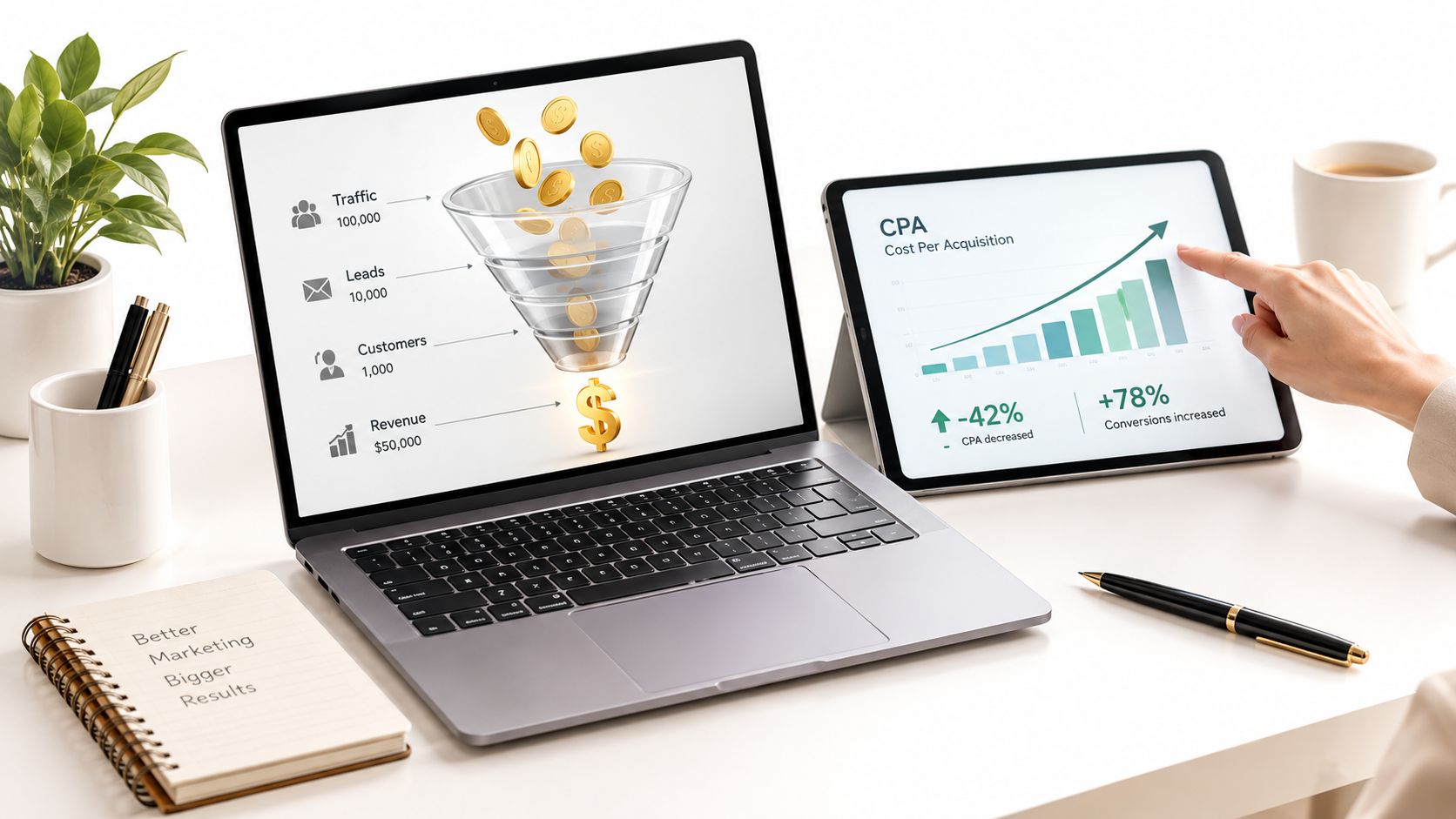
Customer acquisition costs have become materially more expensive across many industries, with one summary reporting CAC up 60% over five years and 222% over eight years. In SaaS, benchmark reporting cited by industry publications says the median New CAC Ratio reached 2.00 in 2024, which means companies were spending about $2 to acquire each $1 of new annual recurring revenue (customer acquisition statistics). That's the right starting point for any serious cost per acquisition conversation, because CPA isn't just a media metric anymore, it's a signal of whether your growth engine is still efficient.
The hard part is that many teams still treat CPA like a clean number that comes straight out of an ad platform. It doesn't. In practice, the number you see is shaped by attribution loss, channel mix, bot traffic, creative fatigue, landing page friction, and, in some cases, geo-targeting failures that never show up in a dashboard.
The Rising Reality of Customer Acquisition Costs
A shift from 1.75 to 2.00 in SaaS acquisition benchmarks signals deteriorating economics, even when topline growth still looks healthy (customer acquisition statistics). Cost per acquisition is no longer a clean media efficiency score. It is an operating measure affected by auction pressure, tracking gaps, fraud, and the quality of the conversion being counted.
Higher bids and saturated audiences explain part of the increase. The hidden cost often sits in the verification layer. Invalid clicks, duplicate leads, fake form submissions, and conversions from poorly targeted locations can consume budget while remaining inside reported totals. Privacy restrictions create another blind spot, causing some channels to receive too little credit and others to receive credit for conversions they did not materially influence.
Why the number on the dashboard can mislead you
A B2B team can report a $180 CPA while 40% of those leads never book a second call. The effective cost per qualified opportunity is then closer to $300. That gap changes which campaigns deserve more budget, even though the dashboard appears to show efficient acquisition.
Attribution can distort the result in the opposite direction. A channel that introduces demand may look unprofitable when later clicks receive the conversion credit. Compare platform-reported CPA with downstream milestones, sales acceptance, repeat engagement, and fraud checks. Proxy-based QA, such as validating lead patterns, timestamps, locations, and event sequences, helps expose acquisition waste before it reaches the revenue report.
Practical rule: If reported CPA improves while qualified opportunities, activation, or retention weaken, audit conversion validity before increasing spend.
Sustainable growth requires more than cheaper clicks. Teams need reliable event validation, clearer quality thresholds, and a view of acquisition cost that includes wasted traffic and distorted credit. That protects the margin behind every reported conversion.
Calculating Cost Per Acquisition Accurately
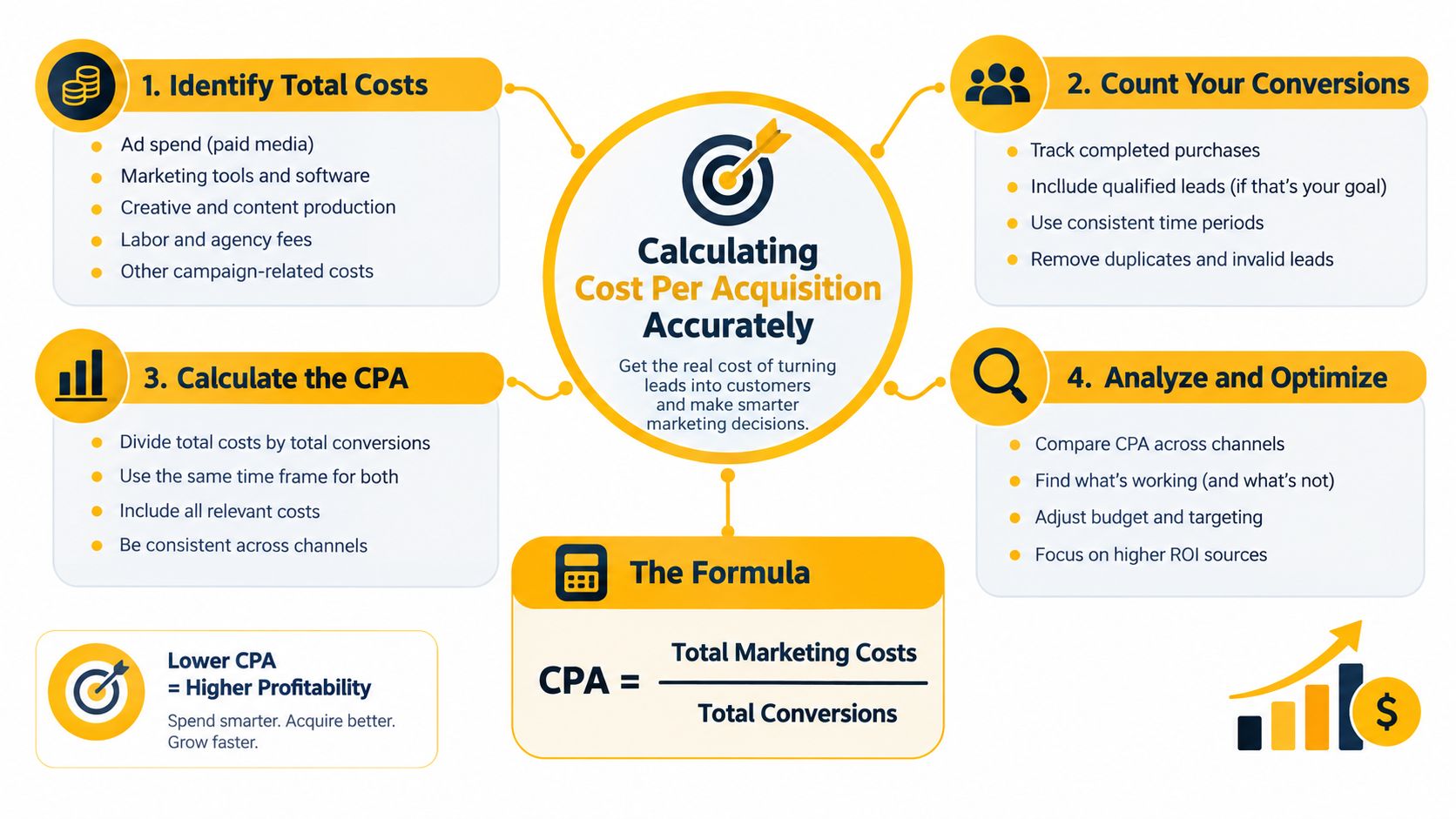
The basic formula is straightforward, CPA = total campaign cost divided by total conversions. That works well when you're measuring one campaign, one event, and one clear outcome. It stops being enough the moment backend economics enter the picture.
A cleaner way to think about it is this. CPA is usually campaign-level and can refer to a lead, purchase, or signup. CAC, customer acquisition cost, is broader, because it includes the total sales and marketing spend required to win a paying customer. That distinction matters whenever the front end looks efficient but the back end burns margin.
A practical ecommerce example
Say a store buys traffic to a product page and the platform reports a low acquisition cost. If refunds rise, the average order value is weak, or repeat purchase is rare, that front-end CPA can look profitable while the business loses money. The error is assuming the first purchase is the full story.
A better calculation pulls in the full customer picture. That means looking at:
- Media spend, because that is the most visible line item.
- Conversion quality, because not every click that buys once becomes a good customer.
- Refunds and churn, because acquisition without retention is expensive churn.
- Lifetime value, because the true test is whether the customer repays acquisition cost over time.
Good acquisition math starts with the customer, not the platform report.
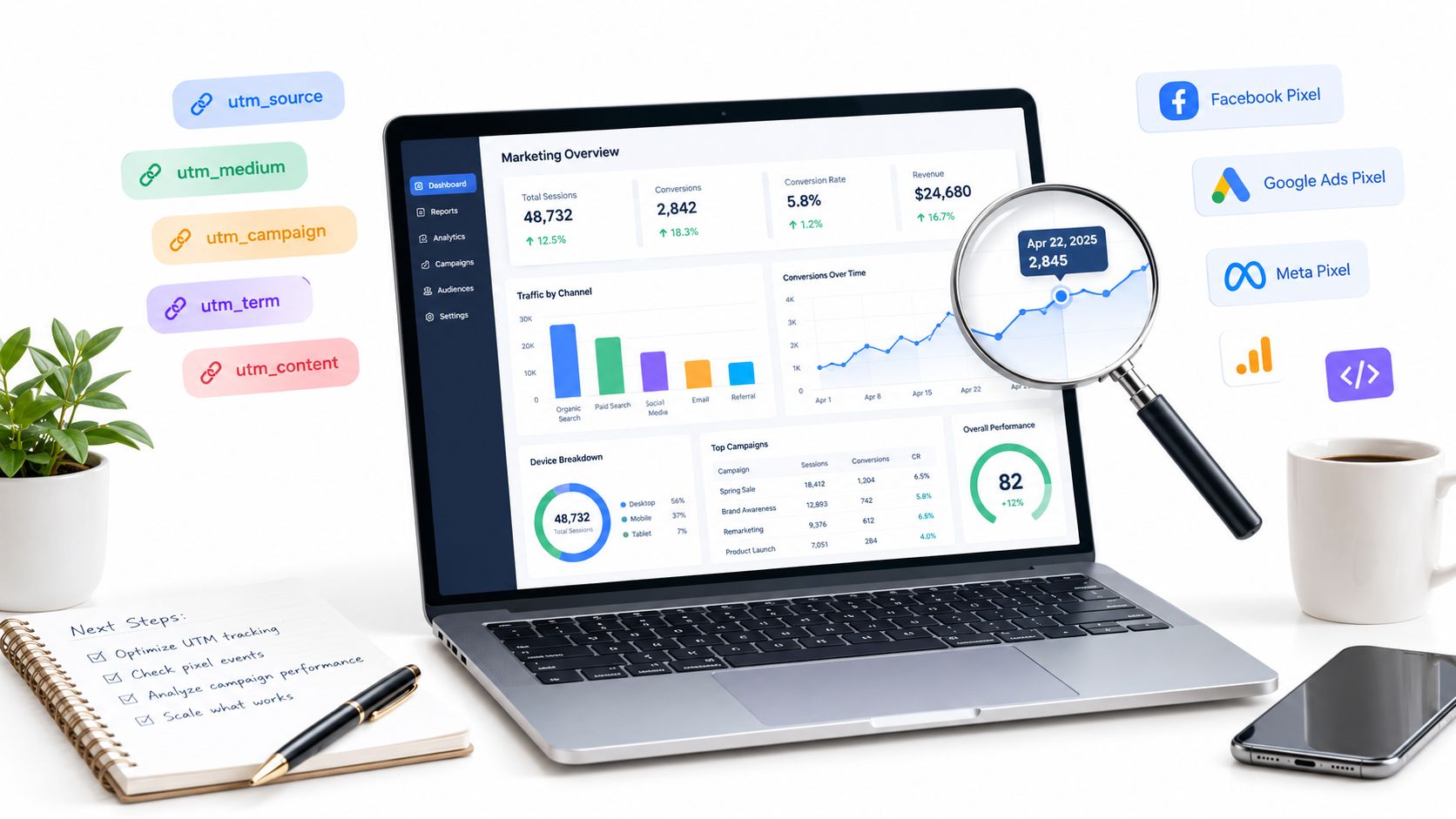
For teams that need tighter campaign measurement, the mechanics of tracking matter as much as the formula itself, and that's where a disciplined process around pixels, UTMs, and validation comes in. A practical framework is outlined in campaign performance tracking, because accurate CPA depends on accurate event capture.
Industry and Channel Benchmarks for 2026
Benchmarks help frame a decision, but they are poor substitutes for account-level economics. A B2B SaaS company buying high-intent search traffic faces different acquisition conditions from a retail brand running social campaigns. A lead-generation business with a long sales cycle also needs a different ceiling than a direct-response ecommerce store.
| Marketing Channel | Average Cost Range | Primary Driver |
|---|---|---|
| Referral marketing | $15 to $50 | Trust and warm intent |
| Paid search | $200 to $350 | Purchase intent and auction pressure |
| Paid social | $150 to $300 | Creative quality and audience fit |
| Affiliate marketing | $100 to $200 | Partner quality and payout structure |
| Email marketing | $85 to $150 | List quality and outreach relevance |
Source: aggregated benchmark data from customer acquisition cost statistics.
The same benchmark set shows wide variation by industry. B2B SaaS organic CAC is lower than paid CAC, while financial services and healthcare sit at materially higher acquisition costs. A separate published benchmark places typical B2B SaaS acquisition at $702 per new customer, with paid search averaging $802 and referrals averaging $141 to $200. Those figures are useful as directional checks, not as bidding instructions.
What the spread really means
Channel labels do not explain acquisition cost on their own. Auction pressure, buying intent, creative quality, partner incentives, and sales-cycle length all affect the result. A referral program may produce an efficient CPA because trust already exists, while paid search pays to capture demand that competitors are also pursuing.
Operational quality changes the comparison further. Invalid clicks, duplicate leads, unverified conversions, and weak placement controls can make a channel appear cheaper than it is. A benchmark built on inflated conversion counts will set an unsafe target and hide margin leakage. Validate events and sample the traffic behind reported conversions before treating any range as a performance standard.
For ecommerce and DTC, CPA is also tier-dependent. Average order value, checkout friction, refund exposure, and available margin determine the ceiling. A product with more margin can tolerate a higher acquisition cost. A low-AOV product needs tighter control, even when its reported conversion rate looks healthy.
Set targets by channel, vertical, and funnel stage, then check them against contribution margin and conversion quality. Review the gap between platform-reported CPA and verified customer CPA. Blended averages make reports look tidy. They rarely tell a budget owner which traffic deserves more spend.
Attribution Distortion and Privacy Blind Spots
The most underrated problem in CPA optimization is not bid strategy. It's measurement quality. If your attribution is off, the acquisition cost you think you're paying can be far away from the cost you're paying.
Recent benchmarking writeups show just how wide the spread can be. One dataset cited CPA ranges of roughly $29.99 to $49.48 across Facebook ad industries, while Google Ads benchmarks were reported as low as $3.62 in hospitality and travel and around $59 in construction and real estate (Facebook ads benchmarks). That spread tells you something important. A single average hides the key question, which is which source is efficient after conversion quality and intent are accounted for.
Where the hidden damage shows up
Last-click attribution often gives too much credit to the final touchpoint and too little to the earlier interactions that created intent. Privacy changes make that problem worse, because identity matching gets weaker and multi-touch paths get harder to stitch together. On top of that, fraud and low-quality traffic can create fake volume, which makes a campaign look active while it drains margin.
If you only trust the platform summary, you can end up scaling the wrong traffic.
This is also where technical verification pays for itself. Teams checking ad placements, locale-specific pricing, or geo-targeted experiences need to see what a user in a specific region sees, not what a dashboard says should have happened. In regulated or high-trust markets, the measured CAC can also move materially once consent rules and identity loss reduce attribution clarity, which is why blended CAC and incrementality-based measurement matter more than tidy last-click reports. A useful framework for privacy-aware testing is GDPR compliance testing.
Channel-Specific Tactics to Lower Acquisition Costs
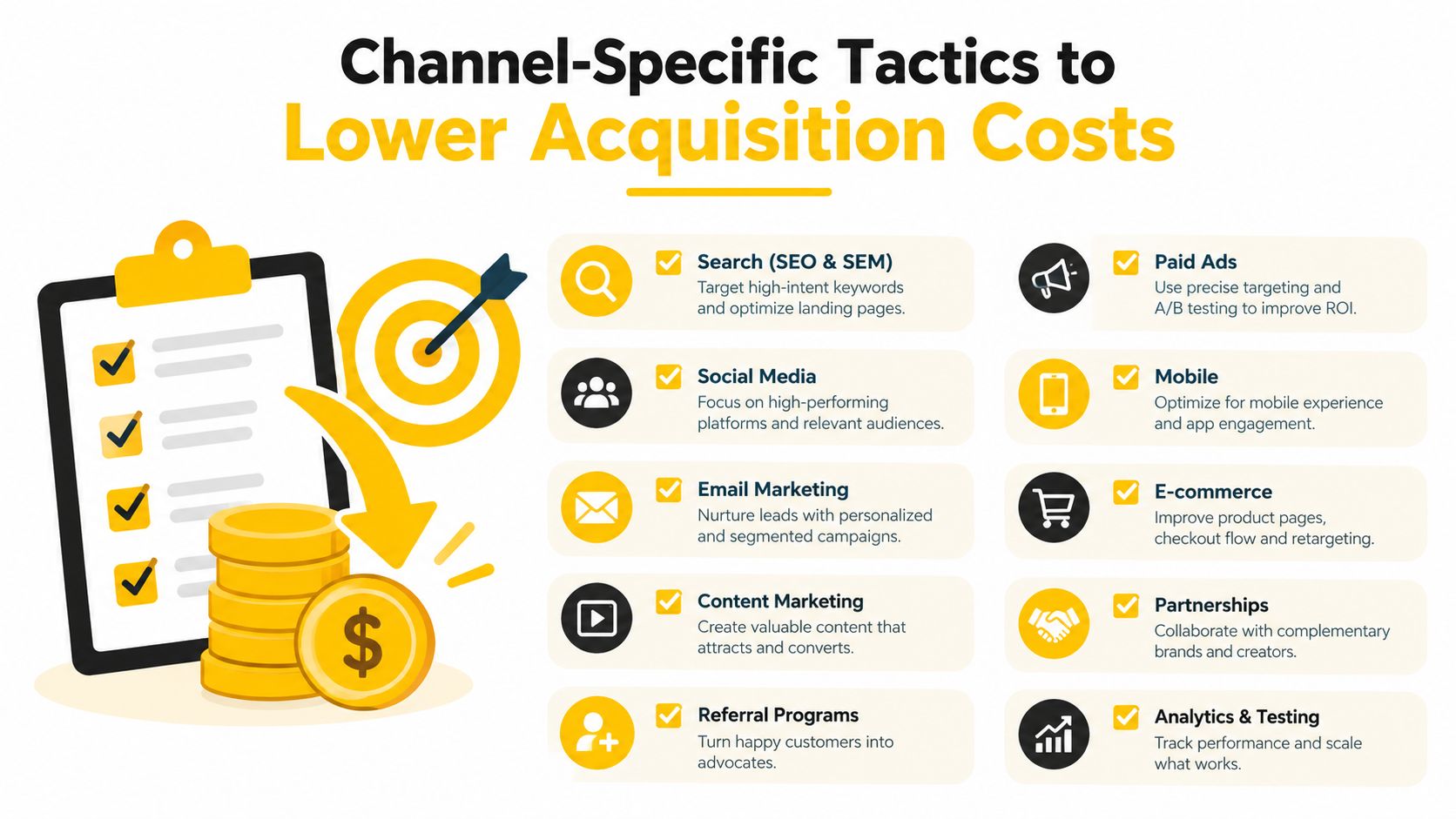
Lowering CPA depends on the mechanics behind each channel. The same budget change can improve one acquisition source and waste another, especially when tracking hides poor traffic or landing page friction.
For PPC, start with intent matching and negative keyword pruning. Broad queries can generate cheap clicks that have little chance of converting when the landing page serves a narrow offer. Tightening search term coverage and cutting irrelevant terms improves click quality and downstream conversion rate. The mechanics of diagnosing that friction are covered in landing page testing.
For paid social, creative fatigue and audience fragmentation often reduce efficiency before the dashboard makes the problem obvious. Repeated exposure can weaken response, while overlapping prospecting and retargeting audiences can make frequency and conversion data harder to interpret. Refresh the hook, simplify the offer, and separate acquisition audiences from retargeting before increasing spend.
For affiliate networks, traffic quality and compliance determine whether a reported conversion is worth acquiring. A low headline CPA can conceal inflated volume, broken redirects, forced placements, or inconsistent user experiences across regions. Validate the landing page, offer, tracking parameters, and post-click flow in every market being purchased. Compare lead quality and retained revenue, not only conversion counts.
Technical validation that protects margin
Multi-account social teams and media buyers use mobile and residential proxies for legitimate quality assurance, regional checks, and account operations. They need to confirm what users see without triggering anti-bot systems during routine validation. SOCKS5 and HTTP/HTTPS proxies can apply location at the proxy layer, making regional checks practical without changing application code.
Evoproxy can serve as part of that QA layer by providing mobile 4G/LTE/3G connectivity from France for geo-dependent testing and campaign validation. Carrier-grade NAT shares public IPv4 space across many subscribers, so mobile traffic is assessed through ASN and carrier context rather than IP address alone (CGNAT and mobile proxies, mobile proxy detection by ASN). That distinction helps expose regional delivery and verification failures that ordinary IP checks can miss.
Use a short operating checklist:
- Prune bad intent: remove search terms and placements that produce weak or misleading conversions.
- Audit geo behavior: confirm the intended offer, pricing, consent flow, and redirect appear in each market.
- Validate tracking links: check redirects, pixels, and conversion events across devices and locations.
- Review partner traffic: compare lead quality, approval rates, and downstream value against reported volume.
Testing and Bidding Strategies for Scale
Lower CPA is nice. Holding it while spend scales is where campaigns usually break. The denominator matters, so landing page and checkout improvements often do more for CPA than endless bid tinkering.
A/B testing should start with the friction points, not the color palette. Test the offer framing, the first screen of the landing page, and the checkout steps that most often lose intent. If conversion rate improves, CPA falls without needing a cheaper click.
When bidding helps and when it hurts
Automated bidding can be useful when the conversion signal is clean and the account has enough volume to learn. It gets dangerous when the platform is fed noisy events, weak attribution, or low-quality conversions. In that case, the system optimizes toward the wrong outcome and scales bad traffic faster than a manual buyer would.
Incrementality tests are the right reality check when you suspect attribution distortion. If a channel looks strong in-platform but weak in blended performance, isolate it and measure what changes when spend moves. That's how you separate true lift from convenient reporting.
A clean test is worth more than a confident dashboard.
Geo-dependent user flows should be QA'd before budget ramps. Localized pricing, shipping, consent banners, and currency presentation can all change conversion behavior. Teams that verify those paths from the user's perspective catch problems early, before they start paying to scale broken traffic.
Protecting Your Margins with Technical Verification
Cost per acquisition is an operating metric. If you treat it like a narrow ad metric, you miss the cost leakages that really matter, false attribution, bad traffic, broken geo logic, and weak post-click conversion.
The practical takeaway is straightforward. Keep your CPA target tied to real unit economics, not platform optimism. Validate traffic quality, check that your placements and landing pages behave correctly in each market, and make sure the data feeding bidding systems isn't already corrupted.

If you're running social, affiliate, or paid acquisition workflows and need to verify how campaigns behave across regions, mobile 4G proxies can help you inspect the experience the way a real user sees it. Evoproxy is built for that kind of validation, including geo checks, account operations, and testing across campaign environments. Visit Evoproxy if you want a practical way to protect acquisition margins while you scale.