
Most guides choose the best rotating proxies by counting IPs or comparing price per gigabyte. That advice is incomplete. A huge pool can still produce duplicate, badly geolocated, or reputation-damaged exits, while an extremely fast rotation can break authenticated sessions and make traffic look less natural.
For serious automation, mobile 4G and 5G proxies are usually the strongest default. They originate from carrier networks and shared subscriber infrastructure, not obvious cloud-hosting ranges. That doesn't make them invisible or suitable for bypassing access controls. It does make them better suited to compliant social-media management, ad verification, market research, geo-testing, and other workflows where IP reputation and location consistency matter.
This guide evaluates rotating proxies by rotation quality, session control, carrier context, protocol compatibility, and measurable success rate. The recommendation is simple: choose the proxy that produces the highest percentage of valid, reproducible transactions, not the one advertising the largest pool.
Why Rotating Proxies Are Essential for Modern Automation
Datacenter proxies remain useful for low-risk tasks, development, and controlled environments. They become a poor default when a team sends high-volume requests to platforms that score IP reputation, enforce rate limits, and correlate network identity with browser or account behavior. A static cloud address can be technically fast and still fail because the target classifies the entire hosting range as automated.
A rotating proxy changes the outward-facing address between requests, sessions, or defined intervals. That separates distributed sampling from one-address concentration, but rotation by itself doesn't solve every detection problem. Websites can still evaluate cookies, browser fingerprints, language, time zone, TLS behavior, request timing, authentication patterns, and repeated workflows.
The useful distinction is between address substitution and request routing. A simple substitution gives an application another IP. A rotating system routes requests through changing network endpoints while preserving the controls needed for geography, continuity, and monitoring. The rotating proxy server overview describes this operational model in practical terms.
Why pool size is a weak buying signal
IPv4 scarcity makes address quality more important than headline volume. APNIC reported approximately 3.686 billion allocated IPv4 addresses worldwide at the end of 2023, equivalent to about 0.46 allocated addresses per person, and reported that only about 3.6 million addresses remained in the Regional Internet Registry available pool at that time. These are allocation figures, not counts of unique consumers or active proxy exits, but they show why providers manage a finite and unevenly distributed resource. See APNIC's IPv4 update for the underlying context.
A provider can advertise many addresses while delivering poor operational diversity. The important questions are whether exits are active, correctly geolocated, distributed across suitable networks, and replaced quickly when a target rejects them. Pool size matters only after endpoint quality and routing policy pass inspection.
Proxy technology has always addressed practical network problems. CERN's first Web server went online on December 25, 1990, CERN httpd 2.0 could operate as an application gateway in 1993, caching was added by 1994, and proxy functionality was formalized in HTTP/1.0 through RFC 1945 in 1996. This history, documented in the GIAC discussion of public proxy infrastructure, matters because proxies were never only about hiding an address. They mediated access, reduced repeated downloads, and controlled how clients reached remote systems.
Practical rule: Buy for successful, correctly localized workflows. Treat IP count as a capacity indicator, not a quality certification.
A strong rotating configuration therefore combines address diversity, geographic relevance, reliable connectivity, controlled rotation, and observability. If a team can't identify which exit served a failed request, reproduce the session, or distinguish a target-side block from a transport fault, the infrastructure isn't ready for production.
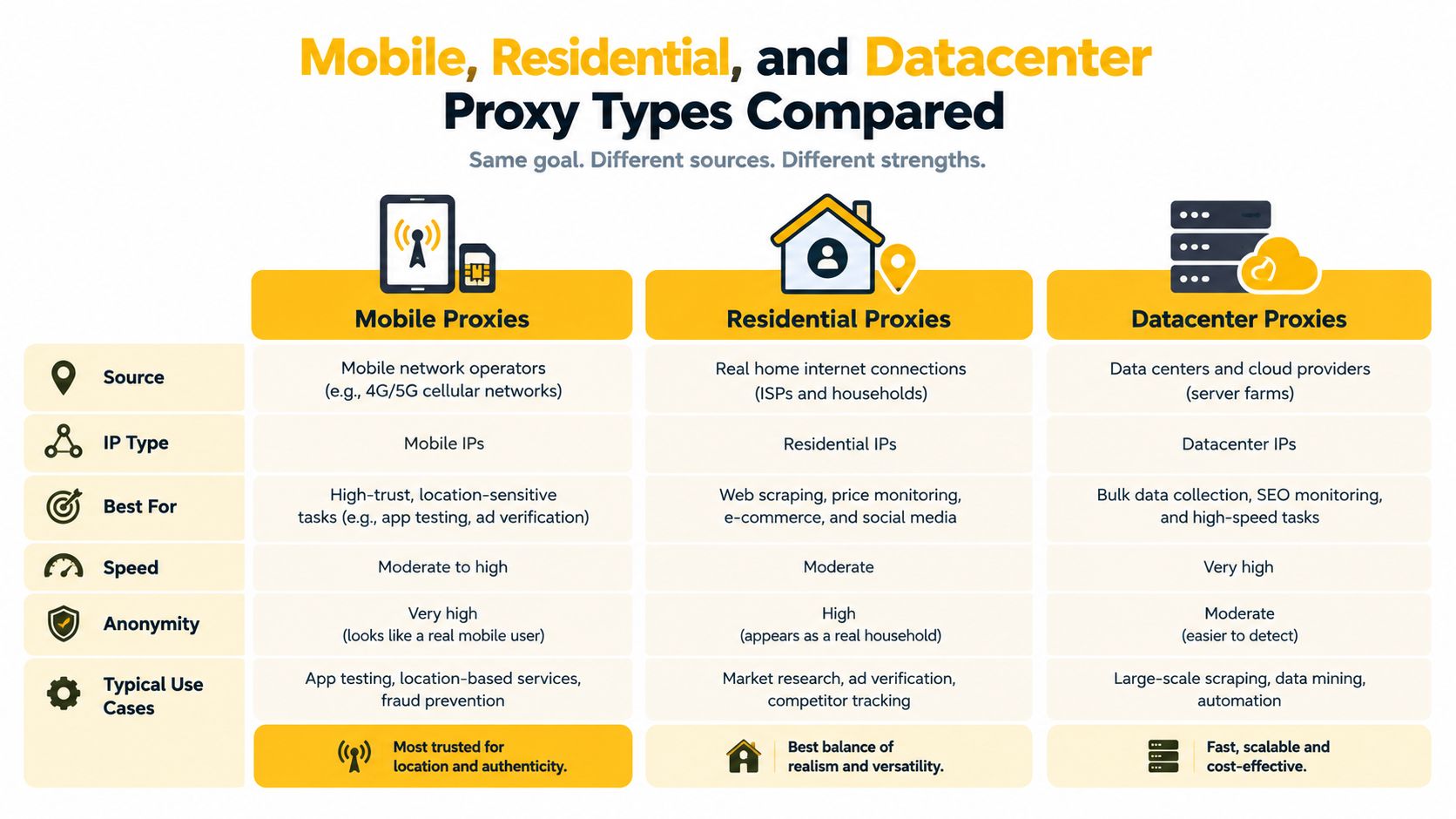
Mobile, Residential, and Datacenter Proxy Types Compared
Proxy categories describe the network origin, while rotation describes how the address changes. A mobile proxy can be rotating or sticky. A residential proxy can also rotate or remain stable. Confusing these dimensions leads teams to select an apparently suitable service that fails under real workflows.
| Proxy type | Network origin | Main strength | Common failure mode | Best fit |
|---|---|---|---|---|
| Mobile 4G/5G | Cellular carrier network | Strong carrier context and granular geo-targeting | Shared reputation and changing network conditions | Social management, ad verification, mobile QA, sensitive localized workflows |
| Residential | Home broadband connection | Consumer-network appearance | Variable latency, inconsistent availability, and higher traffic cost | Market research, localized content checks, broad web data collection |
| Datacenter | Cloud or hosting provider | Speed, predictable capacity, and low cost | Hosting ASN classification and rapid range-level blocking | Development, public low-risk data, infrastructure testing |
Datacenter proxies
Datacenter exits are efficient when the target accepts cloud traffic and the team values throughput over consumer-network resemblance. They work well for internal QA, endpoint testing, and some SEO monitoring tasks. They often fail when a website blocks hosting ASNs, applies aggressive rate limits, or treats an entire subnet as automated.
The failure isn't mysterious. A request can arrive quickly, but the source network remains easy to classify. Replacing one cloud address with another cloud address may change the symptom without changing the underlying reputation signal.
Residential proxies
Residential proxies route through home broadband connections. They generally offer a more familiar access context than datacenter ranges, but their performance can vary with the underlying connection, availability, and geographic supply. A team monitoring localized pages may value that consumer context, while a high-concurrency workflow may struggle with inconsistent latency or limited control over network characteristics.
Residential is a sensible choice for broad market research and public-data collection when precise carrier identity isn't required. It isn't automatically safer, cleaner, or more reliable than mobile. Buyers should still test geolocation, ASN, session behavior, and target-specific response codes.
Mobile proxies
Mobile 4G and 5G exits use cellular networks and often sit behind carrier-grade NAT, or CGN. CGN lets many subscriber devices share public IPv4 infrastructure. That carrier context can make mobile traffic harder to classify solely from the IP range than traffic from a recognizable hosting provider.
The comparison of residential and mobile proxies is useful because the practical difference is not just “real user” versus “not real user.” Mobile networks offer carrier ASNs, cellular routing, and often strong country-level relevance, but they also introduce shared reputation, variable geolocation, and carrier-side address changes.
Mobile is harder to block by IP category alone, not impossible to detect. Treat it as one layer in a compliant system, never as a bypass guarantee.
For high-volume automation, my default ranking is mobile first when reputation and geo-consistency dominate, residential second when broad consumer coverage matters, and datacenter first only when the target and workflow clearly tolerate hosting infrastructure. That order changes if the task is purely internal or performance-sensitive.
How to Evaluate Rotation Quality and Protocol Requirements
A rotating proxy should let you control the unit of identity. Sometimes that unit is one request. Sometimes it's a browser context, an authorized account session, or an entire checkout journey. Choosing the shortest available interval without defining that unit is a common infrastructure mistake.
Sticky sessions preserve the same exit for a defined period. They're usually better for login flows, multi-page QA, authorized account management, and any workflow where cookies or authentication tokens must remain coherent. Standard rotation is better for independent samples, such as checking localized prices or collecting public search results from multiple network vantage points.
The proxy IP rotation guide covers the basic mechanics, but the buying decision requires more than a rotation toggle.
Match rotation to the workflow
Use the following decision logic:
- Per-request rotation: Suitable for independent, low-state requests where continuity has no analytical value.
- Timed rotation: Useful when a task needs a stable identity for a bounded period, followed by a controlled change.
- Sticky sessions: Appropriate for authorized login, checkout, account QA, and multi-step navigation.
- On-demand rotation: Best when the application decides that a new network vantage point is required after a completed workflow or a rejected request.
Frequent changes can invalidate cookies, trigger authentication challenges, and make a normal user journey look incoherent. Long sessions can concentrate reputation and expose the same exit to rate limits. The correct interval is the one that preserves the workflow while producing representative measurements.
Validate network and protocol behavior
An ASN, or Autonomous System Number, identifies the network that announces an address. Country targeting without ASN or carrier validation can produce a technically correct country with the wrong network context. Check whether the exit remains within the intended carrier class, whether city-level results are accurate enough for the task, and whether duplicate or unusable sessions appear after rotation.
Carrier-grade NAT also affects interpretation. RFC 6598 reserves 100.64.0.0/10 for service-provider networks used with CGN, as explained in the IETF RFC 6598 reference. A mobile exit may represent shared carrier infrastructure rather than one uniquely identifiable subscriber. That can improve resemblance to ordinary mobile traffic while introducing reputation variability.
HTTP and SOCKS5 aren't interchangeable. Mozilla's proxy configuration documentation distinguishes HTTP, SOCKS4, and SOCKS5 directives. HTTP proxies fit browser and web-protocol traffic. SOCKS5 provides a more general transport tunnel for compatible applications. Confirm how DNS resolution works, whether HTTPS is tunneled, and how credentials are supplied before interpreting geo-test results.
Build a real benchmark
Measure median and p95 latency, DNS and TLS handshake time, sustained throughput, IP-change completion time, geographic accuracy, and availability under representative concurrency. Record successful transactions per minute, transport failures, HTTP response failures, retries, and session breakage by target site.
A 403 may indicate reputation or policy blocking rather than a weak network. A timeout may point to transport quality, target overload, or an unhealthy exit. Your test harness must keep those categories separate.
Real-World Use Cases for Rotating Proxy Infrastructure
Rotation should follow the workflow, not a provider's marketing promise. Social-media operations, ad verification, market research, and QA require different identity rules, session lengths, and evidence.

Social-media management
Authorized brand-account teams need continuity during normal activity. Assign a consistent mobile exit to each approved account or browser context, preserve the session, and rotate between planned sessions instead of changing the address after every request.
This setup separates operational identities and supports localized experience testing. It does not make prohibited activity acceptable. Browser fingerprints, cookies, language, time zone, and interaction patterns must match the user environment the team intends to represent. Frequent IP changes cannot compensate for inconsistent account signals.
Ad verification and market research
Ad verification depends on accurate location and clean measurement. A specialist can check whether a campaign delivers the intended creative and landing page from a specified country, carrier, or city. Load the page, record the result, and avoid clicks, conversions, registrations, or other engagement that could corrupt campaign reporting.
Market researchers and retail teams usually need controlled regional samples, not one permanent identity. Rotate requests while preserving the target geography, then log the exit, timestamp, response, and observed page variant. Those records make an unexpected price or localized result reproducible. They also help separate a real content change from a failed request.
QA and geo-dependent flows
QA teams should keep one session stable from login through checkout. Changing the exit during that journey can create a false defect because the application receives a different network identity. Rotate only between complete test cases unless the test explicitly examines behavior after a network change.
SEO monitoring, brand protection, and price checks require repeated regional observations. Record enough metadata to identify transient blocks, session failures, and location mistakes before treating a difference as a confirmed finding.
Evoproxy provides 4G/LTE/3G mobile connectivity, personal and shared ports, HTTP, HTTPS, and SOCKS5 support, with timed rotation from one to five minutes or on-demand rotation links. Its mobile proxy service suits teams testing French mobile experiences, authorized social workflows, or location-dependent QA when request rates and account activity remain compliant. Use the shortest rotation that preserves the workflow, not the fastest setting available.
The Hidden Risks of Shared Carrier Addressing and Bot Detection
The popular assumption is that more rotation always means better protection. It doesn't. Extremely short rotations can lower data quality, break sessions, and create a request pattern that no real user would produce.
CGN means multiple customer devices can appear through the same public IPv4 infrastructure. A mobile exit can therefore look authentic while inheriting reputation effects from unrelated subscribers, showing inconsistent city data, or changing independently of the schedule your application requested. A provider that can't explain carrier, ASN, geolocation, and replacement behavior is selling address movement, not dependable rotation.
The broader traffic environment raises the stakes. Automated traffic represented 53% of web traffic in 2025, while bad bots accounted for 40% of all traffic, according to SignalBridge Data's analysis of bot traffic and ad-spend waste. The same source reports global invalid traffic of 20.64% across 105.7 billion measured ad impressions in 2025. Those figures are market-level measurements, not a guarantee about any individual campaign, but they show why careless verification can damage analytics.
Separate legitimate testing from invalid traffic
Ad verification and QA are legitimate when the team controls the environment and avoids creating false business events. They become risky when the workflow generates misleading impressions, clicks, registrations, engagement, or conversions in production systems.
Use a written control set:
- Use approved environments: Test campaigns, staging systems, advertiser-approved pages, or explicit customer authorization.
- Suppress conversion events: Prevent verification visits from entering attribution, remarketing, or conversion pipelines.
- Cap request rates: Keep volume proportionate to the measurement question and avoid unnecessary retries.
- Identify automation where permitted: Preserve transparent test markers or headers when the platform and agreement allow them.
- Retain audit logs: Record target, region, exit, session, timestamp, response, and test purpose.
- Separate audiences: Keep measurement traffic away from production users and business-critical analytics.
More human-looking infrastructure increases responsibility. It doesn't remove it.
A mobile IP also doesn't make a browser fingerprint, device identifier, cookie jar, language setting, time zone, or behavior realistic automatically. Teams should evaluate rotation quality versus rotation frequency, then apply the minimum network change required to answer the business question.
Benchmarking Success Rates and Testing Protocols
A dashboard screenshot cannot predict production performance. Run a time-limited pilot against the exact domains, countries, workflows, and concurrency levels your team will use before signing a long-term contract.
An industry analysis reports that 48% of businesses use proxies primarily for web scraping and data extraction, while 92% of top-tier websites use some form of bot detection. The cited industry page does not provide a transparent primary dataset, so treat these figures as directional. They still support a clear buying rule: measure completed workflows, not network speed alone. The reported figures and methodological limitation appear in the proxy industry statistics analysis.
Use an acceptance test matrix
Run the same workload under several rotation policies:
- Define the transaction: Use a complete authorized login flow, localized page check, or ad-render validation.
- Hold the target constant: Keep the country, device profile, request volume, and application logic unchanged.
- Vary rotation deliberately: Compare per-request, timed, sticky, and on-demand behavior where supported.
- Capture failure classes: Log timeouts, DNS failures, TLS errors, HTTP 403 and 429 responses, CAPTCHA frequency, retries, and broken sessions.
- Repeat by target: Reputation rules differ between websites, so success on one target does not establish reliability on another.
- Review compliance output: Confirm that test traffic does not create conversions, pollute analytics, or cross an authorization boundary.
Track median and p95 latency. Median shows normal behavior, while p95 reveals the slow tail that can cause a production queue to miss its deadline. Count successful transactions per minute as well. Raw requests per second can look strong while retries and blocked responses make the workflow inefficient.
Check leakage and identity consistency
Verify the effective country, city where required, ASN, carrier, DNS path, WebRTC exposure, TLS behavior, and browser fingerprint alignment. An apparently valid exit IP does not prove that the complete request matches the intended test environment. A mobile IP also does not automatically make the browser fingerprint, device identifier, cookie jar, language, time zone, or behavior credible.
Test rotation quality versus rotation frequency. Frequent changes can break sessions, trigger additional challenges, and create inconsistent user journeys. Use the smallest network change that answers the business question. Mobile networks suit high-volume automation when carrier context and localized delivery matter, while residential and datacenter routes can fail through address reuse, data-center classification, or weak geographic consistency.
For market context, a report estimates that mobile proxies represented about 17% of proxy traffic in 2024, and that more than 1.3 million mobile IPs were reportedly used for localized product tracking, app testing, and in-app advertising verification in 2023. These figures are aggregated estimates rather than controlled provider benchmarks. The mobile proxy market report describes the estimates. Validate every provider against your own targets.

End the pilot with a decision based on successful, compliant, reproducible transactions. Choose mobile for carrier context and localized reliability, sticky sessions for continuity, and datacenter infrastructure only where the target accepts it. Test any selected coverage against the specific social, QA, market-research, or ad-verification workflow before scaling.