LTE connectivity is a 3GPP-defined 4G mobile broadband standard, with its first specifications finalized in Release 8 in December 2008. In 2026, that label still matters because LTE remains the dominant global mobile layer, carrying traffic where 5G coverage, capacity, or device support isn't yet consistent.
You may see “LTE” on a phone, select an LTE modem for a remote office, or evaluate a mobile IP for ad verification and market research. The same acronym describes all three situations, but the practical questions differ. A phone user cares about coverage and responsiveness. A business team may care about session stability, IP reputation, location, and whether a device can stay connected while moving between towers.
LTE is best understood as a connectivity layer, not merely a status-bar icon. It defines how a device attaches to a carrier, how radio resources are shared, how packets reach the internet, and how the network identifies the connection. Those details determine whether an LTE link is suitable for video calls, an IoT deployment, a browser-based QA test, or a compliant mobile proxy workflow.
What LTE Connectivity Actually Means
In plain language, LTE stands for Long Term Evolution, a mobile broadband standard specified by the global 3GPP standards organization. Its first specifications were finalized in 3GPP Release 8 in December 2008, and the first commercial LTE service launched on December 14, 2009, in Oslo and Stockholm through TeliaSonera. Verizon then deployed the world's first large-scale LTE network in the United States in December 2010, initially covering 38 major cities. This LTE timeline documents how deployment expanded to more than 530 commercial networks in 170 countries by 2016 and over 800 networks worldwide by the end of 2022.
The important point is that LTE isn't one fixed speed or one radio mode. It's a family of specifications covering the radio interface, the packet-based core network, mobility procedures, security, and device categories. The original Release 8 version is commonly associated with the first generation of LTE. Later LTE-Advanced and LTE-Advanced Pro features introduced stronger capabilities, including carrier aggregation and more advanced antenna configurations.
Why the label matters operationally
Carriers often market LTE, LTE+, 4G LTE, or LTE-A under the broad 4G label. Those terms can describe different capabilities. When you read a modem specification, check the supported LTE category, frequency bands, channel widths, and antenna configuration instead of relying on the word “4G” alone.
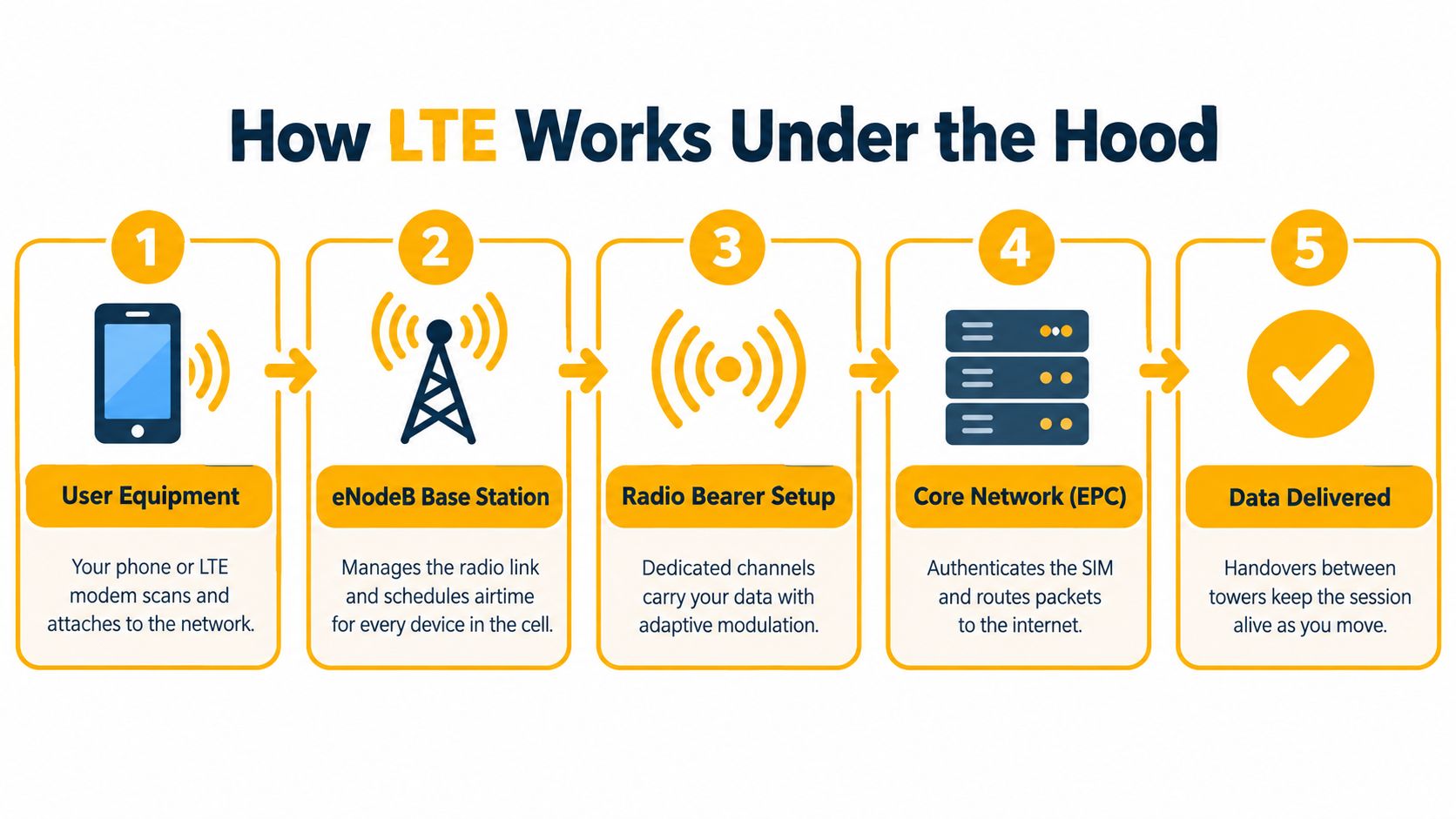
LTE uses an all-IP architecture, meaning voice and data services are handled as packet traffic rather than through the circuit-switched structure associated with older mobile systems. The evolved packet core, or EPC, connects the radio access network to external packet networks. That design reduces unnecessary network hops and supports faster session setup.
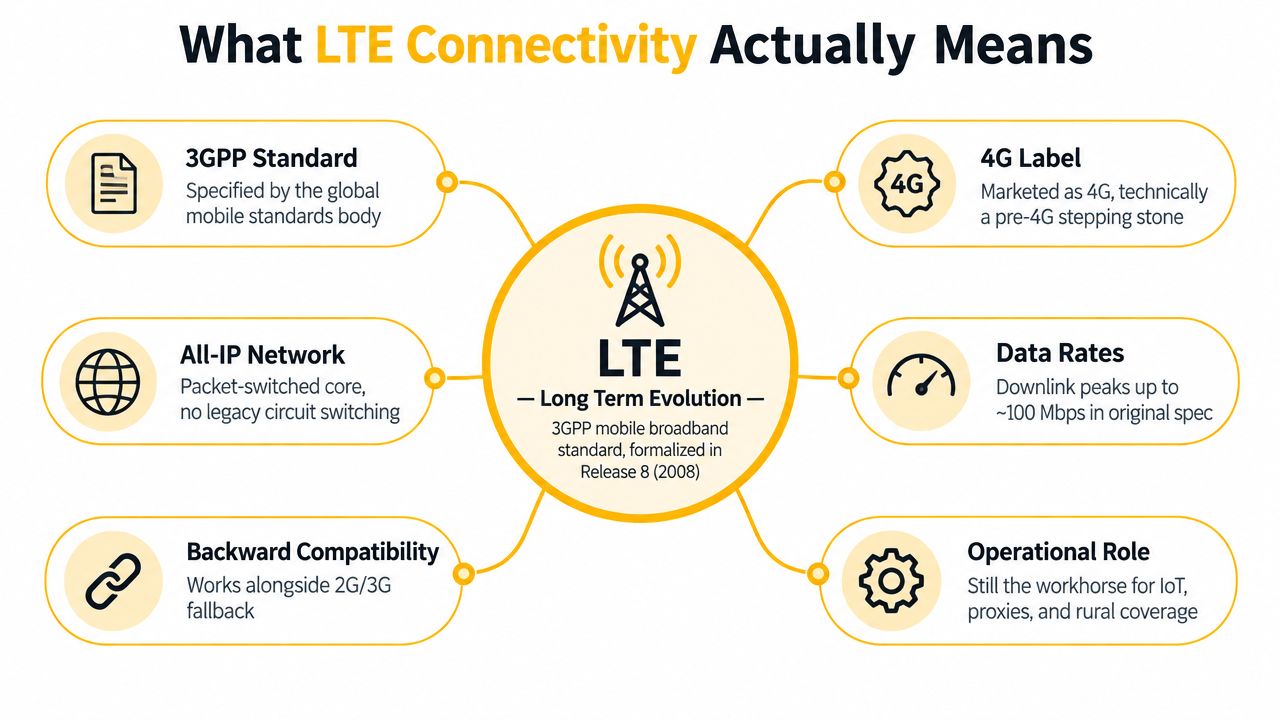
For a marketing or QA team, this distinction has direct consequences. Device category affects expected throughput. Band support affects whether a modem works well in a target region. Network architecture affects latency and connection behavior. In a proxy pool, the LTE label also tells you that the address may originate from a carrier network rather than a hosting facility, which changes how websites may assess it.
How LTE Works Under the Hood
An LTE session starts with user equipment, or UE. That can be a phone, router, embedded modem, or connected machine. The device scans supported bands, identifies a suitable cell, synchronizes with the network, and authenticates through the SIM and carrier core.
The radio connection is managed by an eNodeB, LTE's name for the base station. Think of the eNodeB as a traffic controller for a busy intersection. It doesn't give one device a permanent slice of the road. It schedules small radio resource blocks among many connected devices, adjusting allocations as demand and signal quality change.
LTE uses OFDMA, orthogonal frequency-division multiple access, on the downlink. OFDMA divides a channel into many narrow subcarriers and assigns groups of them to different users. On the uplink, LTE uses SC-FDMA, which has lower peak-to-average power characteristics and helps mobile devices transmit efficiently.
Engineering analogy: MIMO adds lanes to the highway. It doesn't automatically make every vehicle faster, but it lets the network move more data when the device, antennas, and radio conditions support those extra lanes.
MIMO, or multiple-input multiple-output, uses several transmit and receive antennas to send or separate data streams. Higher-order configurations can increase capacity, but only when the device has the required antenna design and the signal provides enough independent paths. A strong LTE signal with a compatible 4x4 MIMO device can behave very differently from a weak signal received by a basic modem.
Spectrum and bandwidth determine the ceiling
Low-band spectrum generally travels farther and penetrates buildings better. Mid-band spectrum offers a balance between reach and capacity. Higher-frequency spectrum can provide more capacity over shorter distances, but obstacles and cell placement matter more.
LTE channel bandwidths range from 1.4 MHz to 20 MHz. Wider channels provide more room for data, while carrier aggregation bonds separate component carriers so an advanced device can use them together. The original Release 8 target in a 20 MHz channel is up to 100 Mb/s downlink and 50 Mb/s uplink. With 4x4 MIMO, later implementations can raise theoretical downlink performance to about 326 Mb/s in the same bandwidth, as explained in this LTE technical overview.
Those are ceilings, not promises. Real throughput depends on spectrum width, modulation, antenna configuration, signal quality, cell load, backhaul, and carrier policy. Latency also varies with radio scheduling, congestion, routing, and the application server. LTE was designed for lower latency and faster session setup than legacy 3G, but a lightly loaded cell and a congested cell won't feel alike.
LTE Compared to 3G, 4G, and 5G
LTE sits between older 3G systems and newer 5G New Radio. The labels overlap in everyday conversation, which creates avoidable confusion. “4G” is often used as a marketing category for LTE, although the original LTE specification and later LTE-Advanced releases aren't identical.
| Generation | Peak Speed | Real-World Throughput | Typical Latency | Coverage |
|---|---|---|---|---|
| 3G | Lower than LTE's original theoretical targets | Often constrained by older radio and network capacity | Higher and less consistent | Broad legacy footprint where still active |
| LTE | Up to 100 Mb/s downlink and 50 Mb/s uplink in the original 20 MHz target | Varies substantially with spectrum, congestion, signal, and device design | Lower than legacy 3G, but dependent on network conditions | Broad, mature mobile coverage |
| 4G LTE-Advanced | Higher theoretical performance through features such as carrier aggregation and advanced MIMO | Depends on compatible network and device combinations | Generally improved capacity and responsiveness | Broad where advanced features are deployed |
| 5G NR | Higher capacity and lower latency potential in suitable deployments | Highly dependent on spectrum, architecture, and coverage | Can reach very low latency in favorable conditions | Uneven, with coverage varying by band and location |
The meaningful comparison isn't just a speed test. Coverage footprint determines whether the connection works inside a building, along a rural route, or during a handover between cells. Device ecosystem maturity affects replacement options, firmware support, and the availability of compatible modules. Latency under load matters more for interactive QA and automation than a peak speed reached for a few seconds.
LTE also changed the service model by moving toward an all-packet network. Older mobile systems used circuit-switched mechanisms for some services, while LTE was designed around packet delivery. That makes LTE a better foundation for always-connected data workflows, including routers, mobile broadband, and machine-to-machine deployments.
5G is the next generation, not an automatic replacement for every LTE connection. Use 5G when the application needs its available capacity or lower latency and the target locations support it. Choose LTE when coverage, mature hardware, predictable carrier access, and operational simplicity matter more than maximum speed.
Why LTE Still Matters in 2026
The assumption that LTE is obsolete doesn't match deployment reality. Independent telecom coverage indicates that 5G subscriptions reached only about one-third of mobile subscriptions in 2025, while Ericsson projects that LTE will continue carrying a large portion of mobile traffic for years. The Ericsson Mobility Report coverage makes the transition clear: 5G traffic is rising, but LTE remains a major access layer.
That matters outside smartphones. A rural router, warehouse scanner, connected vehicle, or location-dependent QA test may use LTE because the local 5G layer is unavailable, congested, or economically unnecessary. A connection that works consistently across the target footprint is more valuable than a faster connection that disappears at the edge of coverage.
The workhorse layer
Carriers also operate LTE and 5G as complementary layers. Some deployments use LTE as an anchor or fallback for mobility and coverage, while newer radio capacity handles compatible traffic where available. The exact architecture varies by operator, but the business conclusion is stable: 5G adoption doesn't remove the need to understand LTE.
LTE remains central to mobile access, particularly where 5G coverage is uneven or device support is mixed. It also supports business connectivity beyond handsets. Enterprise and IoT deployments evaluate power behavior, module category, network persistence, IP reachability, and lifecycle support, not just the icon shown on a screen.
LTE isn't merely a stepping stone in a history lesson. For many workflows, it's the dependable layer that keeps devices and sessions connected when newer coverage isn't consistent.
That durability explains why a mobile proxy can be useful even when a team has access to 5G devices. The relevant question is whether the connection presents a suitable carrier path for the task, with the required geography, session behavior, and reliability.
LTE for Business and Mobile Proxy Workflows
A mobile proxy routes an application's traffic through a connection provided by a mobile carrier. The LTE radio link is only one part of that system. The public IP, carrier network, session policy, and proxy protocol determine how the target website sees the request.
Carrier-grade NAT, or CGNAT, is central to the difference. Mobile operators commonly place subscribers behind shared translation gateways, allowing many devices to use one public IPv4 address. As a result, an address can be shared by genuine mobile users, making blanket IP blocking more disruptive than blocking an address associated with a dedicated hosting facility. This explanation of mobile proxy networking describes why carrier-originated addresses can be harder to classify and block than datacenter addresses.
The concepts that affect workflow design
| Concept | Technical Meaning | Business Implication |
|---|---|---|
| Mobile proxy | Traffic exits through a cellular carrier connection | Useful for testing mobile-origin access and location-dependent behavior |
| Residential proxy | Traffic exits through an address associated with a residential access network | May resemble home-user traffic, but availability and policies vary |
| Datacenter proxy | Traffic exits through infrastructure-hosting networks | Often efficient and fast, but easier for some systems to classify by network identity |
| CGNAT | Many subscribers share translated public addresses | A shared carrier address can have a different reputation profile from a hosting address |
| ASN | An Autonomous System Number identifies a network operator's routing system | Helps teams evaluate whether traffic comes from an expected carrier network |
| IP rotation | The egress address changes according to a schedule or request rule | Useful when a workflow needs distributed access across separate sessions |
| Sticky session | A client keeps the same egress identity for a defined period | Better for login continuity, carts, browsing flows, and multi-step QA |
| HTTP or HTTPS proxy | A proxy interface designed for web requests | Fits browser and web automation traffic |
| SOCKS5 | A general proxy protocol that relays connections and can support remote DNS | Fits broader application traffic and hostname-based routing |
An ASN is the routing identity assigned to an organization or carrier. Teams don't need to memorize carrier numbering to use the concept. They need to confirm that the connection belongs to the expected mobile network rather than an unrelated hosting network.
Rotation and persistence solve different problems. A rotating pool can change the address between requests, which may suit broad market observation or independent location checks. A sticky session keeps one address for a browsing sequence, which is safer for a login flow or a checkout QA test where an identity change could invalidate the session.
HTTP and HTTPS proxies are natural choices for browser traffic. SOCKS5 is broader because it can relay application connections and support remote DNS resolution. Some proxy implementations also encode a country selection in the SOCKS5 username, as described in the SOCKS5 documentation. For country, city, or ASN targeting, this residential proxy overview explains how geographic and network-level selection can support legitimate research and QA.
For a concise implementation reference, see this 4G LTE proxy guide. Configure the session behavior around the workflow, not around a generic preference for rotation.
Real-World Use Cases for LTE Connectivity
A social media team may manage several brand accounts, each with its own approved access process and operating rules. Mobile connectivity can provide carrier-originated egress paths for account administration, regional content checks, and controlled automation. The responsible design keeps credentials separated, respects platform policies, limits request volume, and uses sticky sessions when a task requires continuity.
Ad verification is a more direct QA example. A campaign may target a particular country, city, or carrier environment, but a test run from the wrong network won't prove that the intended audience sees the correct creative. A location-matched mobile connection lets the tester inspect landing pages, redirects, consent flows, and ad rendering from a closer approximation of the user's access path.
Affiliate and PPC teams can use LTE access to validate their own funnels. They can check whether tracking parameters survive redirects, whether a regional offer appears, and whether a landing page behaves correctly on a mobile route. They shouldn't generate artificial clicks, inflate conversions, or bypass advertising controls. The aim is measurement integrity, not fabricated activity.
Where the connection layer adds context
Software QA teams often test more than a page's visual output. They check how an application handles changing latency, intermittent radio conditions, handovers, authentication states, and location-dependent content. An LTE modem or mobile proxy can provide a realistic carrier path for those tests, although a controlled lab still needs separate tools for repeatable network emulation.
Market research and price monitoring teams face another constraint. A request source associated with a hosting network may receive rate limits or additional verification that doesn't appear for ordinary mobile access. A carefully managed mobile pool can help teams collect publicly available information across regions, provided they follow the site's terms, honor robots and access controls where applicable, avoid excessive load, and protect personal data.
Operational rule: Use rotation to distribute independent checks, not to evade access controls. Use sticky sessions when the test represents one real user's journey.
Brand protection teams can apply the same model to counterfeit listings, impersonation checks, and regional storefront monitoring. The value comes from observing what users receive, then recording the time, geography, carrier context, and response behavior so another team member can reproduce the finding. A practical introduction to the underlying category is available in this guide to what a mobile proxy is.
Choosing and Testing an LTE Connection
Start with the location, not the advertised speed. Check the carrier footprint at every important site, including indoor work areas, travel routes, and planned deployment regions. A modem that supports the wrong LTE bands may connect weakly or fail to connect even when the carrier has strong service nearby.
A practical selection checklist
- Confirm hardware compatibility. Decide whether a removable SIM in a modem suits the operation better than embedded hardware. Verify supported LTE bands, antenna connections, firmware maintenance, and carrier approval requirements.
- Match the plan to the workload. Check data limits, throttling rules, roaming terms, and whether the carrier uses CGNAT. For a proxy workflow, clarify whether addresses rotate, whether sessions can remain sticky, and whether the pool has the required country, city, or ASN coverage.
- Separate speed from stability. A peak download result doesn't describe latency under load, packet loss, reconnection behavior, or performance at busy times. Test during the hours when the workflow runs.
- Check the application path. Verify that the intended protocol works, DNS requests resolve as expected, and browser privacy surfaces such as WebRTC don't reveal an unintended route.
- Document the conditions. Record the device, SIM, band, location, signal quality, time, test duration, and target destination. Repeat the test from comparable locations before comparing providers or plans.
For bandwidth, use a reputable speed test for a quick baseline and iperf3 when you control both endpoints and need a repeatable measurement. Test latency while transferring data, because an idle ping can look healthy while the connection queues packets under load.
Proxy buyers should validate behavior on an authorized target site. Confirm the visible country and carrier context, observe whether the IP changes at the promised interval, and test whether a sticky session remains stable across the entire user journey. Also check for DNS and WebRTC leaks, because a correctly routed HTTP request doesn't guarantee that every browser subsystem follows the same path.
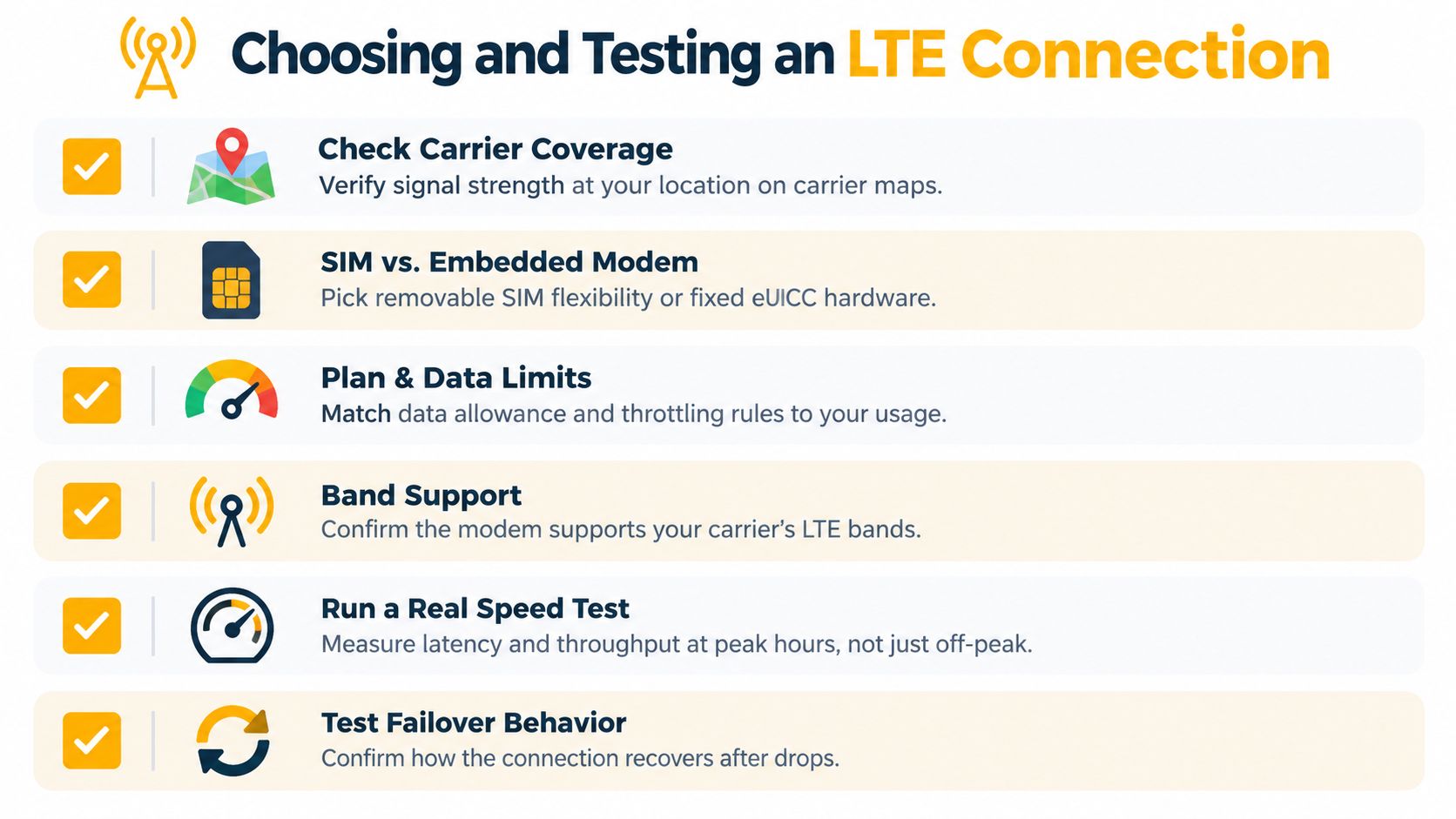
Signal strength, congestion, antenna placement, and device category can all change results. For a focused look at performance considerations, consult this 4G LTE speed resource. Choose the connection that produces repeatable outcomes for the actual workflow, not the one with the most impressive peak number.
Common Questions About LTE Connectivity
Is LTE the same as 4G?
Not exactly. LTE is a 3GPP-defined 4G mobile broadband standard, but the broad 4G marketing label often includes both original LTE and later LTE-Advanced variants. Terms such as LTE+ and LTE-A usually indicate additional capabilities, not a completely separate connection type.
Can LTE replace home broadband?
It can, depending on coverage, data policy, and the household's workload. An LTE modem can provide useful fixed or portable access where wired service isn't suitable, but performance may vary with tower congestion, spectrum, antenna placement, and data limits. Treat it as a location-dependent broadband option rather than a universal substitute.
Is LTE traffic secure?
The cellular radio link includes carrier security mechanisms, but that doesn't make every application automatically private or safe. Use HTTPS, secure account practices, current firmware, and appropriate application encryption. CGNAT changes address sharing and visibility, but it doesn't replace transport security.
Is LTE enough for mobile proxy work, or do you need 5G?
LTE is sufficient for many legitimate workflows, including ad verification, regional QA, market research, price monitoring, and controlled social account administration. 5G can help when the task needs greater capacity or lower latency, but carrier footprint, IP behavior, session persistence, and protocol support often matter more than the generation label.
Use the testing checklist above before committing to a connection. It will reveal whether the route fits your actual geography, application, and compliance requirements.
Evoproxy provides France-based 4G/LTE/3G mobile proxy access with personal and shared ports, configurable rotation, and on-demand session links for workflows that need carrier-based connectivity. Visit Evoproxy to evaluate a mobile connection for compliant ad verification, QA testing, market research, or regional content monitoring.