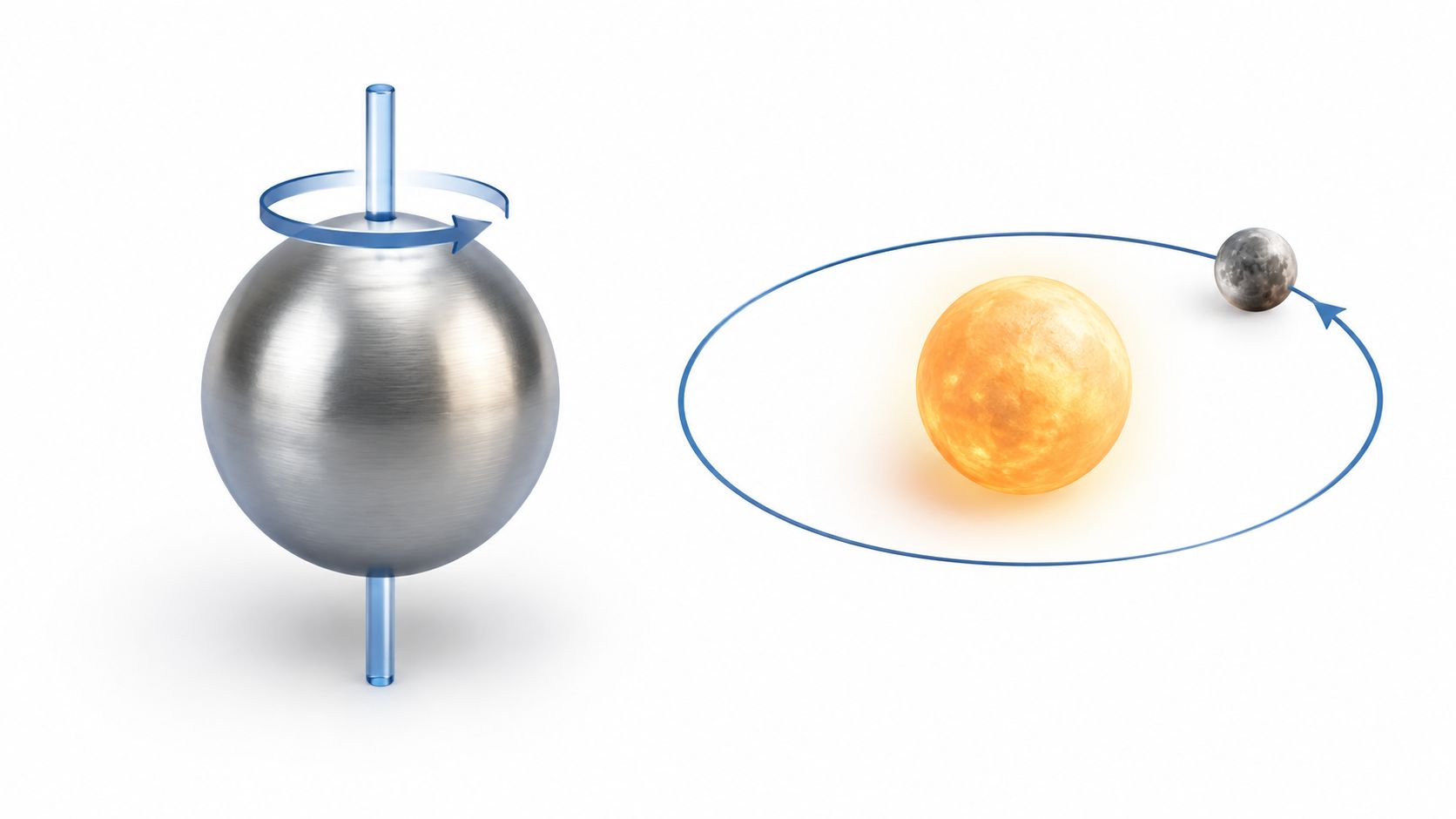
Have you ever explained the difference between rotate and revolve to a student or colleague, only to have them ask why a revolving door is still said to rotate? That question exposes a gap in how we typically teach these terms. Most quick definitions stop at "rotate means spin" and "revolve means orbit," but real-world usage is messier. Technical writers, educators, and professionals need a mental model that holds up under scrutiny, not just a mnemonic for a multiple-choice test. The confusion isn't a sign of poor vocabulary. It happens because everyday English treats these words as near-synonyms while scientific contexts enforce a strict separation based on axis location. Understanding when to apply the simple rule and when to acknowledge the overlap is what separates clear communication from persistent ambiguity. This guide builds that understanding step by step, moving from practical working definitions to the etymological and physical nuances that make the distinction stick.
Understanding the Confusion Between Rotate and Revolve
Why can the same object seem to both rotate and revolve? The answer depends on which motion you are describing. A wheel turns around a line through its center, while the wheel may also travel around a larger track. One motion concerns the object's own axis. The other concerns its path through space.
In everyday conversation, rotate and revolve often work as near-synonyms. Saying that a fan revolves may still communicate that its blades spin, and saying that a planet rotates around the Sun may still be understood even though the usual scientific wording would describe the planet's orbit with another verb. Context usually supplies enough information for casual readers.

Technical and educational writing needs a clearer mental model. Treat the axis as an invisible rod. If the object turns around a rod passing through itself, rotate normally describes that motion. Treat the path as a track around a separate point or body. If the object travels around that external center, revolve normally fits. A planet can therefore do both: it rotates around its internal axis while it revolves around the Sun.
The distinction matters because the two verbs answer different questions. Rotate identifies how an object changes orientation. Revolve identifies how its position changes relative to something outside it. This axis-versus-path test gives teachers, students, and technical writers a reliable starting point without pretending that ordinary English always follows scientific terminology.
Dictionaries also reflect the overlap. They define each term through circular movement around an axis or center, so general usage can treat the words as interchangeable in some situations (Dictionary.com). In astronomy and physics, however, keeping the meanings separate prevents readers from confusing a body's spin with its orbit. In business writing, instructional material, or general explanation, the right choice depends on the audience and the level of precision expected.
Why Context Dictates Usage
Practical rule: When a sentence names both motions, identify the axis-based motion first so readers can classify each verb without rereading. For example, “Earth rotates as it revolves around the Sun” assigns each verb a distinct job.
Apply the chosen convention consistently. Strict terminology supports science education and engineering documentation. Looser wording may sound more natural in marketing or casual prose. The problem begins when one document shifts between these approaches without signaling the change. һөкүмити
Etymology and How Language Shapes the Distinction
Why do rotate and revolve remain easy to confuse after centuries of use? Their histories explain part of the problem. Revolve entered English earlier, recorded between 1350 and 1400, from the Latin revolvere, meaning “to roll back” (Dictionary.com). The older word carried ideas of returning, cycling, and recurring movement, so it developed applications beyond physical motion, including repeated events and cycles.
Rotate arrived later, during the 1800–1810 period, from the Latin rotare, meaning “to cause to spin, roll, or move in a circle.” Its history connects it more directly with spinning motion. As scientific vocabulary became more specialized, rotate gained a particularly clear role in technical descriptions, while revolve continued to serve both everyday and scientific purposes.
Divergent Paths to Modern Synonymy
Historical origins do not permanently control meaning. Over time, dictionaries and ordinary speakers allowed the two words to overlap around the general idea of circular movement. Mechanical devices, astronomy, and familiar descriptions of repeated motion all encouraged flexible usage. Speakers often choose the word that sounds natural rather than tracing its Latin source, especially when no technical measurement or calculation depends on the distinction.
That flexibility creates two working registers. In everyday prose, rotate and revolve can sometimes function as near-synonyms. In science education and technical writing, the traditional separation remains useful because it gives each word a specific task. The same sentence may therefore sound acceptable to a general reader but imprecise to a physics student.
Educational references reinforced the split by describing Earth as rotating on its axis while revolving around the Sun, a pairing that became foundational vocabulary in science classrooms. Teachers can use that familiar pairing as a memory aid, then explain that language conventions depend on purpose. Writers should make the intended register clear and apply it consistently. A technical explanation benefits from the established distinction, while casual prose may tolerate broader usage. Understanding both patterns helps readers interpret older wording and helps writers avoid treating a useful convention as an absolute rule.
Core Definitions and Technical Comparison
Where does the motion's axis sit, inside the object or outside it? That question provides the clearest starting point for separating rotation from revolution in technical writing.
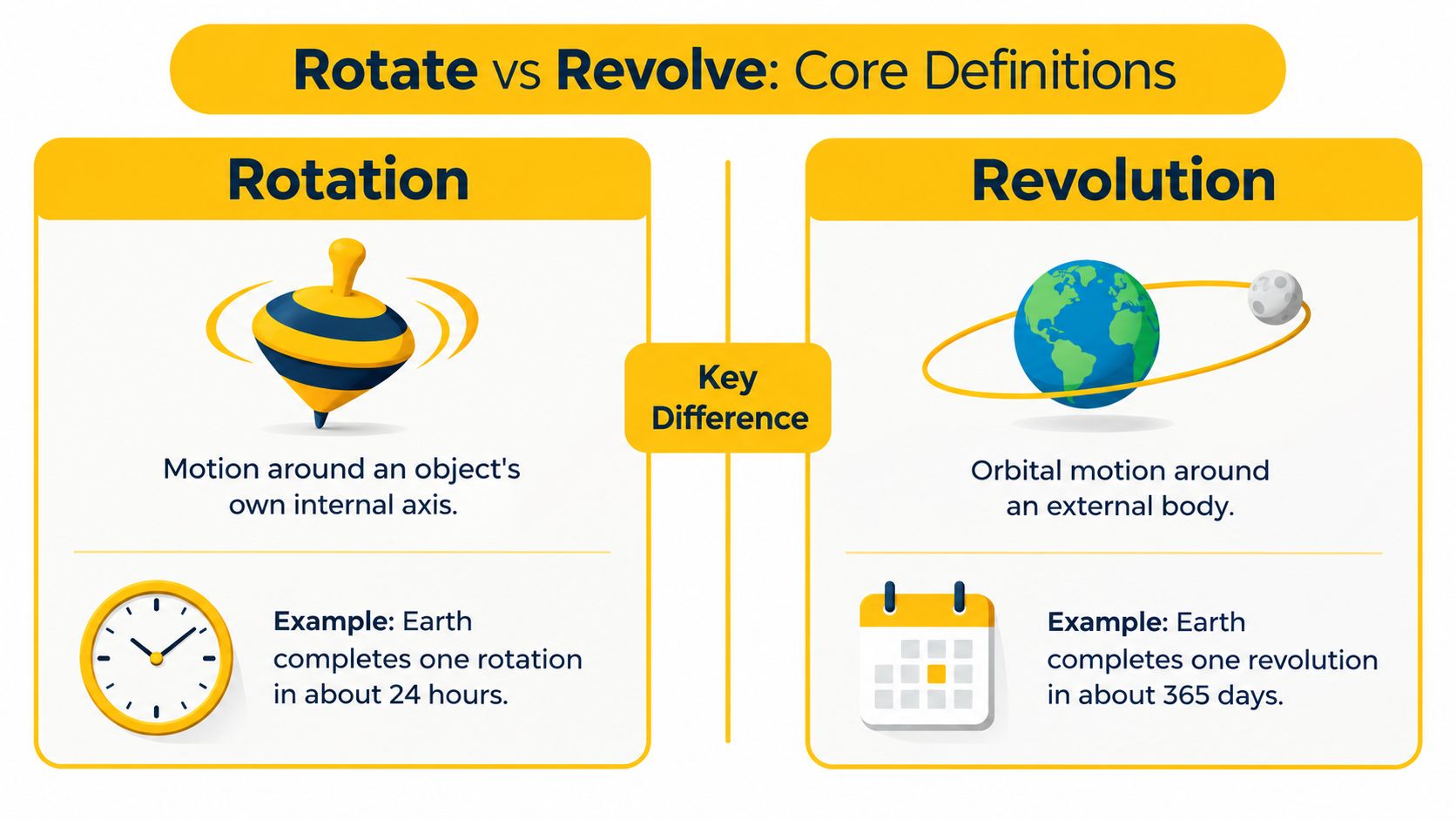
Rotation is motion about an object's own internal axis or center of mass. Revolution is orbital motion around an external point or axis, located outside the moving object (World Wide Words). The distinction describes geometry, not merely the appearance of a circular path. A wheel can rotate while remaining in place, whereas a body can revolve around another body even if its own orientation changes separately.
Real mechanisms can contain both motions at once. A revolving door illustrates the difficulty: each leaf rotates about its hinge axis, while the complete door assembly moves around a central axis. In ordinary language, people may call the entire mechanism a revolving door because users travel around the center. In a technical description, identifying the moving part and its axis removes the ambiguity. An object may also rotate without revolving, or revolve while its orientation changes independently of its path (AskDifference).
Quick Reference Comparison
| Feature | Rotation | Revolution |
|---|---|---|
| Axis Location | Internal to the object | External to the object |
| Motion Type | Spinning about its own axis | Traveling around another body or point |
| Primary Example | A body turning about its center | A body following an orbital path |
| Edge Case | A door leaf turning about its hinge | A door assembly moving around its center |
The table gives a useful first pass, but compound systems require more precise wording. Ask three questions: What object is moving? Which axis or center defines the motion? Is the sentence describing the object's orientation, its path, or both? This procedure helps teachers guide students and helps writers document mechanisms without forcing readers to infer the intended motion. Educational explanations commonly use the same distinction for axial spin and orbital movement (National Geographic Education).
For systems involving both motions, name the axis explicitly in each sentence: “The leaf rotates about its hinge while the assembly revolves about the door's center.” That sentence identifies the moving part, the axis, and the larger path in one step.
Real-World Examples From Astronomy and Everyday Life
What makes the difference between rotation and revolution easier to remember? Watch both motions occur in the same object. Earth provides a clear example: it completes one rotation in about 24 hours and one revolution around the Sun in about 365 days. At the equator, Earth rotates at about 1,600 kilometers per hour (1,000 miles per hour), while it revolves around the Sun at about 107,800 kilometers per hour (67,000 miles per hour) (National Geographic Education). The first motion produces a daily cycle around Earth's axis. The second carries the planet along its yearly path around the Sun.
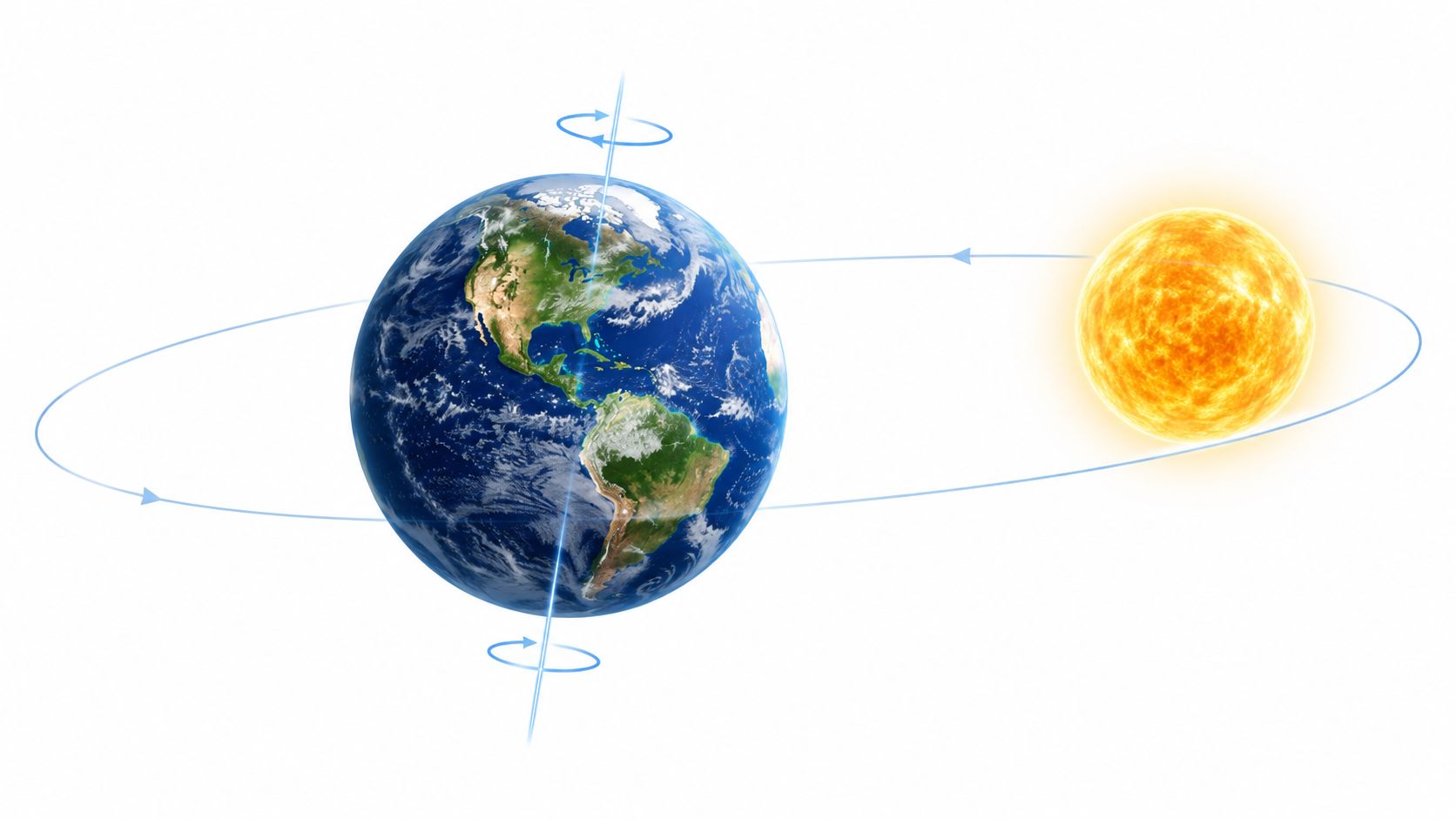
Everyday objects make the same distinction visible at a human scale. A wheel rotates when it spins around an axle through its center. A satellite revolves when it travels around a planet. A revolving door combines both descriptions: each panel rotates around its hinge, while the panel assembly moves around the entrance's central point. The example matters because one object can take part in more than one motion at once. The correct word depends on whether the sentence emphasizes the object's spin, its path, or the complete system.
These examples also show why a simple classroom rule needs careful application. A globe on a stand can rotate about its own axis while the entire model travels around a lamp. A reader who sees only one of those movements may describe the setup inaccurately, even though both descriptions can be correct when they refer to different parts of the system. In technical writing, naming the moving part and its reference point prevents that ambiguity.
Connecting Physical Motion to Digital Systems
The same language appears in digital infrastructure, although the moving element is an address rather than a physical body. Network operations can use cyclical processes to distribute requests and manage changing connections. For web scraping or social media automation, a rotating proxy server cycles through IP addresses at set intervals. The system does not orbit a star, but the repeated change gives technical readers a practical comparison for periodic motion and helps connect familiar workflows with the examples from astronomy.
For educators, observable demonstrations should come before formal terminology. Students who watch a globe spin on its stand while circling a lamp can retain the dual motion longer than a definition presented alone. Writers can apply the same method by choosing a wheel, door, satellite, or planetary example that matches the reader's context. The example then does more than illustrate vocabulary. It shows why everyday speech may blend the terms, while technical writing must identify which motion the sentence describes.
Angular Velocity, Period, and How to Measure Motion
How can two kinds of motion use the same mathematics while describing different situations? The answer becomes clearer when the vocabulary is tied to measurable quantities. Angular velocity describes how quickly an angle changes, whether an object spins or travels around another body. It is commonly expressed in radians per second or degrees per second. Period is the time needed to complete one full cycle.
A rotational period is the time for one complete spin. An orbital period is the time for one complete trip around a central body. The measurements follow the same timing logic, but the physical situations differ. A writer who names the cycle being measured gives readers more information than a sentence that says an object “moves.”
The equations reinforce this overlap. Angular velocity can be written as ω = Δθ / Δt. At a distance r from the axis, tangential speed follows v = rω. During rotation, points farther from the axis cover more distance in the same time, so they have greater linear speed even when the object shares one angular velocity. During revolution, the same relationship connects angular velocity with speed along the path.
Both motions are therefore described by the same angular-velocity equations. The distinction belongs to the application and the reference frame, not to separate mathematics. A general rotate versus revolve terminology comparison can support vocabulary discussion, while the equations provide the physics directly.
Measurement Parallels in Technical Operations
Operational note: Measuring a repeating or response-based process requires a defined event, a consistent unit, and a clear start and end point.
Astronomers use orbital periods to predict recurring positions. Technical teams use elapsed time to evaluate system responsiveness. Learning how to measure latency in a network request follows a related discipline: identify the event, record the interval, and account for conditions that may alter the result. The comparison helps connect an abstract period to a familiar technical measurement without claiming that network latency is an orbit or a spin.
Teachers can turn these measurements into a practical test. Ask students to state what completes one cycle, what point or axis defines the motion, and which quantity is being measured. Writers can apply the same checklist to technical explanations. Naming the period and the measured path makes the intended meaning clear, even when everyday language allows the terms to overlap.
Common Mistakes and Why the Simple Rule Falls Short
Is “rotate on its own axis, revolve around something else” enough to settle every case? It is a useful starting rule, yet technical writing, astronomy, and engineering require more care. In physics, both words can describe angular motion about an axis, so the distinction may disappear in a technical description (Buffalo Rifles). The practical meaning depends on the reference point, the path being emphasized, and the field using the term.
A memorized binary can create false confidence. An object may spin around its own axis while also traveling around another object. Treating the terms as mutually exclusive makes compound motion harder to describe and can cause learners to reject a correct explanation because it contains both words.
Dictionary definitions help with ordinary usage, but they do not settle every technical choice. Major references confirm that everyday speech often treats the terms as near-synonyms (Dictionary.com). A writer who insists on absolute separation in a general explanation may sound pedantic. A scientific writer who ignores the distinction may leave the motion ambiguous. The right choice follows from the intended context, the reference frame, and the feature the sentence needs to highlight.
Where Memorization Fails Understanding
Learner-focused explanations often concentrate on simple examples instead of showing why the distinction changes with context. That leaves readers unprepared for cases that sit between familiar classroom definitions and technical description.
A revolving door illustrates the problem: in ordinary language, it “revolves,” while each panel also rotates around the door's central axis. A tidally locked moon revolves around its parent while rotating once in a way that keeps the same face directed toward that parent. A spinning top rotates and may precess, meaning its axis changes direction as it moves. These examples show that motion can contain several components at once.
Teaching correction: Replace rote recall with scenario analysis. Ask learners to identify the axis, locate the reference point, describe the path, and state which part of the motion the sentence emphasizes. Then have them justify the chosen term.
Clear explanations should also acknowledge ordinary language. Searchers who find only one-line definitions may still struggle when a real example combines spinning and orbital movement. Writers can respond with a worked example for each gray area, explain the scope of the simple rule, and state where everyday usage permits overlap. That approach gives readers a method they can apply to unfamiliar cases instead of another definition to memorize.
Teaching Tips and Best Practices for Clear Usage
Teach the practical rule first, then add the qualifications that make it reliable. Begin with a simple classroom or workplace example and explain what the term highlights. After learners can apply that rule, introduce cases in which one object has more than one motion. This order keeps early explanations manageable without treating the simple rule as universal.

Use diagrams that mark the relevant axis and show the object's movement over time. A globe, fidget spinner, or door hinge can make the difference between spinning in place and moving around another point easier to see. Ask learners to describe what they observe before supplying the technical term. For digital audiences, a familiar process such as user-agent rotation can connect repeated change around a system with a broader technical meaning of rotation. The example should support the concept, not replace the physical explanation.
Writing Guidelines for Technical Documentation
- Define Early: State how the document uses rotate and revolve near the beginning. Readers then know which convention applies.
- Be Consistent: Keep the same technical or general register throughout the document. Switching between them without warning creates ambiguity.
- Specify Compound Motion: Describe rotational and orbital components separately when both occur. This makes the sentence clear even if the system has several simultaneous movements.
- Use Measurable References: Refer to periods, velocities, or observable cycles where those details matter. These references show what is being measured rather than leaving the distinction at the level of vocabulary.
- Acknowledge Overlap: Briefly explain that everyday usage may differ from the document's technical convention. Readers can then interpret other sources without assuming that one wording is always wrong.
A glossary helps non-specialists. Define both terms according to the document's chosen convention, then note that ordinary usage may apply them more broadly.
Technical accuracy also matters outside classrooms. Social media managers, data teams, and growth marketers may need to describe automated systems or explain workflows to stakeholders. Training materials, API documentation, and client reports should identify the motion or process being discussed, state the reference used, and separate overlapping components. Clear wording gives readers instructions they can act on and reduces avoidable clarification requests.
Sample Exam-Style Questions and How to Answer Them
How can an exam question reveal whether a learner understands rotate vs revolve, rather than remembering two definitions? Application scenarios provide the answer. Consider this prompt: “A satellite maintains a fixed orientation toward Earth as it completes one orbit. Describe its motion using precise terminology.” A strong response states that the satellite revolves around Earth while rotating once during each orbit. Its rotational period matches its orbital period, producing synchronous motion. This answer identifies both components instead of treating the motion as a single category. The distinction matters in technical writing because one object can rotate and revolve at the same time.
A definition question should make the reference axis explicit: “What distinguishes rotational motion from orbital motion in kinematic terms?” The answer should explain whether the axis passes through the object or lies outside it, rather than relying only on the shorthand “spinning versus orbiting” (World Wide Words). That criterion helps learners classify unfamiliar systems. It also shows why everyday wording and technical wording can overlap without making either use automatically incorrect.
Misconception Identification Exercises
Give learners statements that contain a specific error, then ask them to correct both the terminology and the underlying idea. For example: “The Earth revolves once every 24 hours.” Students should identify the confusion between rotational and orbital periods. A corrected answer states that Earth rotates daily and revolves around the Sun annually (National Geographic Education).
Use a second prompt to test whether students understand the limits of a simple rule: “In physics, rotate and revolve always describe different types of motion.” Advanced students should explain that both terms can describe angular motion about an axis. The distinction depends on the chosen reference and the context, so the words should not be treated as universally separate categories (Buffalo Rifles).
These exercises develop the habit of checking a claim before accepting it. Wrong answers show whether the difficulty lies with the axis, the period, or compound motion. If learners confuse the axis, use a physical object and mark its internal and external reference points. If they confuse periods, ask them to name what completes one cycle. Questions that require a reason, not just a label, prepare students to read textbooks, technical documents, and everyday explanations more accurately.
Evoproxy provides mobile 4G proxies with configurable IP rotation intervals from one to five minutes for compliant social media management, ad verification, and market research. Visit Evoproxy for details.


