
Your dashboard is steady, your collection jobs have been running for weeks, and then a target starts returning CAPTCHAs halfway through a campaign. Or your social media team notices that public-profile monitoring has slowed while a competitor appears to be collecting the same information without interruption. The first fix many teams try is changing the User-Agent header.
That can help, but only at the shallowest layer. User agent rotation changes the browser identity a request claims to use. It doesn't automatically change the IP reputation, TLS handshake, HTTP/2 behavior, cookies, JavaScript environment, or request timing that a modern defense can correlate. Used properly, it supports a coherent session identity. Used as a random string generator, it can make an otherwise ordinary scraper easier to classify.
What User Agent Rotation Actually Does in 2026
A user agent is a request header that identifies the claimed browser, operating system, and client family. User agent rotation varies that value across identities so a collection system doesn't present every request as the same client. More complete implementations also align related hints such as Accept-Language and Sec-CH-UA, which describe locale and browser-family details.
The useful mental model is a stack. The proxy IP and ASN provide the network identity, the user agent and companion headers provide the claimed browser identity, and behavior supplies the strongest context. A request that claims to come from a current desktop browser but arrives from a low-reputation datacenter range, uses an incompatible TLS signature, and requests pages at machine-like intervals still looks inconsistent.
Historical traffic research shows why fixed identifiers became a weak operational choice. A 2017 SIGCOMM IMC study found that the most prevalent user agents represented only 26% of traffic, and identified 94,876 unique user-agent strings across more than 40 million HTTP flows in a malicious-activity detection dataset. Those findings illustrate how fragmented real client traffic can be, but they don't mean a large random list is automatically realistic. The practical lesson is to avoid presenting every request with one hard-coded label, while keeping each selected identity internally consistent. The SIGCOMM IMC study provides the underlying historical context.
Practical rule: Rotate complete browser-shaped identities between sessions, not isolated strings between adjacent requests.
What it helps with
Rotation can reduce simple rules that reject a repeated library default or a small, static set of client labels. It can also distribute traffic across browser families and device categories when your legitimate workflow represents multiple audiences, such as regional ad verification, mobile QA, or market research.
It won't solve a transport-layer mismatch. Recent guidance reports that among 54,945 unique user agents, 51,268, or 93%, were identified as bots by a user-agent coherence method, showing how often a plausible-looking header conflicts with the rest of a request. The same guidance says that against stronger defenses, user-agent rotation on its own contributes roughly nothing because TLS and browser fingerprints carry more weight. The practical analysis of user-agent rotation makes that limitation explicit.
Treat the header as a claim, not a disguise. If the rest of your client can't support the claim, rotating it adds noise without adding trust.
The Request Fingerprint and Why Headers Alone Are Not Enough
A modern request fingerprint contains several signals that defenders can evaluate together. The visible User-Agent is only one of them.
The layers that need to agree
Start with the network path. The IP subnet, ASN, and geography should make sense for the browser profile and task. A desktop browser claim from a mobile carrier network may be plausible for some traffic, but it becomes less plausible if every other signal says desktop. A claimed local user also shouldn't appear to jump between incompatible regions during one session.
The TLS handshake comes next. JA3 and JA4 are shorthand for methods of describing a client's TLS negotiation. They can expose that a request was created by a generic HTTP library even when its header says it is a familiar browser. HTTP/2 settings, connection reuse, header ordering, and compression negotiation add another layer.
Then come browser-level signals. Sec-CH-UA, Sec-CH-UA-Mobile, and Sec-CH-UA-Platform should agree with the main string. Accept-Language should fit the claimed locale. Cookies should persist like a browser session, while viewport dimensions, JavaScript execution, and navigation timing should describe the same device class.
A desktop Chrome string with no coherent client hints, an unusual header order, and a generic TLS profile may be flagged quickly. Changing only the string doesn't repair those contradictions. Teams dealing with this broader layer should treat fingerprint protection guidance as a separate engineering concern rather than assuming headers solve it.
| Signal | Low-effort scraper request | Browser-shaped request |
|---|---|---|
| User agent | One copied string for every task | Current string selected from a maintained profile |
| Client hints | Missing or inconsistent | Matches browser family, platform, and mobile state |
| Locale | Fixed language unrelated to target | Accept-Language fits the selected geography |
| TLS | Generic library handshake | Handshake supported by the claimed client |
| Header order | Library default ordering | Consistent with the client implementation |
| Cookies | Recreated or discarded often | Preserved for the session |
| Timing | Identical, rapid intervals | Request pacing follows the workflow |
| IP identity | Static or mismatched egress | Proxy geography and session behavior fit the profile |
The important distinction is between changing a label and maintaining an identity. User agent rotation earns its place only when the selected label agrees with the network, protocol, and browser behavior around it.
Building a Realistic User Agent Pool
A useful pool is small, current, and internally consistent. Copying a long list from an old snippet creates maintenance work and increases the chance that one profile claims a browser version, operating system, or engine combination that no longer makes sense.
Start with profiles, not strings
Pull current browser strings from a maintained source, then remove entries that are stale or structurally inconsistent. A practical production guide recommends 5 to 15 well-maintained, market-share-weighted user agents, with desktop Chrome carrying more weight globally and Safari receiving more weight for U.S.-targeted traffic. The user-agent rotation guide also emphasizes that a small set of consistent profiles is more useful than a large collection of old values.
For each profile, store a complete bundle:
- Main identity: User agent, browser family, platform, and mobile state.
- Locale signals:
Accept-Languageand the intended geography. - Client hints:
Sec-CH-UA,Sec-CH-UA-Mobile, andSec-CH-UA-Platform. - Navigation metadata: A coherent
Sec-Fetch-*set for the request type. - Transport support: A client capable of producing a protocol fingerprint that fits the profile.
Weight the pool rather than choosing uniformly. Desktop browser profiles can receive more traffic when that reflects your audience. Mobile profiles should be selected for mobile workflows, not because they appear less scrutinized.
Return a bundle
A minimal Python pattern can return a profile object instead of a bare header:
import random
profiles = [ { "name": "desktop_chrome", "weight": 7, "headers": { "User-Agent": "CURRENT_DESKTOP_CHROME", "Accept-Language": "en-US,en;q=0.9", "Sec-CH-UA": "MATCHING_CHROME_HINTS", "Sec-CH-UA-Mobile": "?0", "Sec-CH-UA-Platform": '"Windows"' } }, { "name": "mobile_safari", "weight": 2, "headers": { "User-Agent": "CURRENT_IPHONE_SAFARI", "Accept-Language": "en-US,en;q=0.9" } } ]
def choose_profile(): return random.choices( profiles, weights=[p["weight"] for p in profiles], k=1 )[0]
In Node, the same idea can stay deliberately simple:
const profiles = [ { name: "desktop_chrome", weight: 7, headers: { "user-agent": "CURRENT_DESKTOP_CHROME", "accept-language": "en-US,en;q=0.9", "sec-ch-ua": "MATCHING_CHROME_HINTS", "sec-ch-ua-mobile": "?0", "sec-ch-ua-platform": ""Windows"" } }, { name: "mobile_safari", weight: 2, headers: { "user-agent": "CURRENT_IPHONE_SAFARI", "accept-language": "en-US,en;q=0.9" } } ];
function chooseProfile() { const total = profiles.reduce((sum, p) => sum + p.weight, 0); let point = Math.random() * total; for (const profile of profiles) { point -= profile.weight; if (point <= 0) return profile; } return profiles[profiles.length - 1]; }
Don't rotate a mobile identity through a desktop session. Don't attach Chrome client hints to a different browser family. Those small mismatches are more damaging than using a single, honest profile for a low-friction target.
Pairing User Agent Rotation With Proxy Rotation
The user agent and egress IP should be treated as one identity. Rotating the header while keeping one static datacenter address creates a repeated network origin with changing browser claims. Rotating the proxy while pinning one browser build creates the opposite pattern. Neither is automatically wrong, but both need to match the workflow you're modeling.
Proxy categories have different trade-offs. Datacenter proxies are generally fast and economical for public, low-friction pages where the target doesn't heavily score IP reputation. Residential proxies use consumer-network egress and can better fit geographically distributed household traffic. Mobile proxies use 4G, 5G, or related carrier connectivity, which can be harder to block because the addresses belong to mobile networks and share the traffic patterns of real subscribers.
Mobile networks also introduce a specific complication, Carrier-Grade NAT, or CGNAT. It lets many subscribers share one public IPv4 address, and the IETF reserved the 100.64.0.0/10 shared address space for this carrier-level use in RFC 6598. The explanation of CGNAT and shared mobile IPs is useful when interpreting why an IP may represent many unrelated users. Shared carrier addressing can improve plausibility, but it also means IP reputation isn't a perfect measure of one operator's behavior.
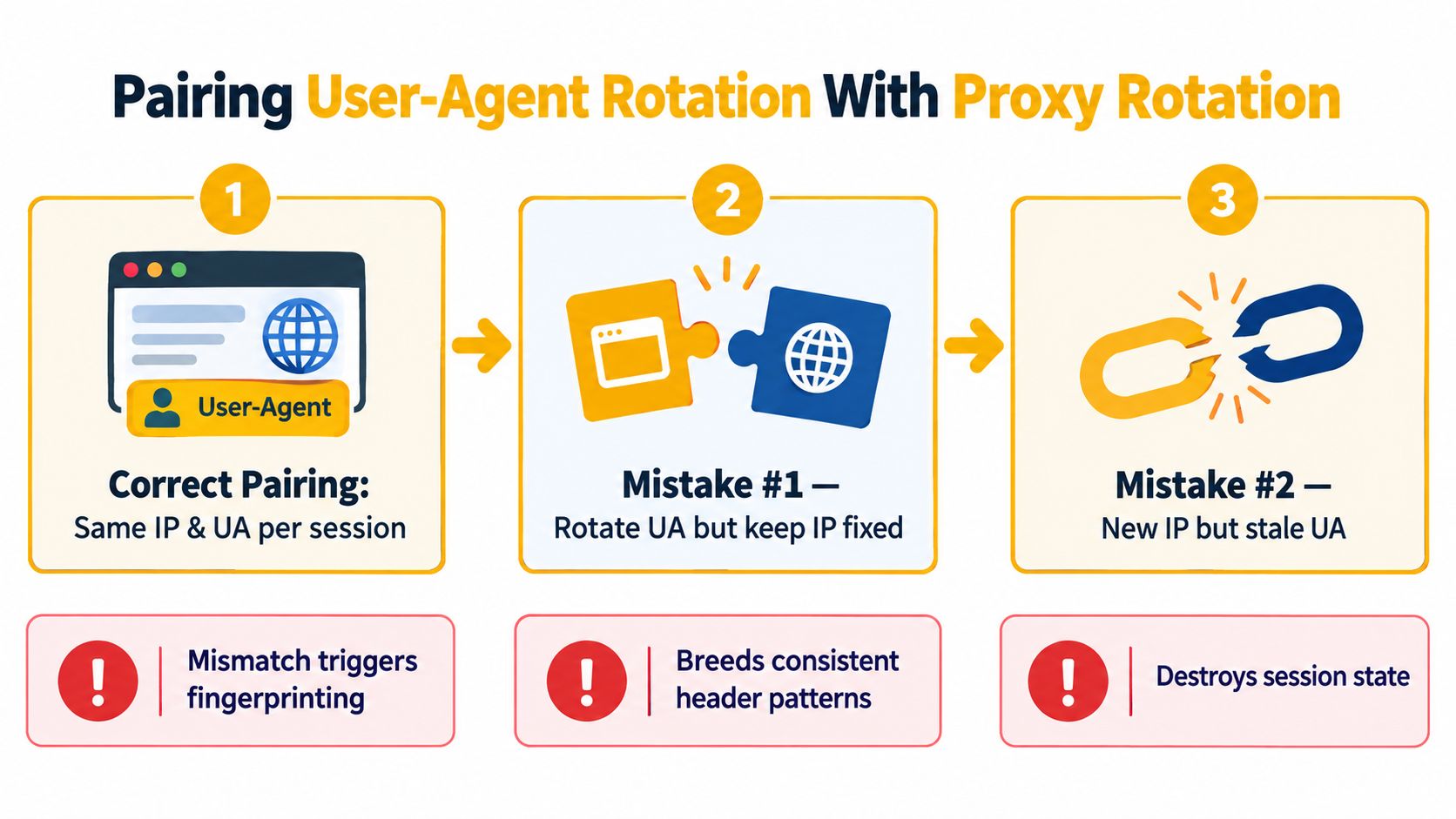
Bind identities to sessions
A sticky session preserves the same exit IP for a defined period. A rotating session changes the exit address between requests or after a configured interval. HTTP and SOCKS5 are common forwarding families. SOCKS5 works at the transport layer across different application protocols, while HTTP proxies are commonly used for web traffic. HTTP keep-alive can also preserve an exit IP inside one TCP connection, so a new connection may be required before a new address appears. This proxy protocol overview covers those connection-level details.
A small Python helper can bind the profile and proxy session key:
import uuid
class IdentitySession: def init(self, profile, proxy_endpoint): self.session_key = str(uuid.uuid4()) self.profile = profile self.proxy = f"{proxy_endpoint}?session={self.session_key}"
def request_options(self): return { "headers": self.profile["headers"], "proxies": { "http": self.proxy, "https": self.proxy } }
In Node, keep the same association at the browser or context boundary:
function createIdentity(profile, proxyEndpoint) {
const sessionId = crypto.randomUUID();
return {
sessionId,
profile,
proxy: ${proxyEndpoint}?session=${sessionId},
signal: AbortSignal.timeout(120000)
};
}
Use residential or mobile egress when IP reputation, geography, or carrier context matters. Datacenter egress still has a place for low-friction collection, internal QA, and workloads where speed and cost matter more than consumer-network similarity. Follow the target's access rules and keep collection limited to legitimate, authorized purposes. For routing mechanics, rotating proxy server guidance provides a useful reference.
Holding One Identity Per Session Instead of Per Request
The reflex to rotate on every request is usually counterproductive. A real browser doesn't change from one browser build to another between two page loads, while the scraper that flips identities on every GET creates a clear session anomaly.
A session carries state beyond cookies. The TLS connection may be reused, header ordering remains stable, client hints describe one browser family, and viewport or JavaScript results continue to represent one device. If the first request claims desktop Chrome and the next claims mobile Safari while using the same cookies and connection, the server has an easy inconsistency to score.
A session-level pattern
Keep the identity immutable inside the session object:
import requests
class StickyIdentity: def init(self, profile, proxy): self.session = requests.Session() self.profile = profile self.proxy = proxy self.session.headers.update(profile["headers"])
def get(self, url, **kwargs): kwargs.setdefault("proxies", { "http": self.proxy, "https": self.proxy }) return self.session.get(url, **kwargs)
identity = StickyIdentity(profile, proxy) response = identity.get("https://target.example/page")
The Node equivalent can scope a browser context to one identity and cancel it cleanly:
async function runIdentity(browser, profile, proxy, work) { const controller = new AbortController(); const context = await browser.newContext({ proxy, extraHTTPHeaders: profile.headers, userAgent: profile.headers["user-agent"] });
try { return await work(context, controller.signal); } finally { controller.abort(); await context.close(); } }
The practical guide to session persistence explains why a sticky routing mode is different from request-level rotation. The session key, cookies, proxy route, and header bundle should move together.
| Dimension | Rotate every request | Rotate per session | Notes |
|---|---|---|---|
| Identity continuity | Poor | Strong | Session state expects continuity |
| Implementation | Simple | More deliberate | Store a complete profile object |
| Detection risk | Higher when state persists | Lower when signals agree | Context matters more than randomness |
| Best fit | Stateless, low-friction checks | Browsing, login, cart, and page journeys | Use the smallest identity boundary that fits |
| Exceptions | Broad sampling across independent contexts | Default for normal visits | Ad verification may require many geo identities |
Per-request rotation still has narrow uses, such as independent ad-verification checks across many locations where each request represents a separate observation. It shouldn't be the default for a multi-page visit, authenticated workflow, or any task where cookies and navigation history matter.
Testing, Monitoring, and Detecting Fingerprint Drift
A rotation system needs observability. A request returning HTTP success isn't enough if the body is a challenge, incomplete page, or altered result. Monitor the identity as a production dependency, not as a header dictionary hidden inside a worker.
Track three operational signals
First, measure success rate by user-agent family. A sudden decline for one profile usually points to stale browser metadata, a bad pool entry, or a mismatch with the associated proxy route. Second, track CAPTCHA or ban responses from the first contact through the early part of a session. A spike soon after a new identity begins often indicates an IP or transport problem rather than a missing string.
Third, record fingerprint drift. Compare the declared browser family and platform with the TLS client behavior, HTTP version, header ordering, and available client hints. If your client claims a current browser but emits a library-shaped handshake, mark that identity unhealthy instead of repeatedly retrying it.
The supplied field benchmark gives a clear warning about shallow fixes. On a 252-URL fixture set, Python requests with user-agent rotation reached 37.3% success, while a client impersonating Chrome 131 reached 78.2%. The benchmark report shows why deeper browser alignment can matter more than changing the visible header.
Make alerts actionable
Use thresholds that reflect your own baseline rather than copying someone else's. For example:
- Pool health: Alert when one browser family underperforms its normal baseline across a sustained sample.
- Early challenge rate: Quarantine an identity when CAPTCHAs appear immediately after session creation.
- Transport mismatch: Treat a TLS client hello that contradicts the claimed browser as a hard failure.
- Proxy diagnosis: If every profile fails on one route but works elsewhere, investigate the proxy layer first.
- Content validation: Compare expected page structure, not just status codes.
A compact event format is enough for a metrics pipeline:
{ "metric": "collector.identity_request", "ua_family": "desktop_chrome", "proxy_type": "mobile", "geo": "target_locale", "status_class": "success", "captcha": false, "tls_profile": "browser_aligned", "header_order": "expected" }
Run A/B tests with a current pool and a deliberately narrow control group. Retire stale entries dynamically by marking them unhealthy in shared configuration, then replace them without redeploying every worker. If failures track one ASN, geography, or proxy session rather than one user-agent family, stop editing headers and fix routing, reputation, or session boundaries.
Best Practices Checklist and Where to Go Next
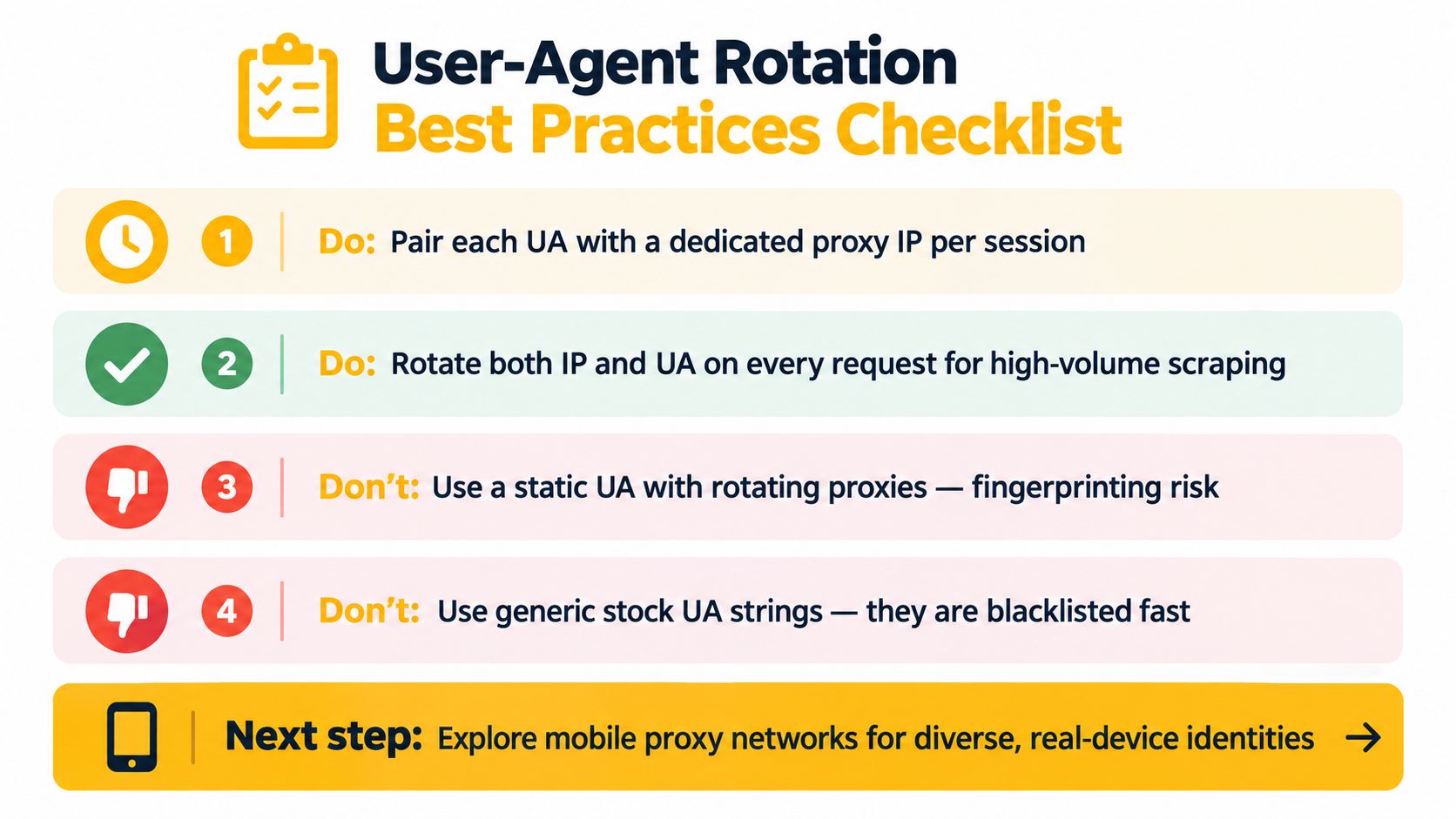
User agent rotation works when it supports a coherent identity model. It fails when teams treat it as a cosmetic change applied after the rest of the request has already contradicted the claim.
Identity hygiene
- Match the network: Select a proxy geography and network category that fit the browser profile and use case.
- Match the protocol: Keep TLS, HTTP/2 behavior, header ordering, and client hints compatible with the claimed browser.
- Match the locale: Align
Accept-Language, target geography, and browser platform instead of mixing unrelated signals. - Review code paths: Search for a desktop user agent paired with a mobile route, a Chrome string without matching
Sec-CH-UA, and any header mutation inside a live session.
Pool management
Maintain a short, current pool rather than a huge archive. Weight profiles according to the traffic you legitimately represent, retire stale versions, and store complete bundles with metadata. A profile should include its expected platform, mobile state, locale, and transport requirements.
Generic stock strings are a poor foundation because they often lack the companion headers and protocol behavior that make them credible. The historical traffic evidence and recent coherence findings point in the same direction. Diversity matters, but consistency matters more.
Session discipline and monitoring
- Use one identity per visit: Keep the user agent, companion headers, cookies, and proxy session together.
- Rotate at logical boundaries: Change identities between independent tasks, geographies, or sessions, not between two linked page requests.
- Measure content quality: Detect challenges and degraded pages even when the server returns a successful status.
- Quarantine drift: Remove profiles that show transport mismatches or early challenge behavior.
- Respect authorization: Use automation for legitimate research, QA, ad verification, price monitoring, brand protection, and account operations that comply with applicable platform rules.
For teams collecting social data or validating affiliate and advertising flows at scale, mobile 4G connectivity can provide a more appropriate IP-layer context than a generic datacenter route. Evoproxy offers configurable mobile proxy sessions, including time-based rotation and session-oriented routing, so you can test whether carrier-based egress fits your identity model without making the user-agent layer carry the entire burden.
Evoproxy provides mobile 4G proxy connectivity for workflows such as social media operations, geo-dependent QA, market research, and affiliate verification, with configurable session and rotation behavior. Visit Evoproxy to evaluate mobile IP routing alongside your browser-profile strategy and build a more consistent identity stack.


