
A research team can collect two plausible views of the same product and still misread the market. One analyst sees a regional promotion; another does not. Both records may be accurate for their respective sessions, yet neither establishes what shoppers in the target market see.
Proxies for market research let researchers observe prices, ads, search results and product pages through a chosen location and network. The practical trade-off is that more requests do not necessarily produce better evidence: repeated or poorly targeted checks can distort the sample and increase compliance risk. A sound proxy setup prioritizes whether observations represent the market, even when that means collecting less data and making fewer requests.
Why Market Research Teams Use Proxies
A product page may offer delivery to one postal area but reject the same order from another. For a research team assessing market access, that difference can affect whether a product is available to local shoppers, not just what the page displays.
A proxy forwards a request so a target site sees an IP address associated with a different location and network. That can help analysts inspect prices, product availability, advertising and search results from a defined market. For structured competitive intelligence gathering, the useful output is evidence about the market, not just a successful page request.

Research teams have long used samples to estimate broader behavior. Consumer panels follow a selected group of households over time, and the history of the U.S. consumer panel industry traces that method's development. Modern datasets in this tradition track purchases from approximately 40,000 to 60,000 U.S. households, with longitudinal records available from 2004 onward.
The same discipline applies to proxy research: collect observations systematically, repeatedly and with calibration against the population in question. A page retrieved through a proxy is still a sample, shaped by location, network and other signals the site may use. If those conditions do not match the research question, a clean request can still produce misleading evidence. A sound design sets the required location and sample scope in advance, then limits collection to what can answer the question. That means judging proxy performance by whether the results support valid decisions, not by request volume alone.
Mobile, Residential and Datacenter Proxies Compared
Start with network origin, because that's what a target site evaluates first. Mobile proxies use addresses issued by 4G, LTE and 5G carriers. Residential proxies use consumer ISP address space, while datacenter proxies use hosting-provider address space.
Proxy types compared for market research
| Proxy type | Where the IP comes from | How targets tend to see it | Best research fit | Main trade-off |
|---|---|---|---|---|
| Mobile 4G/5G | Carrier networks, usually behind carrier-grade NAT | Looks like ordinary phone traffic on a carrier ASN; one IP is shared by many subscribers | Social listening, mobile-web QA, ad checks on mobile feeds | Speed and IP changes depend on carrier conditions; usually costlier |
| Residential | Consumer ISP address space | Looks like home broadband; reputation varies by pool | Price and catalogue monitoring, country-level content checks | Quality depends on the pool, so check the source |
| Datacenter | Hosting-provider address space | Recognizable by hosting ASN; more often rate-limited, blocked or served altered content | High-volume checks on public pages that permit automated access; speed-sensitive tests | Lower trust with many platforms; expect more blocks |
Why mobile traffic looks different
Carrier-grade NAT, or CGN, lets a mobile carrier place many subscribers behind a translation layer so they share one public address. One IP can therefore represent many real phones at once. RFC 6598 on shared address space reserves 100.64.0.0/10 for service-provider networks that connect customer equipment to CGN devices, and that range isn't globally routable.
That structure explains why mobile IPs are harder to flag. The traffic resembles ordinary phone use, the ASN, the autonomous system number identifying the network operator, belongs to a mobile carrier, and blocking one shared address risks hitting many genuine users. Platforms tend to be cautious for that reason. It doesn't guarantee access or anonymity, and IP reputation still needs context from ASN, carrier, geography and session behavior.
Datacenter traffic sits at the other end. A hosting ASN is easy to recognize, so requests are more often rate-limited, blocked or served altered content without warning. Residential traffic sits between the two. It looks like home broadband, but its quality depends heavily on how the pool was sourced and maintained.
Practical rule: Start with the cheapest proxy type that passes your validation checks, then escalate only when the data shows you need to.
Match the type to the task rather than buying one pool for everything. Use mobile for social listening and mobile-web QA where the phone experience is the object of study. Use residential for catalogue monitoring and country checks. Use datacenter for high-volume public-page work where speed and cost matter most and automated access is permitted. A mismatch in either direction costs you, either in money or in silent data distortion.
Geo-Targeting Accuracy by Research Question
Testing what a site shows in a country is a different job from estimating demand in that country. Confusing the two is where many proxy-based studies go wrong. Proxies are good at the first job and, on their own, weak at the second.
Geo-targeting means a website or platform serves content based on where a visitor appears to be. IP geolocation is the estimate of where an address sits. Neither is the same as a customer's true location, and the gap is largest on mobile networks.
Research summarized by the Internet Society reports median mobile geolocation errors of roughly 179 to 207 km across tested providers, with failure rates exceeding 50% in parts of Africa and Asia and remaining below 20% in Europe, according to the Internet Society analysis of mobile IP geolocation. Carrier NAT, centralized gateways and dynamic routing can place a handset's public IP far from the phone itself. Fixed broadband geolocation is materially more reliable.
Location precision needed by research question
| Research question | Precision needed | Proxy setup | How to validate |
|---|---|---|---|
| Country price or currency check | Country | Residential or mobile IP in the target country | Compare displayed currency and tax lines with a manual browse from the same country |
| Regional availability or delivery eligibility | Region or postcode, verified rather than assumed | Mobile IP on a target carrier where offered | Repeat across several IPs and sessions; record variation |
| Local demand estimate for one city | City level; IP geolocation alone is not reliable enough | Use proxies to test content only; combine with first-party or panel data | Independent validation; report an uncertainty range |
| Ad delivery check in one market | Country, sometimes region | Mobile or residential IP in the market | Compare the served creative and placement with platform delivery reports where available |
| Language or locale variant QA | Country and language | Any in-country IP | Check page language, locale settings and currency on each run |
Country-level checks for currency, language, eligibility rules and promotions are usually dependable enough for content and pricing verification. City-level conclusions need independent validation before you publish them. Choosing between geo-targeted proxies at country, region or carrier level should follow the claim you intend to make, not the finest option on offer.
Validate with a fixed routine. Run repeated tests across several IPs and access networks. Compare returned location metadata with known endpoints, and record whether results vary by carrier and session. Set the precision level before you buy, so the setup matches the statement you plan to defend later.
Proxy Features Worth Paying For
Choose proxy features based on their effect on research validity. Geographic accuracy and session control determine which market pages and prices you can observe, while pool quality affects how often you encounter reused or flagged IPs. For text-focused research, bandwidth can be a lower priority than those controls.
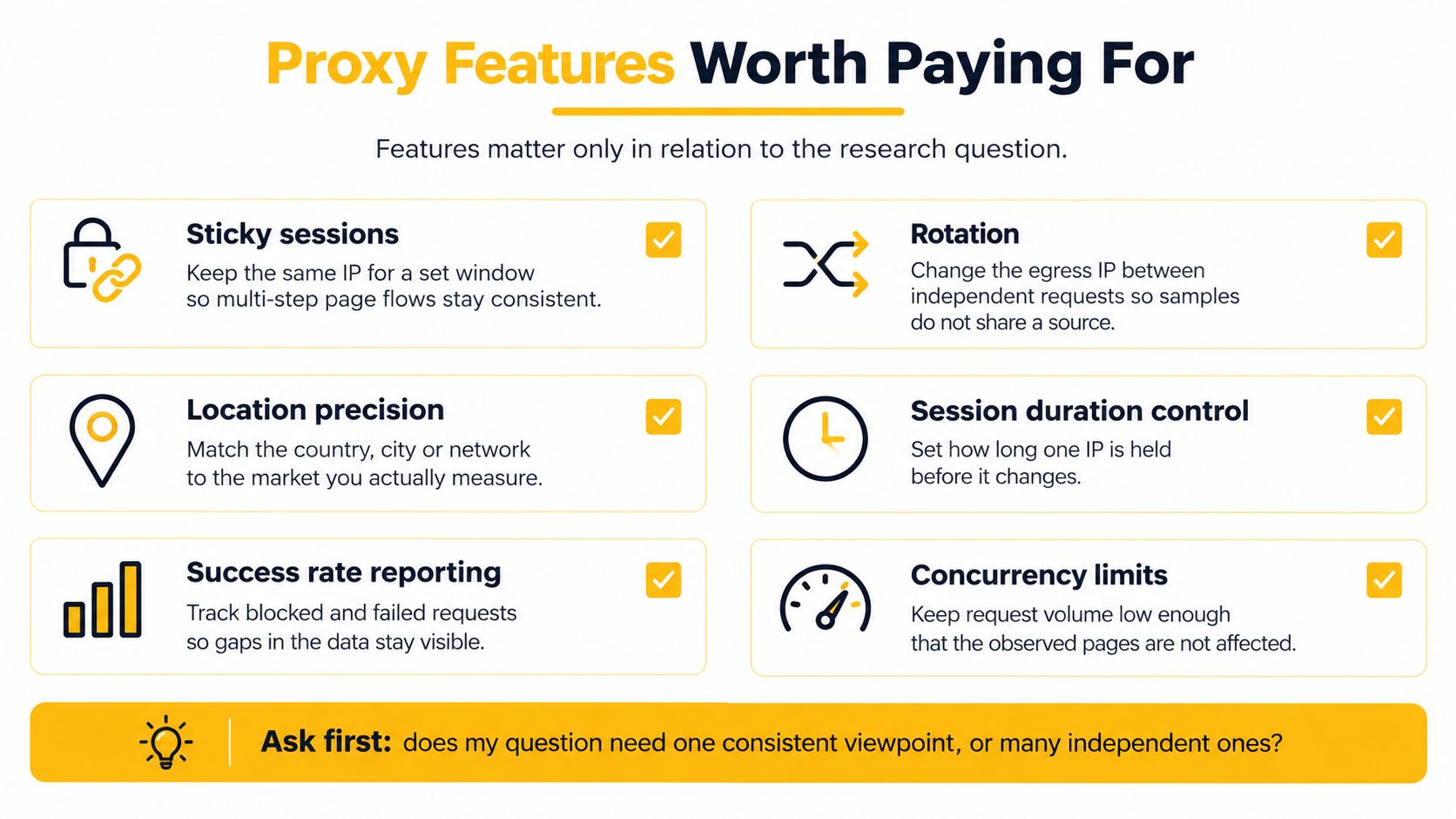
Sticky sessions and rotation support different collection needs. Rotation changes the outgoing IP between separate tasks. A sticky session keeps one identity for a set period, which helps preserve cookies, filters, carts and multi-step workflows. HTTP cookies link requests with server-side state. Keep one identity through a single authorized workflow, then rotate between independent workflows to avoid mixing their state.
Proxy features and what to check for each
| Feature | What it controls | What to check |
|---|---|---|
| IP pool size | How many distinct IPs and subnets you draw from | Unique IP count per target country and whether the pool is shared |
| Rotation | How often the egress IP changes | Fixed, timed or on-demand changes and their interval settings |
| Sticky sessions | How long one IP holds cookies and login state | Maximum session length compared with the length of one workflow |
| Trust score | How likely an IP is already flagged | The provider's stated method and a test run against a known page |
| Bandwidth | How much data you can move per month | Monthly cap compared with average page weight times pages per run |
| Geo coverage | Which countries and carriers you can target | Named countries and whether specific mobile carriers are offered |
Treat a trust score as a provider claim to verify in your own test. Ask how it is measured, then compare the result from a known page with ordinary browsing. A large pool can reduce IP reuse, but it does not show whether the addresses in your target market are suitable. Ask for counts by country and assess the pages your research needs to access.
Estimate bandwidth before committing. Multiply average page weight by pages per run and runs per month, then compare the estimate with the cap. Image-heavy catalogue research can use far more data than collecting price text alone, so match the allowance to the pages you plan to retrieve.
Use the table to get specific answers from a provider: available locations, session limits, rotation settings, pool composition and bandwidth terms. Then assess collection legitimacy separately. Design around authorized access and the research question; avoiding unnecessary requests can improve validity by reducing state changes and collection artifacts. A successful connection alone does not establish that the observed results represent the market.
How to Run a Proxy-Based Research Workflow
A research run can return clean pages and still misrepresent the market. Set the workflow around the population you need to measure, then check whether the collected sample supports the claim you intend to make. In practice, fewer requests with a clear sampling rule can produce more defensible results than broad, unstructured collection.
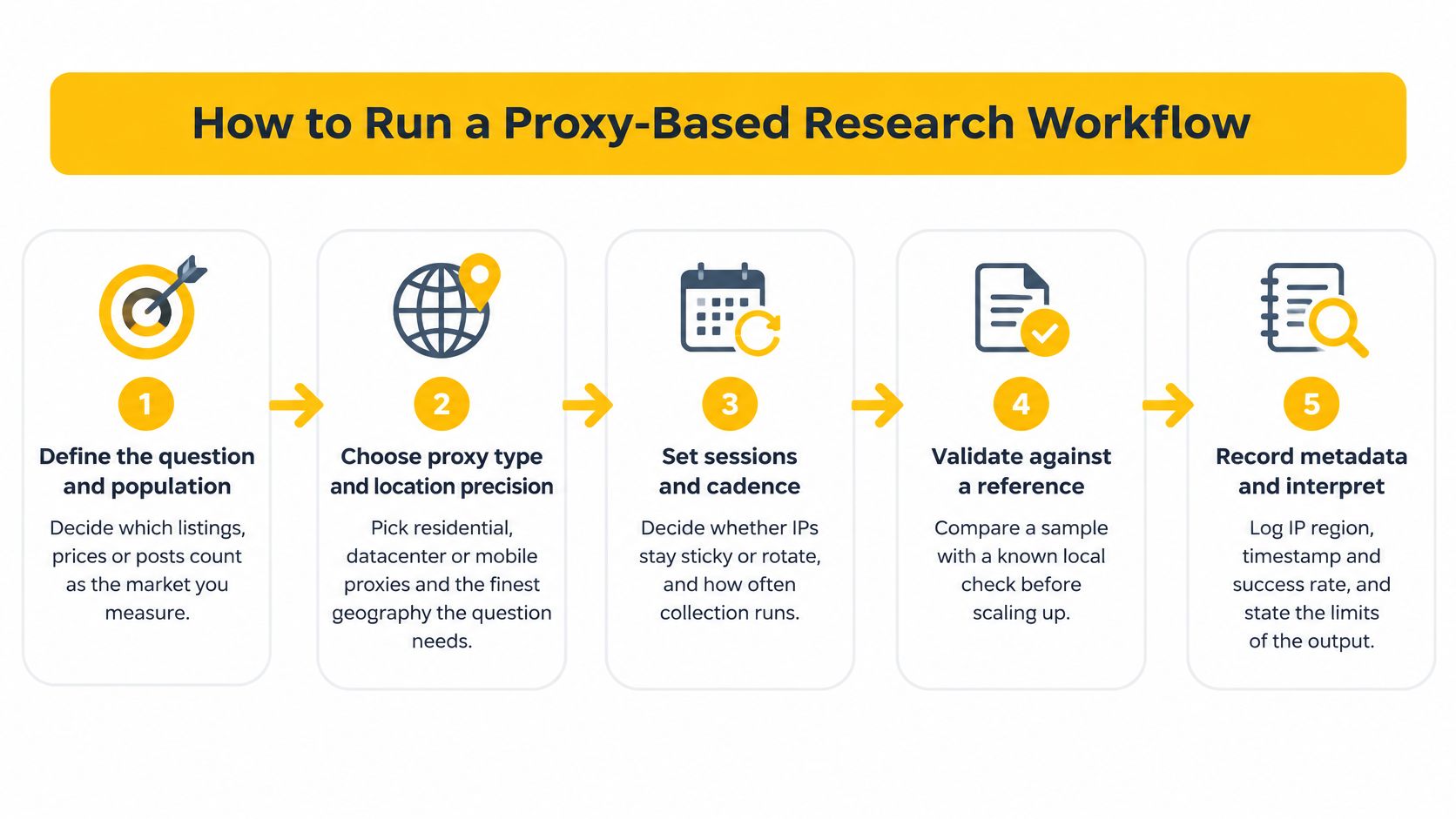
The eight steps
Define the question and population. Specify which listings, prices or posts count as part of the market you are measuring. This boundary determines how you assess coverage and what conclusions the sample can support.
Choose the proxy type and location precision. Match the setup to the research question. A country-level price comparison and a city-level demand estimate require different levels of location precision.
Select the protocol. Standard web clients can use HTTP or HTTPS proxying, with HTTPS requests passed through the CONNECT method. Choose SOCKS5 when your collection setup needs a more general TCP-oriented tunnel. Mozilla documents these as separate proxy types, with SOCKS operating at a lower level than HTTP.
Test the connection before collection. On a known page, check the apparent public IP, ASN, country, DNS behavior, TLS and browser compatibility, authentication, and error responses. Fix identity problems before a full run.
Use sticky sessions within a workflow and separate identities between jobs. Keep one product check on the same session from page load through filters and availability. Assign independent jobs separate identities so cookies and other state do not cross between them.
Log requests and set a rate cap. Record each request's timestamp, endpoint, observed IP, ASN, country, response code and session ID. Deduplicate listings across runs, and keep request volume modest.
Compare results with ordinary browsing. Test a controlled sample of known pages against a human session. Track coverage by country and device, as well as blocked-page, CAPTCHA and duplicate rates. Check whether the setup changes which listings enter the sample, not just how many pages load.
Report uncertainty. Distinguish observed counts from extrapolated totals and state the coverage limits. A working collection process does not, by itself, establish that the dataset represents the market.
Validation matters because collection gaps can distort estimates. In a USENIX Security study comparing marketplace scrapes with a seized back-end database, the scrapes missed approximately 46% of objects. Captured and uncaptured listings also differed significantly in price, views and product category. Estimates based on reviews and listing data underestimated total revenue by a factor of four.
Collection frequency affected coverage in that study: one or two scrapes typically covered only about 14% to 30% of the underlying population. Repeat collection when the question requires it, retain timestamps, and segment results by popularity, category and seller activity. Before extrapolating, compare the sample against a known total.
Three Research Scenarios Worked Through
A retail team tracks a competitor's catalogue prices in France. It picks residential IPs in France because the question is country-level pricing, keeps one sticky session per category list so filters stay consistent, and samples popular listings first because uncapped collection gives biased coverage. It can state French shelf prices for the sampled categories. It can't claim a national price index.

A media buyer verifies a PPC campaign in Belgium. She uses mobile 4G IPs on a local carrier to see the ad as a phone user would, checking placement, landing-page locale and currency on each run, then compares what was served with the platform's delivery reports. She can confirm the creative was served in Belgium on that carrier. She can't say how many Belgian shoppers saw it.
A brand team reviews mentions on mobile feeds in one market using accounts it's authorized to use. It assigns one identity per workflow, keeps request rates modest and keeps a written list of feeds checked. It can describe sentiment in the feeds reviewed. It can't describe the whole market conversation.
Confirm Compliance Before You Scale Your Pilot
Before collecting market data, define what the team needs to learn and what it does not need to retain. Publicly accessible pages can still contain personal information, so a sound research design limits collection to the signals needed for the decision. In practice, fewer requests can produce a more defensible dataset than broad, aggressive rotation.
Treat compliance as part of the collection design. GDPR and CCPA require transparency in relevant data practices, and public access alone does not settle what a team may collect or retain. Review the compliance requirements before the pilot begins, while the scope and collection methods can still be changed.
The gate before you scale
- Purpose in writing: Record the research question and the business decision it informs. This gives privacy reviewers a basis to assess whether collection is proportionate.
- Personal-data minimization: Exclude commenter names, account identifiers and employee profiles when they are not needed to measure the market signal.
- Lawful basis and retention: Document the applicable basis for processing and set a deletion date for raw data.
- Access restrictions: Follow applicable robots directives, platform terms and technical limits. Do not use proxy rotation to evade them.
- Audit trail: Log sources, request rates, proxy identities and timestamps so legal, procurement or security reviewers can reconstruct the collection.
This gate matters in competitive intelligence, ad verification and social research. A collection aimed at prices or creative can also capture comments, account identifiers or employee information. Set boundaries before requests begin, and keep market measurement separate from personal-data surveillance. Retrofitting that separation can be difficult.
Run a scoped pilot before increasing volume. Choose one question, one country and one proxy type, then compare the results with ordinary browsing. If the test requires a local 4G or LTE connection, consider mobile 4G proxies such as Evoproxy. Assess whether the sample reflects the intended audience and whether the collection is documented, not how much data it gathers.
If the research requires checking prices, ads or mobile feeds as a local phone user would see them, Evoproxy offers mobile 4G proxies with rotating and sticky sessions for a scoped test. Start with one market and one question, assess how representative the results are, and visit Evoproxy to set up a test.