
Your team has a competitor spreadsheet, a few saved screenshots, and a report that looked useful when it was published. Then a rival changes its pricing, launches a new landing page, alters its social messaging, or starts showing different offers in a key region. By the time someone notices, the research describes a market that no longer exists.
Learning how to do competitive market research means building more than a competitor list. It means creating a repeatable intelligence system that combines clear business questions, comparable data, responsible collection methods, and a reporting loop that turns changes into decisions.
Why Static Competitor Lists Fail in Fast Markets
A static competitor profile answers what was true when someone created it. It rarely answers what changed yesterday, which audience a competitor is targeting now, or whether a new offer is appearing only in selected locations. That makes a one-time report useful as a baseline, but weak as an operating system.
Competitive intelligence has become more important as markets have intensified. One industry report found that 90% of businesses said their industry had become more competitive in the previous three years, while 48% said it had become much more competitive. Later research found that 59% of practitioners said their markets had become much more competitive, an increase of 16 percentage points since 2020. These figures are reported in the State of Competitive Intelligence research.
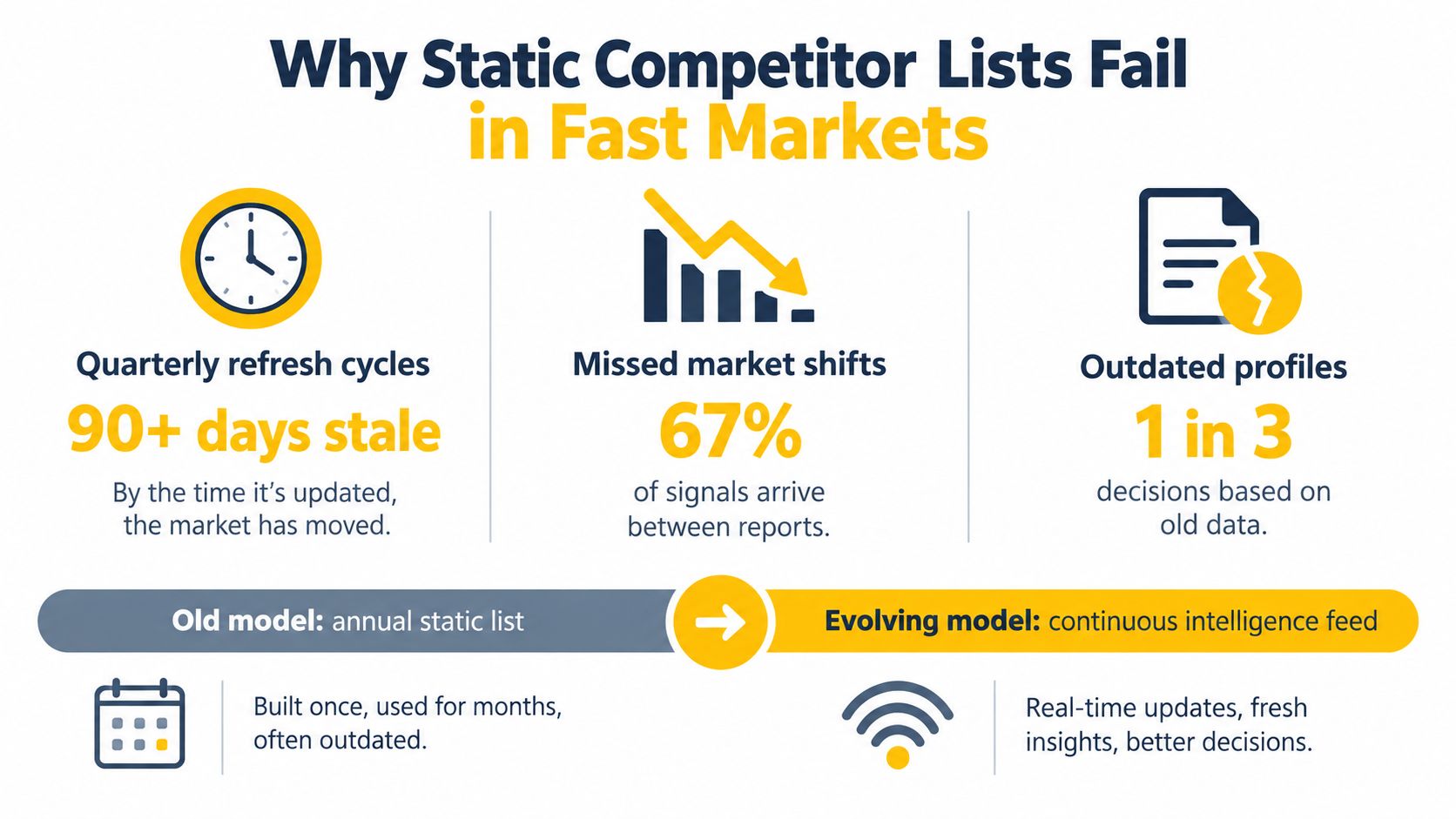
Replace snapshots with a monitoring loop
A continuous workflow doesn't mean collecting everything all the time. It means deciding which changes matter, defining triggers, and reviewing evidence on a cadence that fits the market.
A practical loop looks like this:
- Set intelligence priorities. Decide which business decisions need evidence.
- Collect from multiple sources. Combine public pages, search results, social signals, customer feedback, surveys, and permitted automated collection.
- Analyze patterns. Compare changes across competitors, regions, channels, and time periods.
- Distribute findings. Give each team a concise implication and recommended action.
- Monitor and iterate. Adjust the questions and collection rules when the market changes.
The shift is operational, not cosmetic. A 2026 industry survey reported that 40% of leaders said their organizations continuously review competitive intelligence insights using monitoring tools, as described in the same competitive intelligence report. The important lesson is that monitoring should sit inside marketing, product, sales, and operations workflows instead of living in an isolated document.
Practical rule: A competitor report should have an owner, a refresh cadence, a change log, and a named decision attached to every major finding.
Defining Clear Research Goals and Intelligence Priorities
Start with the decision, not the dataset. “Research the competition” is too broad to guide collection, and it encourages teams to gather screenshots, rankings, prices, and comments without knowing what any of them will change.
Write the business question in a form that can produce an action. For example:
- Pricing: Are we positioned too high for the segment we want, or are competitors communicating more value at a similar price?
- Positioning: Which customer problem does each competitor emphasize, and where is the message crowded or underdeveloped?
- Go-to-market: Which channels, regions, and content themes appear to support competitor demand generation?
- Product planning: Which features are treated as table stakes, and which differences appear repeatedly in customer feedback?
Convert questions into intelligence priorities
Each question needs a small set of metrics and a definition of what would count as a meaningful change. Common competitive metrics include engagement rate, share of voice, sentiment, keyword rankings, and audience growth, a measurement set outlined in this competitive intelligence workflow guide.
Don't treat those metrics as interchangeable. Engagement rate can help compare content response, but it needs consistent definitions across channels. Share of voice can indicate visibility within a defined search, media, or social category, but it says little about conversion without supporting evidence. Sentiment can reveal recurring praise or frustration, yet automated sentiment labels need manual review because sarcasm, context, and language affect classification.
A useful research brief includes:
- Decision owner: Who will act on the finding?
- Research question: What uncertainty must the work resolve?
- Comparator scope: Which competitors, segments, regions, and channels matter?
- Metrics: What will be measured, and how will each metric be calculated?
- Evidence standard: Which findings require a second source, human review, or customer validation?
- Action threshold: What change would trigger a pricing review, content response, product investigation, or campaign adjustment?
Keep the first cycle narrow. A focused question with reliable evidence beats a large dashboard that no one trusts.
Identifying the Right Competitors to Monitor
Your real competitor set is defined by customer consideration, not by your internal category label. A substitute that solves the same problem can compete for the same budget even if it uses a different business model. An emerging entrant can matter before it appears in established industry lists.
A structured benchmarking framework recommends selecting 6 to 12 peers that customers cross-shop, then adding 1 to 3 best-in-class analogs for comparison. The framework is described in this competitive benchmarking guide.
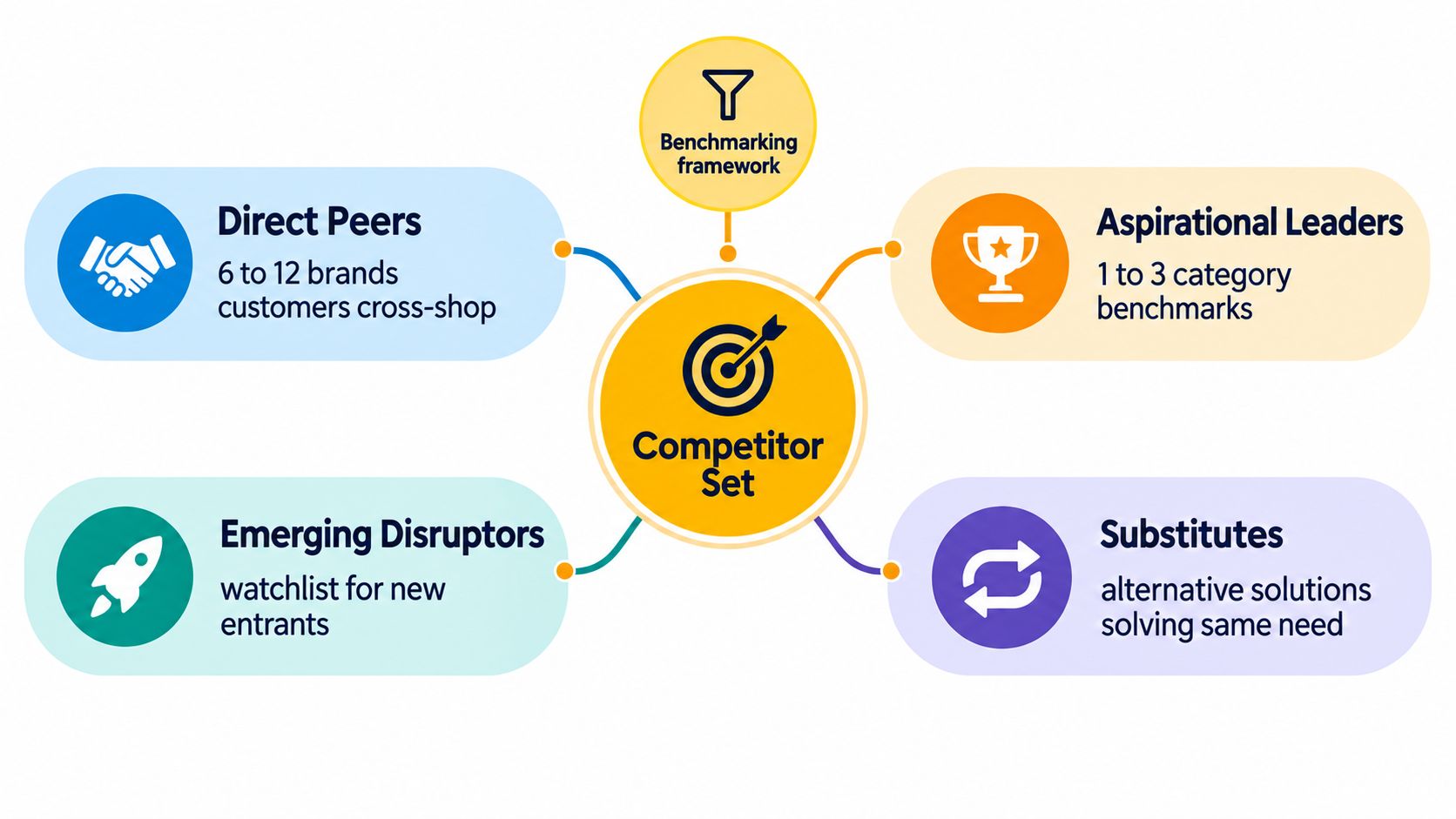
Build the set from customer behavior
Start with evidence from sales calls, lost-deal notes, support conversations, customer interviews, search behavior, and survey responses. Look for repeated comparison patterns. If prospects regularly mention the same alternatives before buying, those brands belong in the monitored peer group, even if your team considers them indirect.
Then classify each name:
- Direct peers sell a similar offer to a similar audience.
- Substitutes solve the same customer need through a different offer.
- Emerging disruptors are newer or less established players showing unusual momentum.
- Aspirational leaders provide a useful standard for experience, messaging, distribution, or operational execution.
The distinction helps you avoid a common mistake, researching only the brands that look most like you. A direct peer may be the right pricing comparator, while a different category leader may reveal a better onboarding flow or a clearer explanation of value.
Validate and trim the list
Give each candidate a reason for inclusion. Record the segment, use case, region, and evidence showing that customers consider the competitor relevant. Remove brands that appear only because they're famous or easy to find.
Use the peer group for like-for-like benchmarking and the analog group for practice discovery. Keep an emerging watchlist separate from the core comparison so uncertain signals don't distort the main analysis. For ongoing brand and competitor tracking, a structured brand monitoring tools workflow can help centralize mentions, changes, and review ownership.
Choosing Data Sources and Proxy Infrastructure
No single data source explains competitive position. Public reports provide market context, websites reveal offers and messaging, social channels expose content and audience response, surveys capture stated preferences, and permitted web collection can help track changes at scale. The strongest analysis triangulates these sources instead of treating one channel as ground truth.
Use the source that matches the question:
- Public information works well for documented positioning, product pages, published pricing, and corporate announcements.
- Social analytics helps identify content themes, audience response, and shifts in publishing behavior.
- Surveys and interviews test awareness, preference, objections, and cross-shop behavior directly.
- Web collection supports structured monitoring of public pages, search visibility, localized content, and changes over time, provided the workflow respects applicable law, site rules, and privacy obligations.
Proxy infrastructure matters when the same public experience changes by location, carrier, or session. A mobile proxy routes traffic through a SIM-enabled device on a carrier network such as 3G, 4G, or 5G. Mobile addresses commonly use carrier-grade NAT, or CGNAT, where many subscribers share one public IP. Because a block can affect legitimate users sharing that address, mobile IPs are generally harder for platforms to detect and block than datacenter IPs, as explained in this proxy fundamentals reference.
| Proxy Type | Detection Risk | Cost Range | Best Use Case |
|---|---|---|---|
| Mobile, 4G or 5G | Generally lower than datacenter IPs because traffic comes through carrier networks and shared addressing | Varies by provider, traffic, and session model | Social research, regional ad checks, account-access QA, and mobile-network validation |
| Residential | Often appears as traffic from household broadband connections, but quality and consent standards vary | Varies by pool quality, geography, and usage | Localized content checks and consumer-facing page verification |
| Datacenter | Easier to classify because addresses come from hosting infrastructure | Often suited to high-volume collection, depending on provider and terms | Controlled, high-volume tasks where location and trust requirements are limited |
Rotation and session persistence solve different problems. Rotating proxies assign a new exit IP per request, which can spread requests across addresses. Sticky sessions keep the same IP for a defined period or until the session expires, which is better for workflows that need continuity across multiple page loads. Documentation on rotating and sticky proxy sessions describes configurable session lifetimes and automatic reassignment after expiry.
Geo-targeting adds another layer. Research teams may need to test content by country, state, city, carrier, or ASN, where an ASN identifies the network that advertises an IP range. For compliant research, match the proxy type and geography to the question, use reasonable request rates, and avoid collecting personal data unnecessarily. A neutral overview of geo-targeted proxy use in threat intelligence explains why location and network targeting matter for verification workflows.
Analyzing Competitor Data and Separating Signal from Noise
Raw observations become useful only after normalization. A competitor may publish more frequently because it serves a larger audience, not because every post performs better. A brand may appear highly visible for broad keywords while remaining weak for the specific searches that influence your buyers.
Create a comparison matrix before drawing conclusions. Standardize definitions, time windows, geography, channel, device type, and sampling rules. Separate observed facts, interpreted patterns, and hypotheses that still need validation.
Combine quantitative and qualitative evidence
Quantitative measures show movement. Qualitative evidence explains why it might be happening. Read customer comments, reviews, support themes, survey responses, landing-page copy, and campaign messages alongside engagement, visibility, rankings, and audience indicators.
For example, a competitor's rising share of voice may reflect a short campaign rather than durable positioning. If the increase appears alongside repeated customer praise for a newly emphasized benefit, it deserves investigation. If it appears only in automated summaries or isolated posts, treat it as a lead rather than a conclusion.

Test every apparent signal
AI-generated summaries can compress a large dataset quickly, but they can also merge unrelated mentions, repeat a high-volume opinion, or miss context. Social sentiment has similar weaknesses. Loud, highly active audiences aren't automatically representative of the buying population.
Use a validation sequence:
- Trace the source. Open the original page, post, review, or dataset record.
- Check recurrence. Look for the same pattern across independent sources and time periods.
- Test the sample. Ask whether the data represents the relevant segment, region, and customer stage.
- Search for disconfirming evidence. Deliberately look for examples that challenge your preferred explanation.
- Label confidence. Mark findings as observed, supported, or provisional.
Analyst's rule: An automated summary can prioritize what to inspect. It shouldn't replace inspection of the underlying evidence.
Avoid comparing unnormalized metrics. Record whether engagement includes every interaction or only selected actions, whether sentiment uses the same language rules, and whether keyword visibility reflects the same location and device. This discipline prevents confirmation bias from turning convenient digital traces into strategic conclusions.
Producing Actionable Recommendations and Reports
A useful report connects evidence to a decision in one readable line. Start each finding with the change, explain the supporting evidence, state the business implication, and assign an owner.
A compact reporting structure works well:
- Observation: What changed in the monitored market?
- Evidence: Which sources support the observation?
- Interpretation: Why might the change matter to your audience?
- Recommendation: What should the team test, change, or investigate?
- Owner and timing: Who acts, and when will the result be reviewed?
- Confidence: What remains uncertain?
Prioritize recommendations by potential business impact, evidence strength, effort, and reversibility. A low-risk messaging test can move ahead of a costly product change when both address the same signal. A pricing response should require stronger validation than a new content experiment.
Distribute the output where teams already work. Marketing may need message and visibility changes, product may need recurring feature complaints, sales may need objection patterns, and leadership may need only the implications and decisions. A market research data collection workflow can support consistent inputs, but the operating rhythm matters more than the dashboard.
Review urgent changes as they appear, run a regular summary for trend interpretation, and revisit the research questions when decisions or market conditions change. Evoproxy offers mobile 4G/LTE/3G connectivity with rotating sessions and geo-focused routing for compliant market research workflows, including personal and shared mobile proxy ports. If your team needs to verify localized experiences, monitor public competitive signals, or test region-dependent flows, visit Evoproxy to explore a setup suited to your use case.


