
Audit week usually exposes the same pattern. A team says it has GDPR covered because legal approved the privacy notice last year, engineering added a cookie banner, and security ran a point-in-time review. Then the hard questions land. Can you prove a deletion request reached backups? Which systems still hold old lead data? Does your model training pipeline have an erasure path after consent is withdrawn? Who tested the handoff from intake form to downstream processor?
That's where GDPR compliance testing stops being a policy exercise and becomes an engineering one.
For teams running social accounts across regions, validating ad delivery, monitoring pricing, scraping public market signals, or QA testing localized flows, the gap is even sharper. You're often dealing with multiple processors, region-specific interfaces, automated pipelines, and location-dependent user journeys. The legal duties are the same, but the failure modes are operational. A consent state that doesn't sync, a DSAR queue that drops requests without notice, or a retention job that skips object storage can undo a lot of neat documentation.
Why GDPR Compliance Testing Deserves a Real Program
The organizations that struggle most are rarely the ones with no paperwork. They're the ones that treat testing like an annual checkbox.
A typical failure sequence looks familiar. Support receives a deletion request and closes the ticket after removing the user from the production app. Marketing still has the person in a legacy CRM. Analytics logs still hold identifiers. An internal AI workflow copied source records into a training or evaluation dataset, and nobody defined how erasure should propagate there. When a regulator or customer asks for evidence, the team has screenshots, not a control trail.
That approach doesn't hold up in a regulatory environment that has already produced about €7.1 billion in cumulative GDPR fines across 2,685 documented cases, with the database rising to 3,062 cases when partially specified fines are included, according to the CMS GDPR Enforcement Tracker numbers and figures. That matters because enforcement at this scale changes how mature teams test. They don't ask only whether a policy exists. They ask whether the control works under ordinary failure conditions.
Practical rule: If a control can't be rerun, evidenced, and tied to a legal duty, it isn't mature enough for audit week.
The law itself gives you principles and obligations, not a single test methodology. The European Commission is clear that only the GDPR text has legal force, while guidance material is explanatory, not binding. That's why a strong program maps every test back to a specific duty instead of claiming a tool or setup is “GDPR compliant” on its own. See the European Commission's data protection overview.
The four-phase loop that works in practice
I've found the most reliable programs run as a control loop with four parts:
Scope and map Identify systems, processors, data categories, lawful bases, transfer paths, and high-risk workflows.
Test core privacy controls Validate consent, minimization, access, export, deletion, and retention in realistic end-to-end paths.
Validate technical safeguards Check security measures, logging coverage, access restrictions, and incident response readiness.
Report and iterate Store evidence, assign remediation, rerun failed assertions, and fold new processing into the next cycle.
Why this matters to technical growth teams
If you run geo-targeted campaigns, localized storefronts, social account operations, or ad verification, your processing changes often. New landing pages appear. New analytics fields get added. New regions get tested. That churn is exactly why one-time reviews age badly.
GDPR compliance testing works when it's built like QA for privacy controls. Repeatable. Versioned. Linked to change.
Scoping, Data Mapping, and Deciding If a DPIA Is Required
Starting too late is a common mistake. Testing tickets get opened before the organization knows where personal data enters, where it moves, and which systems inherit risk from upstream processing.
A workable structure is a 12-week phased program. One practical model starts with weeks 1 to 2 for automated personal-data discovery and data-flow mapping, then prioritizes high-risk systems such as special-category data, internet-facing apps, client portals, APIs, identity systems, and shared storage before lower-risk internal tools and log pipelines. That sequencing is described in this GDPR compliance testing workflow. Even if your exact timing differs, the logic is sound. Test the systems most likely to create material privacy impact first.
What to map before you test
Your inventory should be plain enough for engineers to update and specific enough for counsel or a DPO to review. I use fields like these:
System name Product app, CRM, support platform, warehouse, object storage bucket, model registry, or queue.
Data category Account data, behavioral data, special-category data, employee data, children's data, or derived profile data.
Processing purpose Authentication, fraud prevention, ad measurement, customer support, personalization, analytics, training, or QA.
Lawful basis Consent, contract, legal obligation, legitimate interests, and so on.
Retention rule Stated retention period, trigger event, deletion method, and exception path.
Processor boundary Internal controller system, processor, sub-processor, or shared joint workflow.
Transfer detail Cross-border transfer path and transfer mechanism where relevant.
Erasure path Direct delete, tombstone plus purge, backup expiry, or unsupported.
If your team also runs automation or public-data collection, keep your collection standards documented. A concise policy reference like web scraping ethics guidelines helps separate legitimate market research and QA from sloppy data practices.
DPIA decisions need an actual rule
The weakest phrase in many privacy programs is “we didn't think this was high risk.” That won't survive scrutiny by itself.
A better approach is to test against Article 35(3) presumptive cases and the EDPB-style criteria that indicate likely high risk. Current guidance also highlights a nuance teams miss: if you rely on just one criterion to say no DPIA is needed, document that reasoning. See this DPIA trigger explainer.
Article 35(3) DPIA Trigger Decision Matrix
| Presumptive Case (Art. 35(3)) | Testable Condition | Indicator Count Threshold | Evidence to Capture |
|---|---|---|---|
| Systematic and extensive evaluation with automated processing | Profiles people to influence eligibility, ranking, or material treatment | DPIA presumed | Decision logic, fields used, output effects, human review path |
| Large-scale processing of special-category or highly sensitive data | Stores or analyzes health, biometric, or similarly sensitive data at scale | DPIA presumed | Data inventory, access model, retention, processor list |
| Systematic monitoring of publicly accessible areas | Observes behavior in a persistent or broad way | DPIA presumed | Monitoring scope, data fields, notice path, storage duration |
| Innovative or novel technology use | AI or automation changes risk, inference, or traceability | Two or more indicators | Model inputs, training sources, opt-out path, erasure method |
| Children or vulnerable groups involved | Processing affects users with reduced power or awareness | Two or more indicators | User segment definition, consent path, safeguards |
| Automated decisions with significant effect | Output affects rights, access, or material outcomes | DPIA presumed | Appeals process, human intervention route, audit logs |
Documenting the “no DPIA” path
When you conclude no DPIA is required, write it down in the same disciplined way you would document a required DPIA.
Capture:
- Which presumptive cases were tested
- Which criteria were present or absent
- Why the threshold wasn't met
- What safeguard reduced residual risk
- Who approved the decision and when
- What future change would reopen the analysis
A short, dated “no DPIA required” memo with reasons is far stronger than an unwritten assumption everyone forgets six months later.
Core Control Tests for Consent, DSARs, and Retention
Many programs stop sounding polished and start showing whether they work.
The most useful test cases aren't abstract. They're assertions with evidence. If your audience includes social teams, ad operations, or QA engineers, think in terms they already use: trigger, expected output, observed output, rollback, and proof.
Consent tests that catch real drift
Consent failures often come from mismatched states across the front end, tag layer, app events, and downstream processors.
I usually want proof of these conditions:
Granular choice exists The interface separates categories instead of bundling everything into a single accept state.
Withdrawal parity exists Revoking consent is no harder than granting it. The same user can reverse the choice through a live path, not a buried support process.
State propagation works Once consent changes, downstream collection behavior updates consistently across scripts, SDKs, and exports.
Regional logic is correct The banner, notice text, and default state match the user's region and processing context.
A useful assertion reads like this: “Given a user in Region X who declines analytics consent, event payloads after refresh do not include optional analytics identifiers, and downstream exports reflect the same state.” The evidence is a screen recording, event log sample, consent state record, and export verification.
DSAR tests have to run end to end
A subject access or deletion request is where fragmented systems get exposed. DLA Piper reported approximately €1.2 billion in GDPR fines issued in 2025 alone, bringing the cumulative total to about €7.1 billion by 10 January 2026, while breach notifications reached an average of 443 per day, up 22% year over year and marking the first time the daily average exceeded 400 since GDPR began, according to the DLA Piper GDPR fines and data breach survey. That pattern is one reason mature testing now emphasizes workflow execution, logging, and response speed instead of just pre-launch review.
For DSARs, don't test only intake. Test the full chain:
Request intake Can the request be submitted reliably through the public path and internal support path?
Identity verification Is the verification proportional, documented, and not excessive for the data requested?
Search and retrieval Do all in-scope systems return data linked to the subject identifier set you use in production?
Export quality Is the export understandable, complete, and structured enough to be useful?
Deletion propagation Does erasure reach primary stores, derived tables, queues, backups, and downstream processors?
Exception handling Are lawful retention or legal-hold exceptions documented with clear scope and expiry?
Don't close a deletion test when the app record disappears. Close it when every downstream copy is either erased or accounted for under a documented exception.
Retention and minimization are where hidden copies show up
A lot of GDPR trouble lives in non-production. A strong benchmark here is remediation validation. The 7th edition of the GDPR Enforcement Tracker Report recorded 2,685 fines by 1 March 2026 totaling about EUR 6.11 billion, and one repeatedly neglected area in practical testing is non-production data hygiene. Teams should verify that staging, CI, and local systems contain only masked, synthetic, or anonymized data, alongside checks on consent flows, deletion and export requests, and vendor process documentation, as discussed in this GDPR enforcement and testing analysis.
I'd turn that into concrete checks:
Minimization assertion Event schemas carry only fields required for the documented purpose.
Retention assertion TTL or purge jobs remove expired records on schedule, and the deletion is visible in system logs.
Backup assertion Backup copies either support targeted erase or have a documented expiry path consistent with policy.
Synthetic data assertion Test, staging, and local development environments don't contain live personal data unless tightly justified and controlled.
AI and automation need separate erasure tests
This is still under-tested. Recent enforcement checklists emphasize verifying that privacy notices, consent flows, legitimate-interest assessments, and deletion requests propagate across primary systems, backups, third-party processors, and AI training sets, reflecting a move toward continuous operational testing. See the GDPR enforcement heat map and checklist discussion.
If your team builds scoring, recommendation, or classification workflows, add a dedicated test for training and evaluation artifacts. Ask two blunt questions: Can you identify where a subject's data entered the pipeline? Can you remove or suppress it in future model use?
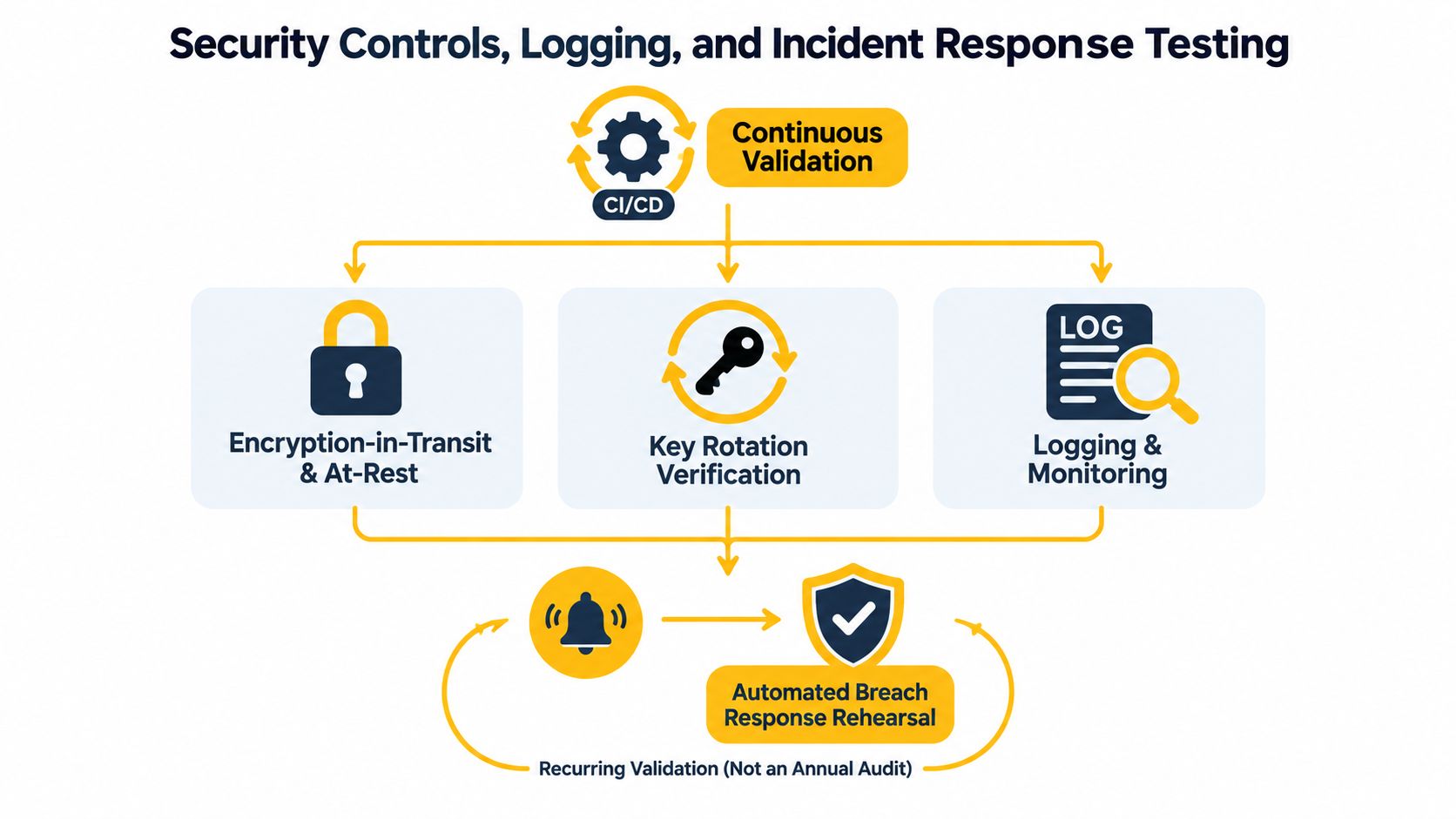
Security Controls, Logging, and Incident Response Testing
Privacy controls fail when security testing is treated as a once-a-year event. The UK GDPR is unusually explicit here. The ICO says organisations must have a process for regularly testing, assessing, and evaluating the effectiveness of security measures. That framing matters because it turns recurring validation into a legal expectation, not just good engineering hygiene. The operational reference is the ICO guide to data security.
Turn Article 32 into assertions
Start with assertions, not aspirations.
Encryption in transit Sensitive paths reject insecure transport and expose only approved secure paths.
Encryption at rest Stores containing personal data use the expected storage-level or application-level protection, and key ownership is documented.
Key rotation evidence Rotation events are logged, reviewable, and tied to the asset inventory.
Access segregation Privileged roles are narrower than standard operational roles, and test accounts can't cross the boundary.
Logging coverage Systems processing personal data emit access, admin action, and failure logs into a central review path.
What to collect as evidence
I prefer evidence that another engineer can reproduce without asking the original tester what they meant.
Good evidence includes:
- Configuration snapshot at test time
- Runner identity and approval context
- Test output with pass or fail result
- Linked remediation ticket for failures
- Retest result after the fix
That retest step matters. Security review without remediation validation is a false finish.
A passed control with no reproducible evidence is weaker than a failed control with a clear ticket, owner, and rerun date.
Rehearse the breach timeline
Your breach workflow should be exercised before you need it. Run a table-top or scripted rehearsal from alert to disclosure decision. Include a near-miss scenario, because teams often overfocus on confirmed compromise and under-test the gray zone where facts are incomplete.
A practical rehearsal checks:
Detection Did monitoring generate an actionable signal?
Triage Who classifies whether personal data may be affected?
Containment Can the team limit access or stop further exposure quickly?
Assessment What data categories, systems, and subjects may be involved?
Notification decision Is there a documented rationale for reporting or not reporting?
Evidence preservation Are logs, screenshots, and timeline artifacts stored immutably?
If you process user activity across regions or channels, run the same scenario against web, API, and support workflows. The gaps are rarely identical.
Tooling Landscape and Network Setup for Compliant Testing
No single tool makes a workflow GDPR compliant. That's the first buying rule.
What tools can do is verify narrow parts of the control chain. You still need documented scope, legal review, ownership, and retesting. For teams handling social publishing, ad checks, market intelligence, SEO monitoring, or geo-dependent QA, the network layer also matters because location affects what the user sees and what data gets processed.
Tool Categories for GDPR Compliance Testing
| Tool Category | What It Verifies | Key Limitation |
|---|---|---|
| Data discovery scanners | Where personal data appears across databases, storage, and logs | They can miss context, lawful basis, and downstream business use |
| Consent workflow tools | Banner state, preference capture, and propagation signals | They don't prove every downstream processor honored the state |
| DSAR workflow systems | Intake, routing, approval, and case tracking | They can hide retrieval gaps in source systems |
| Synthetic data generators | Reduced exposure in non-production environments | They don't fix poor retention or access controls by themselves |
| Centralized logging stacks | Auditability of access, change, and incident events | Coverage is only as good as the integrations feeding them |
Network choices affect test quality
If you need to validate region-specific banners, localized ad rendering, country-based routing, or account protections that vary by user network, your test traffic should resemble legitimate user traffic from the relevant geography.
That's where datacenter, residential, and mobile exits differ:
Datacenter proxies come from hosting providers. They're useful for stable automation, but they're often easier for target systems to fingerprint as non-consumer traffic.
Residential proxies route through household IP space. They can better match ordinary browsing patterns for region checks.
Mobile 4G and 5G proxies route through carrier networks. They're often harder to tie to one specific user because carrier-grade NAT lets many subscribers share a limited IPv4 pool, which makes mobile traffic look more like normal consumer traffic to reputation systems. A practical check is to verify the exit ASN, or autonomous system number, because a true mobile exit should resolve to a wireless carrier ASN rather than a hosting company ASN. That behavior is explained in this discussion of CGNAT and mobile IP sharing.
For QA and compliance testing, that doesn't mean “use mobile everywhere.” It means use the network type that matches the flow you're validating, then document it.
Rotation, stickiness, and protocol choices
Your test record should include the network mechanics:
- IP rotation for repeated independent sessions
- Sticky sessions when continuity matters across multi-step workflows
- Exit geography down to the country or region used
- Protocol choice, usually HTTP/HTTPS or SOCKS5
Those details affect observed behavior. SOCKS5 is commonly used for non-browser automation, and some proxy setups implement geo-targeting through username or endpoint parameters rather than the protocol itself. That's a useful testing convenience, but it also means reproducibility depends on logging those parameters carefully, as outlined in this SOCKS5 and geo-targeting documentation.
If you need a documented mobile option for geo-sensitive QA, one example is test environment setup guidance paired with a provider such as Evoproxy, which offers French mobile 4G connectivity for region-accurate validation. Used properly, that's just one infrastructure choice among several. The compliance part is the evidence trail you keep around each run.
Reporting Cadence, Evidence Templates, and Sample Scripts
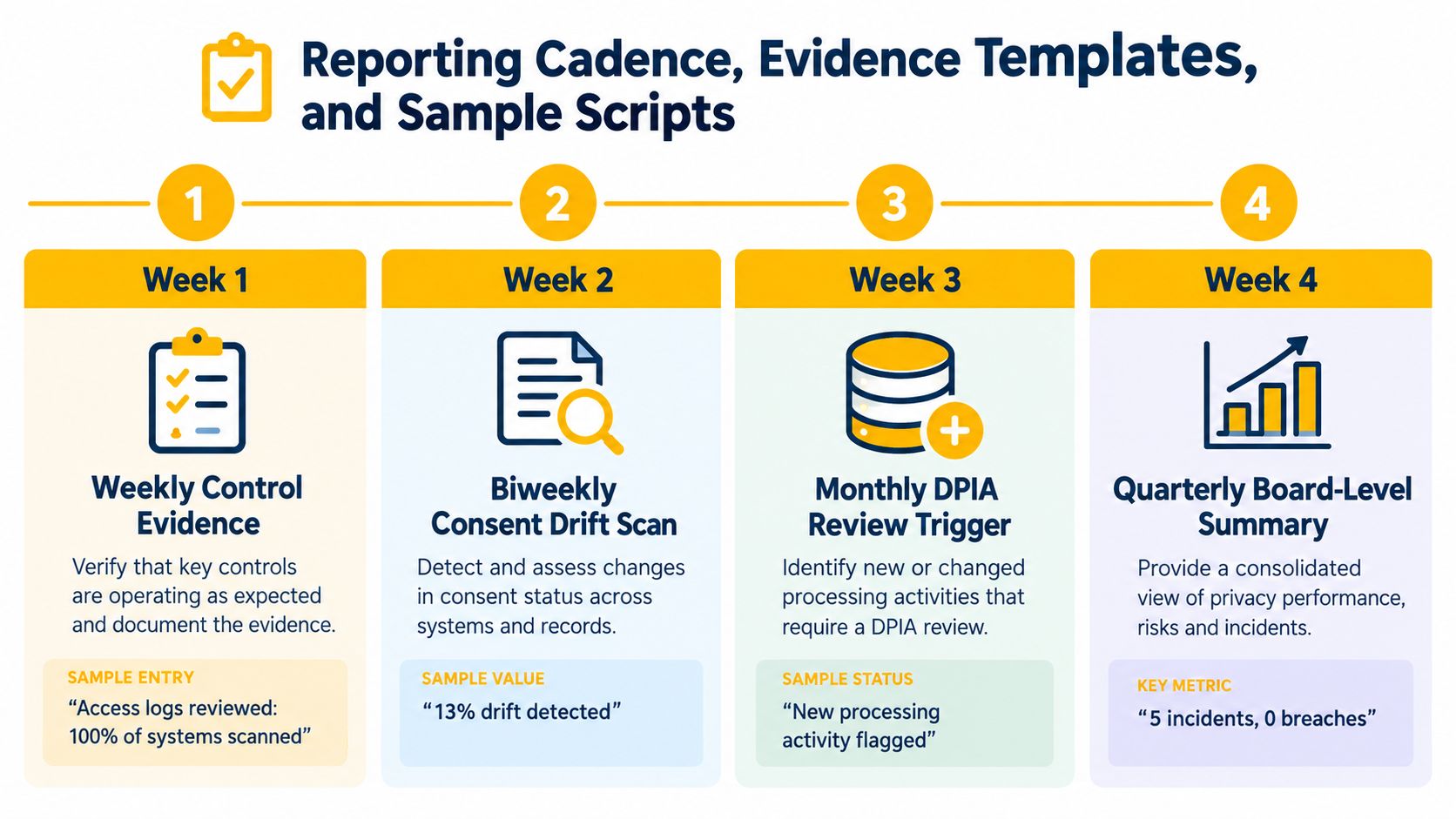
Testing gets taken seriously when the reporting cadence is boring, consistent, and hard to dispute.
A cadence teams can actually maintain
Use a short cycle that produces audit-ready evidence without turning privacy into a side project nobody can sustain.
Weekly evidence review Confirm that scheduled control tests ran, inspect failures, and assign remediation owners.
Monthly processing review Check whether new workflows, vendors, regions, or AI uses changed the DPIA position.
Quarterly executive summary Roll up control health, unresolved risks, recurring failure themes, and overdue remediation.
Minimal evidence template
A practical record usually needs these fields:
| Field | Why it matters |
|---|---|
| Control owner | Someone has to answer for reruns and remediation |
| Test scope | Defines systems, processors, and identifiers in scope |
| Assertion run | States exactly what was tested |
| Result | Pass, fail, or blocked |
| Evidence path | Points to logs, screenshots, recordings, or exports |
| Remediation owner | Names who fixes the issue |
| Retest date | Prevents “known issue” from becoming permanent |
Sample retention violation record
Here's the style of script output I'd want from a failed retention sweep:
Retention policy violation. Source query targeted expired customer-support attachments older than the documented retention threshold. Expected result was zero active records. Actual result returned records still present in object storage and indexed in search. Severity marked high because deletion automation ran but didn't purge derivative metadata. Linked remediation ticket includes storage path, run timestamp, runner identity, and the configuration snapshot used for the test.
The key is reproducibility. Every artifact should carry a timestamp, the identity of the runner or service account, the config version, and an immutable storage path. Keep test artifacts long enough to support accountability, but apply retention rules to the artifacts themselves too.
Recurring Test Checklist and Next Steps
The recurring checklist is simple. The discipline is not.
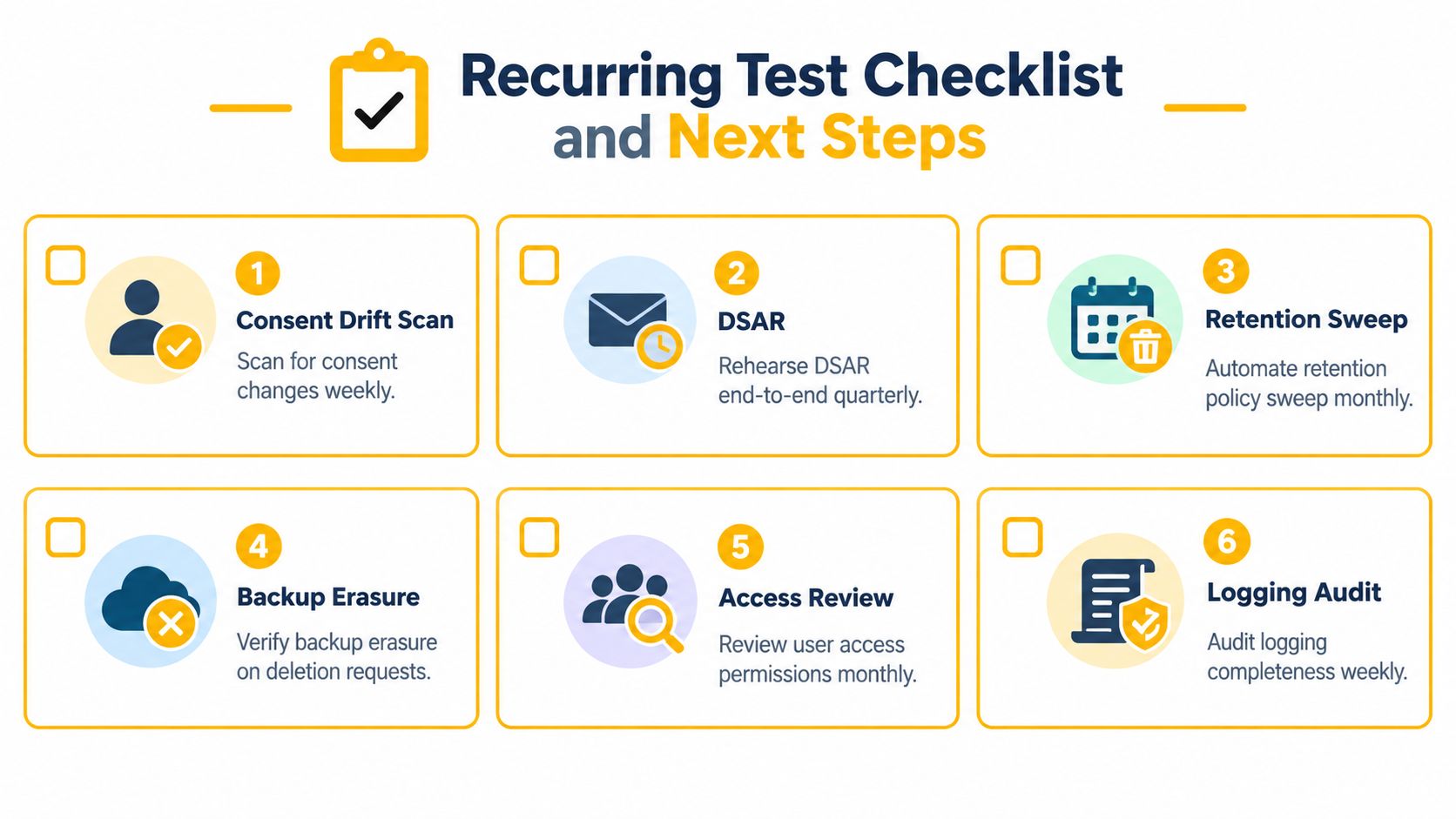
Use a standing schedule that covers:
- Weekly consent drift scans across banners, SDK states, and downstream processors
- Quarterly DSAR rehearsals from intake through export or erasure
- Monthly retention sweeps for primary stores, logs, and object storage
- Backup erasure checks whenever deletion paths or storage architecture change
- Monthly access reviews for privileged and support roles
- Weekly log integrity checks to confirm audit coverage is complete
For geo-dependent flows, record the network path used to test localized banners, cross-border routing, or region-specific request handling. That record should include session behavior, geography, and protocol choices, alongside your broader compliance requirements reference. If your work depends on location-accurate QA, mobile 4G proxies can be a practical option because they better resemble ordinary consumer routing than datacenter exits, especially when you need repeatable tests without breaking the audit trail.
If your team needs geo-accurate testing for localized consent banners, regional ad checks, or cross-border user flows, Evoproxy offers mobile 4G infrastructure that fits those compliance-sensitive QA scenarios. It's useful when you need documented session control, realistic carrier-based exits, and reproducible region testing without treating the network layer as an afterthought. You can see the setup options and evaluate fit for your workflow at Evoproxy.


