
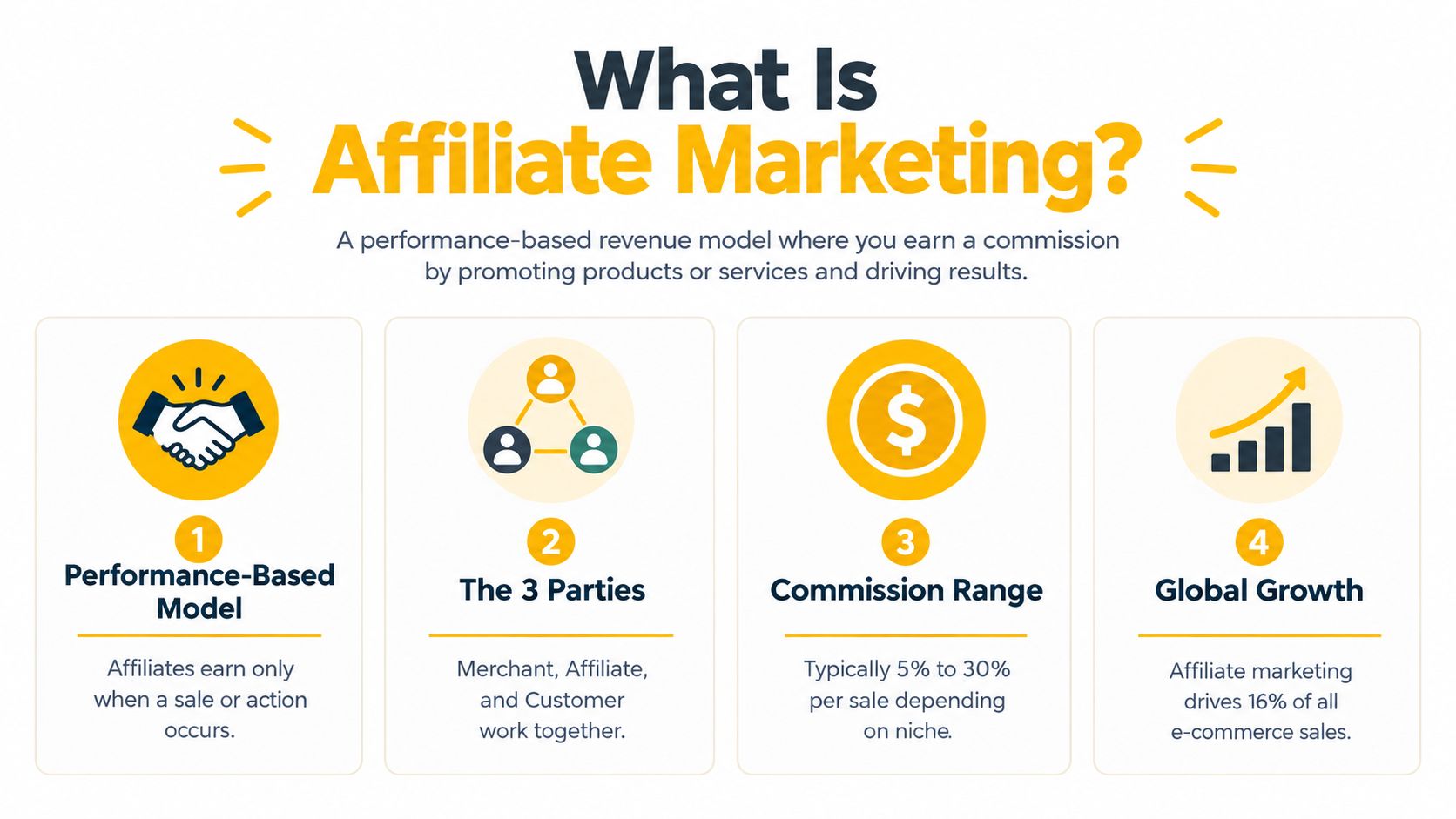
Affiliate marketing is a performance-based revenue model where independent promoters earn commissions by driving traffic or sales through tracked links. The worldwide market was about $18.44 billion in 2025, and one projection puts it at $35.43 billion by 2033.
You may already be managing several social accounts, testing paid campaigns, or monitoring product demand, yet still face the same bottleneck: distribution. You can identify a strong offer, but reaching the right audience, measuring its response, and paying only for verified outcomes requires a working system.
Affiliate marketing provides that system. Think of it as a distribution layer for media buying and account management, not a passive-income shortcut. A merchant supplies the offer, an affiliate supplies qualified attention, and tracking connects the resulting action to a commission. The operator's job is to control traffic quality, message, attribution, compliance, and economics.
The basics become much easier once you separate those responsibilities. You'll understand who does what, how tracking assigns credit, which channels fit your capabilities, and why reliable reporting matters more than raw click volume.
What Is Affiliate Marketing
A product page can convert well and still hit a ceiling if the brand relies on one audience or one paid channel. Affiliate marketing adds a separate distribution layer. The merchant gives independent publishers a tracked offer, the publisher sends qualified traffic through approved channels, and a commission is paid when a defined action happens.
That makes affiliate marketing a performance model, not a referral hobby. The merchant pays for an outcome, such as a sale or qualified lead, while the affiliate handles part of the distribution work. An affiliate might publish a comparison article, create social content, send an email, or run approved paid traffic. The merchant still owns the product, fulfillment, customer service, and the partnership terms.
The operating logic is close to media buying and account management. A serious program defines allowed traffic sources, commission rules, attribution conditions, validation steps, and payout timing. The tracking link is more than a clickable URL. It carries an identifier that ties a result back to the partner who drove it.
Practical rule: Treat every affiliate offer as a campaign with a source, audience, landing experience, conversion event, and quality-control process.
The model grew from early referral programs into a major performance channel. Industry estimates place the market at about $18.44 billion in 2025, which shows why standardized tracking and clear terms matter once many partners are involved. A independent 2026 industry summary reports that the market is spread across regions, with Asia Pacific at 34.44%, Europe at 24.92%, and North America at 19.96% of the total. It projects growth to $35.43 billion by 2033.
A historical milestone was the launch of early retail affiliate programs in 1996, which helped formalize modern affiliate partnerships by showing how publishers could earn commissions from referred sales, as described in this affiliate marketing history timeline. The useful lesson is operational, not nostalgic. Affiliate marketing works because referral activity can be identified, measured, reviewed, and compensated.
The Core Actors in Affiliate Ecosystems
Every affiliate transaction involves three primary actors. Confusing their responsibilities creates poor campaigns and weak partner relationships.
The merchant
The merchant, also called the advertiser or product owner, supplies the product or service. This business sets the commission terms, approves promotional methods, provides product information, processes the transaction, and handles customer support.
A merchant must define what counts as a valid conversion. For example, a completed purchase may qualify only after the return period has passed. A lead program may require a complete form and a reachable prospect rather than an unverified submission.
The affiliate
The affiliate, or publisher, creates or buys attention. That could mean publishing educational content, managing social accounts, sending email, producing video, or using approved advertising placements. The affiliate chooses the audience and presentation, but must follow the merchant's rules.
A social seller might demonstrate a product in short-form content. A search-focused publisher might create a comparison page. A media buyer might test several compliant audience segments and send each through a distinct tracking path.
The consumer
The consumer sees the content or advertisement, clicks the tracked link, and completes the required action on the merchant's property. The consumer needs a clear explanation of the offer, an honest presentation of its benefits and limits, and transparent disclosure that the promoter may earn a commission.
The relationship works when each party has a clear exchange:
- The merchant provides value: A product, service, checkout process, and defined terms.
- The affiliate provides distribution: Reach, context, creative work, or qualified traffic.
- The consumer provides the action: A purchase, lead, registration, or another approved event.
The affiliate doesn't own the customer experience after the click, and the merchant shouldn't assume that every visitor has equal value. Clear communication between both parties protects budget, reputation, and reporting quality.
Tracking, Attribution, and Commission Models
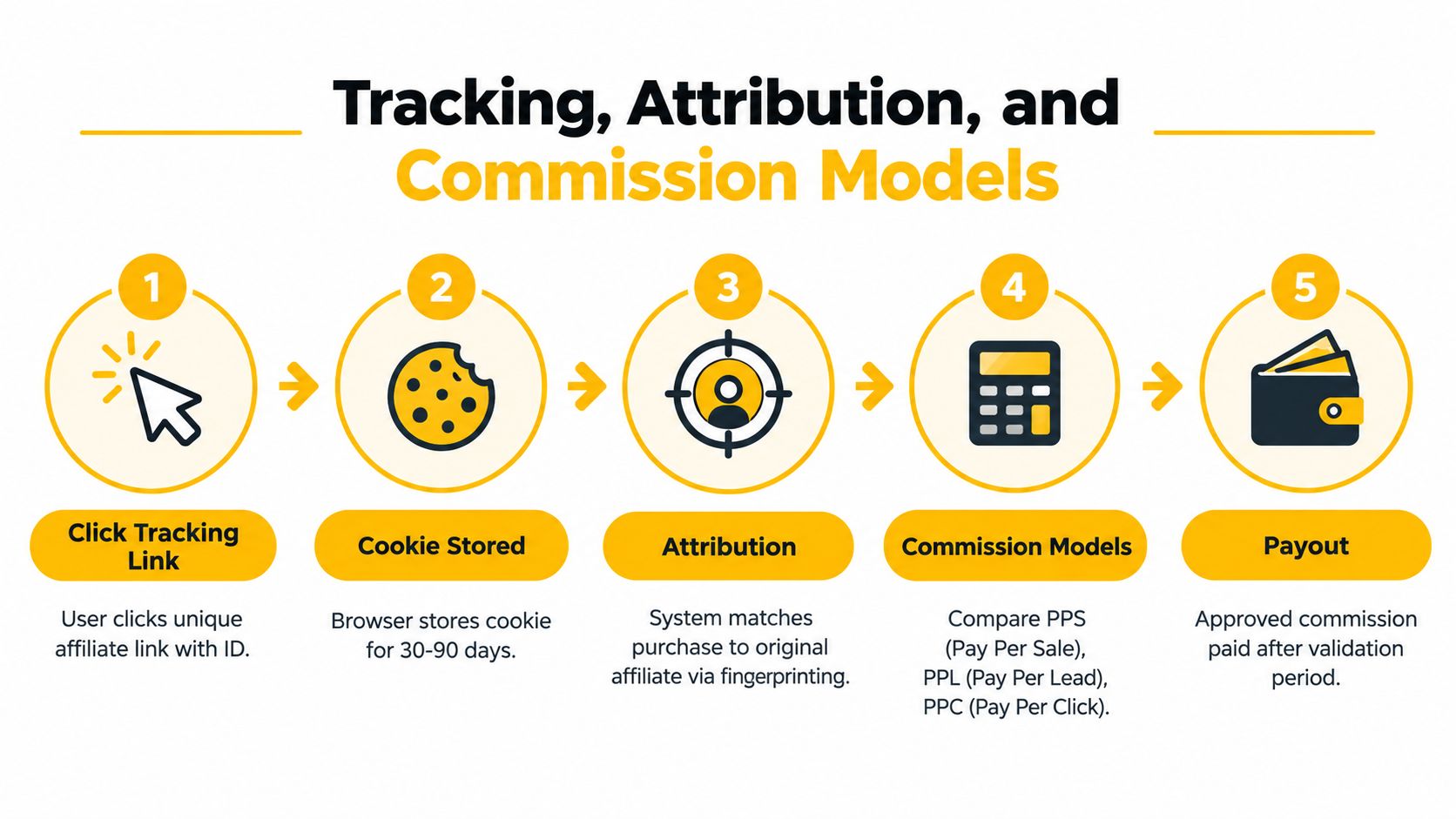
A visitor clicks an affiliate link, the program records that source, and the system keeps a trail long enough to decide whether a later conversion should be credited. In practice, this works like media buying with accounting attached. The link is the media ID, the cookie or browser signal is the short-term identifier, and the attribution rule is the ledger rule that decides who gets paid.
That sounds tidy. Real traffic is messy. People switch devices, clear browser data, use privacy controls, or come back through another channel. Before scaling spend, media buyers should ask how the program handles cross-device behavior, repeat visits, refunds, duplicate claims, and competing affiliates, because those rules change whether reported conversions become payable revenue.
The main payment structures
Pay per sale, or PPS, pays after a completed purchase. The commission can be a percentage of the order or a fixed amount. This model ties affiliate revenue to merchant revenue, but approved earnings can still change after cancellations, refunds, or fraud review.
Pay per lead, or PPL, pays when a visitor completes a defined lead action. A submitted application, qualified inquiry, or verified registration might count. The merchant has to define what makes a lead valid, because a large submission count means little if the sales team rejects most of it.
Pay per click, or PPC, pays for visits rather than completed outcomes. It can fit campaigns built for awareness or traffic, but it puts more pressure on click quality and fraud controls. A program that pays for clicks needs clear rules for repeated clicks, automated traffic, and invalid sources.
Attribution is a business rule
An attribution window is the period during which a program can credit a conversion to a previous interaction. A shopper might click a product comparison, leave, receive an email, and return later through a direct visit. Whether the affiliate gets credit depends on the program's rules and on whether another channel has priority.
Ask these questions before launching:
- What is the conversion event? Define the exact action that creates commission eligibility.
- Which channel receives credit? Check last-click rules and any multi-touch logic.
- What invalidates a conversion? Review refund, duplicate, incentivized, and automated-traffic policies.
- When is commission approved? Separate reported revenue from payable revenue.
- How is data reconciled? Compare affiliate reporting with analytics, order records, and ad-platform data.
Recent industry trend coverage points to more use of human-supervised AI, first-party data, and multi-touch attribution, along with coordinated blog, email, social, and video distribution. For a small operator, the practical response is simple: use clear campaign identifiers, document traffic sources, and do not treat one dashboard as the full record.
Common Channels and Strategies
Channel selection should follow your existing capabilities, not a generic checklist. A publisher with strong search skills can build durable comparison content, while a social media manager may produce faster feedback through short-form demonstrations. A paid operator can test messaging quickly, but must account for media cost, approval rules, and the risk of buying traffic that doesn't convert.
Organic content
Blogging and SEO work well when buyers actively research before purchasing. A useful page answers a specific question, compares relevant options, explains tradeoffs, and places affiliate links where they help the reader make a decision. The drawback is delayed feedback. Search visibility can take time, and rankings can change.
Social distribution
Social content offers rapid creative testing and direct audience interaction. A manager can test several hooks, formats, and calls to action, then move the strongest message into a broader campaign. The risk is dependence on platform policies and audience access, so maintain records of creative, links, disclosures, and approved account activity.
For agency workflows, use a documented operating process alongside the social media management tools for agencies. The tools matter less than consistent permissions, naming conventions, review steps, and reporting.
Email and video
Email gives you a direct relationship with subscribers, while video can demonstrate a product in a way static copy cannot. Both channels reward trust and relevance. A segmented email about a specific problem is more useful than a general list-wide promotion, and a product demonstration should show limitations as well as benefits.

The strongest approach is usually omnichannel but not scattered. Use one core offer, adapt the message to each channel, and keep the tracking structure consistent. A small operator might begin with one social format and one email or content asset, then expand after seeing qualified conversions. Recent trend reporting also points to privacy-driven tracking changes and social commerce shaping the channel mix, so build first-party audience relationships instead of relying entirely on browser signals.
Essential Metrics for Performance Analysis
Raw clicks are a starting signal, not a business result. A campaign can generate attention while losing money through weak conversion quality, low order value, refunds, or expensive distribution.
Track the journey from impression or reach through approved revenue. The core metrics answer different questions:
- Click-through rate: Do the creative and placement generate action?
- Conversion rate: Do referred visitors complete the desired event?
- Average order value: How much revenue does each completed order produce?
- Churn rate: For recurring services, how quickly do acquired customers cancel?
- Customer lifetime value: What value does the customer generate over the relationship?
- Earnings per visitor: Does the traffic produce enough commission to justify acquisition cost?
Conversion rate needs context. A high rate from a tiny, narrow audience may produce less value than a lower rate from a scalable, qualified audience. Likewise, a large number of clicks can conceal poor intent or invalid traffic.
Return on ad spend
For a paid affiliate campaign, calculate ROAS as:
Attributed revenue ÷ advertising spend
If the program pays commissions rather than sharing gross sales, use the value that belongs to the operator:
Approved affiliate commission ÷ advertising spend
Keep these calculations separate. A merchant may care about revenue and margin, while an affiliate buying traffic cares about approved commission after reversals. Add creative costs, landing-page costs, agency labor, and infrastructure when evaluating the full contribution margin.
The campaign performance tracking guide can support a consistent measurement process, but no dashboard fixes ambiguous definitions. Establish one source of truth for clicks, conversions, approved commissions, refunds, and spend. Review performance by channel, creative, audience, landing page, and partner rather than judging the entire program from an aggregate total.
A useful decision is not “Which campaign got the most clicks?” It's “Which traffic path produced verified value at an acceptable cost, and can we repeat it without reducing quality?”
Common Pitfalls and Misconceptions
A common mistake is treating affiliate marketing like passive income. Links can keep sending visits after publication, but the work does not stop there. Someone still has to research offers, write useful content, maintain disclosures, monitor tracking, answer audience questions, review reversals, and adjust to policy changes.
Fraud is a day-to-day operational risk. It can show up as fake clicks, forced attribution, duplicate leads, misleading promotion, or traffic that breaks program terms. Industry estimates suggest affiliate fraud can take a large share of spend, and that revenue often concentrates among a small group of partners. Beginners should read those patterns as a warning, not as a promise of easy earnings.
Risk areas to control
Attribution disputes happen when multiple partners influence the same buyer. Define credit rules before launch, then keep click, source, and conversion records so you can resolve conflicts later.
Saturated niches make generic content easy to ignore. Narrow the audience, add firsthand evaluation where possible, and answer the questions that product pages leave open.
Commission changes can change the economics of a campaign overnight. Keep a margin buffer and avoid building the whole business around one merchant.
Short attribution windows can miss conversions that happen after the first click. Read the terms carefully and model the effect qualitatively if the program does not provide reliable journey data.
Policy violations can lead to rejected commissions, account restrictions, or lost distribution. Do not use misleading claims, prohibited bidding, undisclosed endorsements, or automation that breaks platform rules.
Disclosure is a compliance requirement and a trust practice. Tell readers that a link may generate a commission, place the disclosure where people can see it, and make sure the content still helps them even if they never click.
Trust is an operating asset. One commission is not worth damaging the audience relationship that supports future campaigns.
How to Start Your First Affiliate Program
Start with the merchant side of the system. If you're launching a program for your own product, define the offer, customer, eligible conversion, commission, validation period, prohibited traffic, and payout process before recruiting partners.
A practical launch sequence
- Choose the tracking method. Use an affiliate network or a direct platform that can issue unique links, record conversions, flag duplicates, and export transaction data.
- Write plain-language terms. State allowed channels, disclosure requirements, brand-bidding rules, coupon policies, attribution logic, refund handling, and payment conditions.
- Prepare partner assets. Provide approved product descriptions, images, landing pages, creative guidance, tracking conventions, and examples of compliant claims.
- Recruit relevant partners. Start with publishers whose audience matches the product. Review their content quality, traffic sources, disclosure habits, and engagement patterns.
- Test before scaling. Run a controlled conversion from click to reporting to approval. Reconcile the affiliate record with the order record.
- Review weekly. Look for unusual click patterns, sudden conversion changes, invalid leads, refund clusters, and partners using unapproved creative.
If your team manages several branded accounts, document access, approvals, content calendars, and escalation paths in a multiple social media account management workflow. Infrastructure should support compliant operations, not conceal them.
A launch checklist is short: tracking tested, terms published, disclosures ready, creative approved, partner vetting complete, payout rules documented, and reporting reconciled. Don't recruit broadly until those controls work.
Conclusion and Next Steps
The basics of affiliate marketing are straightforward, but the operating model is not passive. Merchants define the offer, affiliates manage distribution, tracking assigns credit, and metrics determine whether the economics work. Start with one audience, one offer, one compliant channel, and a measurement process that distinguishes clicks from approved value.
For teams managing multiple accounts or geo-dependent campaigns, reliable infrastructure also matters. Use access and automation responsibly, document activity, and make decisions from verified data rather than optimistic attribution.
Evoproxy provides mobile 4G/LTE/3G connectivity with personal and shared ports, rotation controls, and French mobile IP access for compliant social media management, campaign validation, market research, and QA workflows. If those needs match your affiliate operation, visit Evoproxy to review the available setup.


